


Shopping Cart
Remove All Your shopping cart is currently empty

Synonyms: TMEM173, sting, Stimulator of interferon genes protein, Mediator of IRF3 activation
Anti-Sting Polyclonal Antibody
| Pack Size | Price | USA Stock | Global Stock | Quantity |
|---|---|---|---|---|
| 50 µL | $221 | 7-10 days | 7-10 days | |
| 100 µL | $372 | 7-10 days | 7-10 days | |
| 200 µL | $529 | 7-10 days | 7-10 days |
| Description | Anti-Sting Polyclonal Antibody is a Rabbit antibody targeting Sting. Anti-Sting Polyclonal Antibody can be used in WB. |
| Synonyms | TMEM173, sting, Stimulator of interferon genes protein, Mediator of IRF3 activation |
| Ig Type | IgG |
| Reactivity | Mouse,Rat (predicted:Human) |
| Verified Activity | Sample: Lane 1: Mouse Lung tissue lysates Lane 2: Mouse Uterus tissue lysates Lane 3: Mouse Thymus tissue lysates Lane 4: Mouse Large intestine tissue lysates Lane 5: Rat Lung tissue lysates Lane 6: Rat Uterus tissue lysates Lane 7: Rat Thymus tissue lysates Lane 8: Rat Large intestine tissue lysates Primary: Anti-STING1 (TMAB-01790) at 1/1000 dilution Secondary: IRDye800CW Goat Anti-Rabbit IgG at 1/20000 dilution Predicted band size: 42 kDa Observed band size: 38 kDa 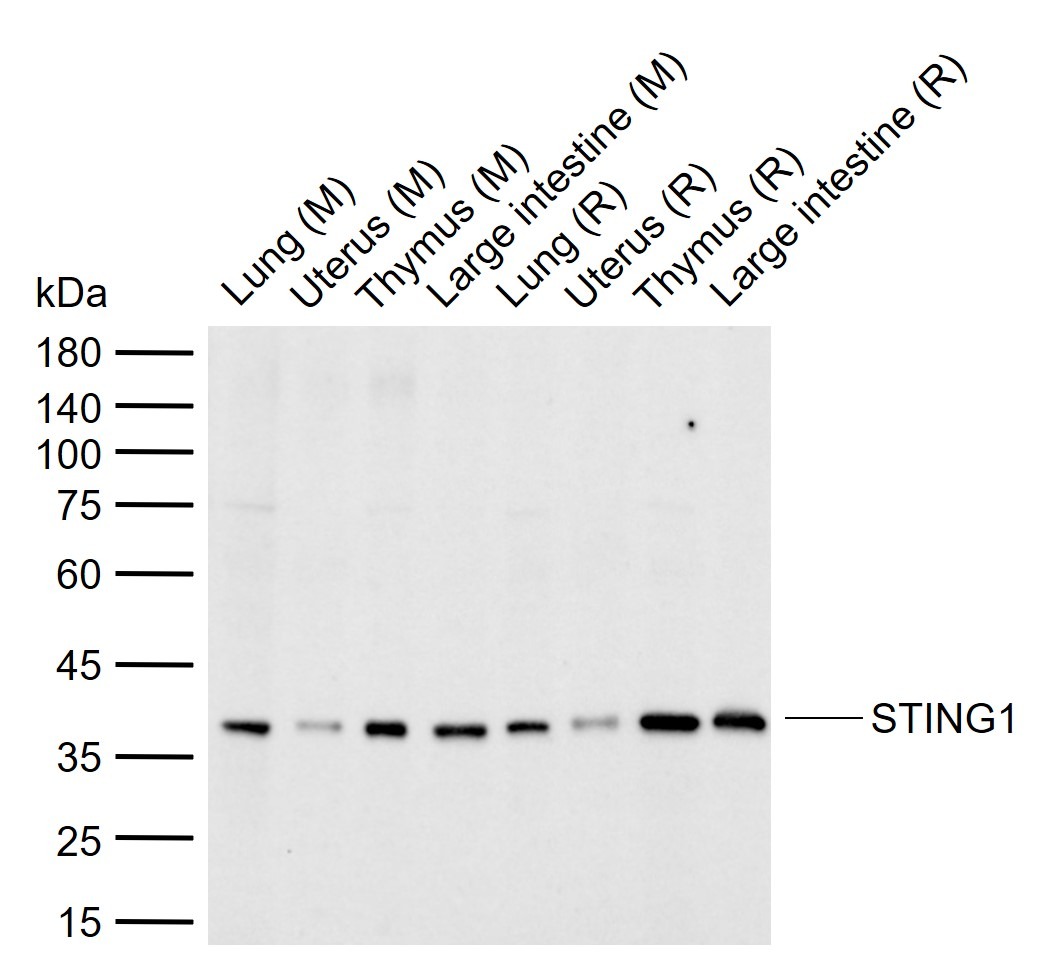 |
| Application | |
| Recommended Dose | WB: 1:500-2000 |
| Antibody Type | Polyclonal |
| Host Species | Rabbit |
| Subcellular Localization | Endoplasmic reticulum membrane. Mitochondrion outer membrane. Cell membrane. Cytoplasm > perinuclear region. In response to double-stranded DNA stimulation, relocalizes to perinuclear region, where the kinase TBK1 is recruited. |
| Tissue Specificity | Ubiquitously expressed. |
| Construction | Polyclonal Antibody |
| Purification | Protein A purified |
| Appearance | Liquid |
| Formulation | 0.01M TBS (pH7.4) with 1% BSA, 0.02% Proclin300 and 50% Glycerol. |
| Concentration | 1 mg/mL |
| Research Background | This gene encodes a five transmembrane protein that functions as a major regulator of the innate immune response to viral and bacterial infections. The encoded protein is a pattern recognition receptor that detects cytosolic nucleic acids and transmits signals that activate type I interferon responses. The encoded protein has also been shown to play a role in apoptotic signaling by associating with type II major histocompatibility complex. Mutations in this gene are the cause of infantile-onset STING-associated vasculopathy. Alternate splicing results in multiple transcript variants. [provided by RefSeq, Sep 2014] |
| Immunogen | KLH conjugated synthetic peptide: human STING1 |
| Antigen Species | Human |
| Gene Name | STING1 |
| Gene ID | |
| Protein Name | Stimulator of interferon genes protein |
| Uniprot ID | |
| Biology Area | NFkB pathway,NFkB pathway,Antiviral Signaling,Interferons,Transmembrane |
| Function | Facilitator of innate immune signaling that promotes the production of type I interferon (IFN-alpha and IFN-beta). Innate immune response is triggered in response to non-CpG double-stranded DNA from viruses and bacteria delivered to the cytoplasm. Able to activate both NF-kappa-B and IRF3 transcription pathways to induce expression of type I interferon and exert a potent anti-viral state following expression. May be involved in translocon function, the translocon possibly being able to influence the induction of type I interferons. May be involved in transduction of apoptotic signals via its association with the major histocompatibility complex class II (MHC-II). Mediates death signaling via activation of the extracellular signal-regulated kinase (ERK) pathway. |
| Molecular Weight | Theoretical: 42 kDa. Actual: 38 kDa. |
| Stability & Storage | Store at -20°C or -80°C for 12 months. Avoid repeated freeze-thaw cycles. |
| Transport | Shipping with blue ice. |
| Size | Quantity | Unit Price | Amount | Operation |
|---|
 Feedback
 Hello! How can I help you today?
Copyright © 2015-2026 TargetMol Chemicals Inc. All Rights Reserved.
