


Shopping Cart
Remove All Your shopping cart is currently empty


Synonyms: β-Nicotinamide Adenine Dinucleotide, β-NAD, β-DPN, DPN, Cozymase
| Pack Size | Price | USA Stock | Global Stock | Quantity |
|---|---|---|---|---|
| 500 mg | $41 | In Stock | In Stock | |
| 1 g | $48 | In Stock | In Stock |

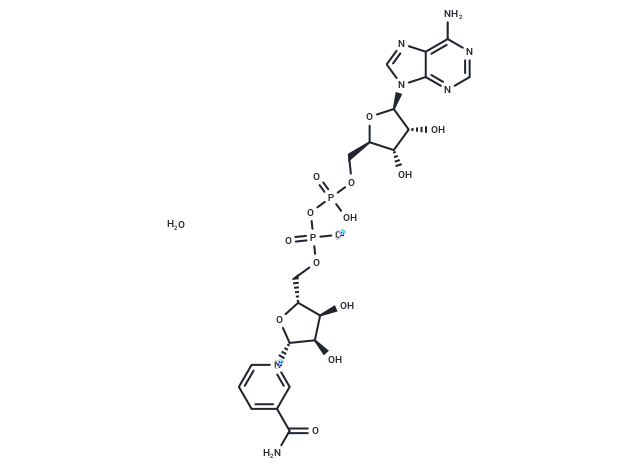
| Description | NAD+ (β-Nicotinamide Adenine Dinucleotide) is a coenzyme composed of ribosylnicotinamide 5'-diphosphate coupled to adenosine 5'-phosphate by pyrophosphate linkage. It is found widely in nature and is involved in numerous enzymatic reactions in which it serves as an electron carrier by being alternately oxidized (NAD+) and reduced (NADH). |
| In vitro | METHODS: HEK293 cells were treated with FK866 (2 µM) and NAD+ (100 µM) for 48 h. Metabolic activity was determined by MTT Assay. RESULTS: Addition of FK866 to the culture medium resulted in rapid depletion of intracellular NAD stores and inhibition of the metabolic activity of NADPH-dependent dehydrogenase. When supplemented with additional NAD+, the metabolic activity of the cells returned to control levels. [1] METHODS: Isolated microvessels from rat retina were treated with NAD+ (0-1000 nM) for 0-24 h. Cell death was detected using trypan blue dye. RESULTS: Exposure to NAD+ increased microvascular cell death in a dose-dependent manner, with the half-maximum effective concentration of NAD+ being approximately 2 nM. assessment of the time course of NAD+-induced vascular toxicity showed that cell death was detected after 16 h of NAD+ exposure. [2] |
| In vivo | METHODS: To study the effects on ischemia/reperfusion (I/R) injury, NAD+ (5-20 mg/kg) was injected intravenously into Wistar rats with myocardial ischemia/reperfusion. RESULTS: Injections of 10-20 mg/kg NAD+ dose-dependently reduced I/R-induced myocardial infarction, with a dose of 20 mg/kg NAD+ reducing infarction by approximately 85%. Injection of NAD+ significantly reduced I/R-induced apoptotic cardiac injury. [3] |
| Synonyms | β-Nicotinamide Adenine Dinucleotide, β-NAD, β-DPN, DPN, Cozymase |
| Molecular Weight | 663.43 |
| Formula | C21H27N7O14P2 |
| Cas No. | 53-84-9 |
| Smiles | O.NC(=O)c1ccc[n+](c1)[C@@H]1O[C@H](COP([O-])(=O)OP(O)(=O)OC[C@H]2O[C@H]([C@H](O)[C@@H]2O)n2cnc3c(N)ncnc23)[C@@H](O)[C@H]1O |
| Relative Density. | Ca. 1.6 g/cm3. Temperature:20 °C. |
| Storage | Store at low temperature,Keep away from direct sunlight,Store under nitrogen Powder: -20°C for 3 years | In solvent: -80°C for 1 year Shipping with blue ice/Shipping at ambient temperature. | |||||||||||||||||||||||||||||||||||
| Solubility Information | DMSO: 6.7 mg/mL (10.1 mM), Sonication is recommended.  H2O: 53.3 mg/mL (80.34 mM), Sonication and heating are recommended. | |||||||||||||||||||||||||||||||||||
| In Vivo Formulation | 5% DMSO+95% Saline: 0.33 mg/mL (0.5 mM), Solution. PBS: 100 mg/mL (150.73 mM), Sonication is recommended. Please add the solvents sequentially, clarifying the solution as much as possible before adding the next one. Dissolve by heating and/or sonication if necessary. Working solution is recommended to be prepared and used immediately. The formulation provided above is for reference purposes only. In vivo formulations may vary and should be modified based on specific experimental conditions. | |||||||||||||||||||||||||||||||||||
Solution Preparation Table | ||||||||||||||||||||||||||||||||||||
DMSO/H2O
H2O
Note : The dilution table applies only to solid products. For liquid products, please calculate the stock solution based on the stated concentration and/or density. | ||||||||||||||||||||||||||||||||||||
 For example, if the intended dosage is 10 mg/kg for animals weighing 20 g , with a dosing volume of 100 μL per animal, and a total of 10 animals are to be administered, using a formulation of
  10% DMSO+ 40% PEG300+ 5% Tween 80+ 45% Saline/PBS/ddH2O , the resulting working solution concentration would be 2 mg/mL.
Dissolve 2 mg of the compound in 100 μL DMSO to obtain a stock solution at a concentration of 20 mg/mL . If the required concentration exceeds the compound's known solubility, please contact us for technical support before proceeding.
1) Add 100 μL of the DMSO stock solution to 400 µL PEG300 and mix thoroughly until the solution becomes clear.
2) Add 50 µL Tween 80 and mix well until fully clarified.
3) Add 450 µL Saline,PBS or ddH2O and mix thoroughly until a homogeneous solution is obtained.
| Size | Quantity | Unit Price | Amount | Operation |
|---|
 Feedback
 Hello! How can I help you today?
Copyright © 2015-2026 TargetMol Chemicals Inc. All Rights Reserved.
