


Shopping Cart
Remove All Your shopping cart is currently empty


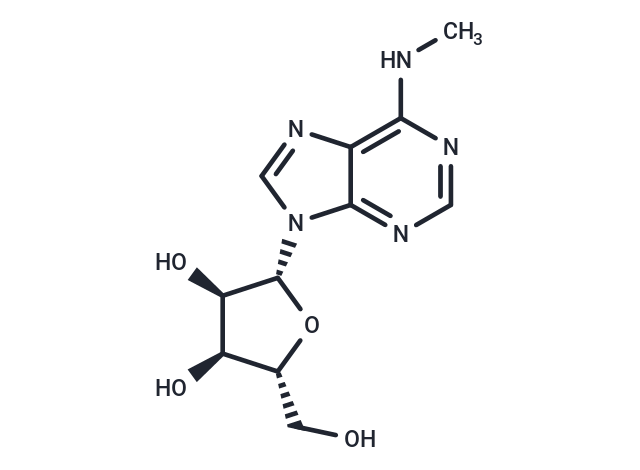
Synonyms: NSC-29409, N-Methyladenosine, m6A, 6-Methyladenosine

| Pack Size | Price | USA Stock | Global Stock | Quantity |
|---|---|---|---|---|
| 50 mg | $41 | In Stock | In Stock | |
| 100 mg | $66 | In Stock | In Stock | |
| 200 mg | $96 | In Stock | In Stock | |
| 500 mg | $161 | In Stock | In Stock | |
| 1 mL x 10 mM (in DMSO) | $30 | In Stock | In Stock |
| Description | N6-Methyladenosine is a methylated adenine residue, glycoside is an endogenous uridine product of transfer RNA degradation. It is the most prevalent internal modification of messenger RNA present in all higher eukaryotes and can modify viral RNA with antiviral activity. |
| In vitro | N6-Methyladenosine is an abundant modification in mRNA and is found within some viruses, and most eukaryotes including mammals, insects, plants and yeast. It is also found in tRNA, rRNA, and small nuclear RNA(snRNA) as well as several long non-coding RNA, such as Xist. [1] [2] [3] N6-Methyladenosine is an endogenous urinary nucleoside product of the degradation of transfer ribonucleic acid (tRNA). [4] N6-Methyladenosine is a widespread RNA modification in many tissues with high levels in the brain. N6-Methyladenosine is enriched near stop codons and within 3'UTRs in both mouse and human mRNAs. [5] The recent discovery that FTO, an obesity risk gene, encodes an m6A demethylase implicates m6A as an important regulator of physiological processes. [6] |
| In vivo | LD50: Mice >1 g/kg (i.g.). [7] |
| Synonyms | NSC-29409, N-Methyladenosine, m6A, 6-Methyladenosine |
| Kinase Assay | NOD1 Dose Response assay: Day 1 Procedure 1) Harvest HEK-293-T NFKB-Luc at 100% confluency at 100% confluency. 2) Add NOD assay media with Multidrop. 3) Spin down plates at 1000 rpm for 1 min in centrifuge. 4) Serial compound dilutions. 5) Add gamma-tri-DAP to cell suspension at 0.75 ug/mL. 6) Seed 13000 cells/well in 4 uL/well to full plate HEK-293-T NFKB-Luc to TC-treated plate. 7) Spin down plates 500 RPM for 5 min on centrifuge. 8) Lid Plates. Sandwich 4 plates between 2 lidded 384 plates filled with Water. 9) Wrap plates securely in single layer of Plastic Wrap. 10) Incubate overnight (14 hours) in 37 ℃ and 5% CO2 incubator. Day 2 Procedure 1) Add 3 ul/well of SteadyGlo solution with Multidrop. 2) Shake plates on a plate shaker for 20 min. 3) Spin plates 1000 RPM for 1 min using centrifuge. 4) Read luminescence.IC50 values are calculated using GraphPad Prism 5.0.The average Z' for the screen is 0.6, the signal to background is 11.1, signal to noise is 78.6 and signal to window is 6.0. |
| Molecular Weight | 281.27 |
| Formula | C11H15N5O4 |
| Cas No. | 1867-73-8 |
| Smiles | O[C@H]1[C@H](N2C=3C(N=C2)=C(NC)N=CN3)O[C@H](CO)[C@H]1O |
| Relative Density. | 1.85g/cm3 |
| Storage | Keep away from direct sunlight,Keep away from moisture Powder: -20°C for 3 years | In solvent: -80°C for 1 year Shipping with blue ice/Shipping at ambient temperature. | |||||||||||||||||||||||||||||||||||||||||||||
| Solubility Information | Ethanol: 2 mg/mL (7.11 mM), Sonication is recommended. DMSO: 126 mg/mL (447.97 mM), Sonication is recommended.  H2O: 14 mg/mL (49.77 mM), Sonication is recommended. | |||||||||||||||||||||||||||||||||||||||||||||
| In Vivo Formulation | 10% DMSO+40% PEG300+5% Tween 80+45% Saline: 4 mg/mL (14.22 mM), Sonication is recommended. Please add the solvents sequentially, clarifying the solution as much as possible before adding the next one. Dissolve by heating and/or sonication if necessary. Working solution is recommended to be prepared and used immediately. The formulation provided above is for reference purposes only. In vivo formulations may vary and should be modified based on specific experimental conditions. | |||||||||||||||||||||||||||||||||||||||||||||
Solution Preparation Table | ||||||||||||||||||||||||||||||||||||||||||||||
Ethanol/H2O/DMSO
H2O/DMSO
DMSO
Note : The dilution table applies only to solid products. For liquid products, please calculate the stock solution based on the stated concentration and/or density. | ||||||||||||||||||||||||||||||||||||||||||||||
 For example, if the intended dosage is 10 mg/kg for animals weighing 20 g , with a dosing volume of 100 μL per animal, and a total of 10 animals are to be administered, using a formulation of
  10% DMSO+ 40% PEG300+ 5% Tween 80+ 45% Saline/PBS/ddH2O , the resulting working solution concentration would be 2 mg/mL.
Dissolve 2 mg of the compound in 100 μL DMSO to obtain a stock solution at a concentration of 20 mg/mL . If the required concentration exceeds the compound's known solubility, please contact us for technical support before proceeding.
1) Add 100 μL of the DMSO stock solution to 400 µL PEG300 and mix thoroughly until the solution becomes clear.
2) Add 50 µL Tween 80 and mix well until fully clarified.
3) Add 450 µL Saline,PBS or ddH2O and mix thoroughly until a homogeneous solution is obtained.
| Size | Quantity | Unit Price | Amount | Operation |
|---|
 Feedback
 Hello! How can I help you today?
Copyright © 2015-2026 TargetMol Chemicals Inc. All Rights Reserved.
