


Shopping Cart
Remove All Your shopping cart is currently empty


Synonyms: NSC 79037, CCNU
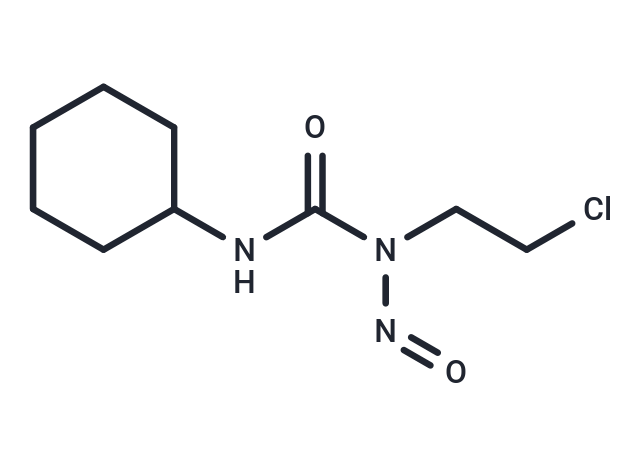
| Pack Size | Price | USA Stock | Global Stock | Quantity |
|---|---|---|---|---|
| 100 mg | $50 | In Stock | In Stock | |
| 200 mg | $85 | In Stock | In Stock | |
| 1 mL x 10 mM (in DMSO) | $50 | In Stock | In Stock |
| Description | Lomustine (NSC-79037) is an alkylating agent of value against both hematologic malignancies and solid tumors. |
| In vitro | Lomustine inhibits the growth of ZR-75-1 and U373 with IC50 of 12 μM and 15 μM, respectively. Lomustine reduces the level of expression of the DNA repair protein O6-alkylguanine-DNA alkyltransferase. [1] Lomustine (420 μM) triggers apoptosis through the mitochondrial pathway via decrease in the level of the anti-apoptosis proteins Bcl-2 and Bcl-xl, respectively, in both medulloblastoma and normal human epithelial and fibroblast cells. Lomustine induces cell cycle delay in G2/M phase in medulloblastoma cells and up-regulates p21 protein level in a p53-independent manner in HFSN1 cells. [2] |
| In vivo | Lomustine can cause delayed, cumulative dose-related, chronic hepatotoxicity that is irreversible and can be fatal. [4] Lomustine could result in infrequent severe hematological toxicity in cats with spontaneously arising tumors, and the incidence of either grade III or IV neutropenia and thrombocytopenia is 4.1% and 1.0%, respectively. Lomustine trends toward a greater likelihood for progressive neutropenia and statistically significant higher response rates in cats with spontaneously arising tumors. [5] |
| Synonyms | NSC 79037, CCNU |
| Cell Research | Cell lines are routinely grown as monolayers in DMEM supplemented with 10% foetal calf serum, 25 mm HEPES, glutamine and penicillin/streptomycin. Cytotoxicity studies are carried out in HEPES-free medium in a 5% CO2 atmosphere. 750-1000 cells/well are plated in 96 well plates and after overnight incubation are treated for 2 hours with or without 33 μM BG. Temozolomide or CCNU is then added for 1 hour in the same medium, the final DMSO concentration not exceeding 1%. The cells are grown for a further 7 days in fresh medium and assayed for protein content by the NCI sulphorhodamine assay; growth studies show that cells are in log phase growth during the assay period. For the repeat temozolomide dosing schedule cells are given consecutive 24 hours treatments, with fresh medium each day. Assays are carried out at least in duplicate.(Only for Reference) |
| Molecular Weight | 233.7 |
| Formula | C9H16ClN3O2 |
| Cas No. | 13010-47-4 |
| Smiles | N(C(N(CCCl)N=O)=O)C1CCCCC1 |
| Relative Density. | 1.35 g/cm3 |
| Storage | Powder: -20°C for 3 years | In solvent: -80°C for 1 year Shipping with blue ice/Shipping at ambient temperature. | |||||||||||||||||||||||||||||||||||
| Solubility Information | H2O: < 1 mg/mL (insoluble or slightly soluble) Ethanol: < 1 mg/mL (insoluble or slightly soluble) DMSO: 250 mg/mL (1069.75 mM), Sonication is recommended.  | |||||||||||||||||||||||||||||||||||
| In Vivo Formulation | 10% DMSO+40% PEG300+5% Tween 80+45% Saline: 10 mg/mL (42.79 mM), Solution. 10% DMSO+90% Saline: < 10 mg/mL (42.79 mM), Lower concentrations may be soluble, but exact solubility limit is unknown. Please add the solvents sequentially, clarifying the solution as much as possible before adding the next one. Dissolve by heating and/or sonication if necessary. Working solution is recommended to be prepared and used immediately. The formulation provided above is for reference purposes only. In vivo formulations may vary and should be modified based on specific experimental conditions. | |||||||||||||||||||||||||||||||||||
Solution Preparation Table | ||||||||||||||||||||||||||||||||||||
DMSO
Note : The dilution table applies only to solid products. For liquid products, please calculate the stock solution based on the stated concentration and/or density. | ||||||||||||||||||||||||||||||||||||
 For example, if the intended dosage is 10 mg/kg for animals weighing 20 g , with a dosing volume of 100 μL per animal, and a total of 10 animals are to be administered, using a formulation of
  10% DMSO+ 40% PEG300+ 5% Tween 80+ 45% Saline/PBS/ddH2O , the resulting working solution concentration would be 2 mg/mL.
Dissolve 2 mg of the compound in 100 μL DMSO to obtain a stock solution at a concentration of 20 mg/mL . If the required concentration exceeds the compound's known solubility, please contact us for technical support before proceeding.
1) Add 100 μL of the DMSO stock solution to 400 µL PEG300 and mix thoroughly until the solution becomes clear.
2) Add 50 µL Tween 80 and mix well until fully clarified.
3) Add 450 µL Saline,PBS or ddH2O and mix thoroughly until a homogeneous solution is obtained.
| Size | Quantity | Unit Price | Amount | Operation |
|---|
 Feedback
 Hello! How can I help you today?
Copyright © 2015-2026 TargetMol Chemicals Inc. All Rights Reserved.
