


Shopping Cart
Remove All Your shopping cart is currently empty


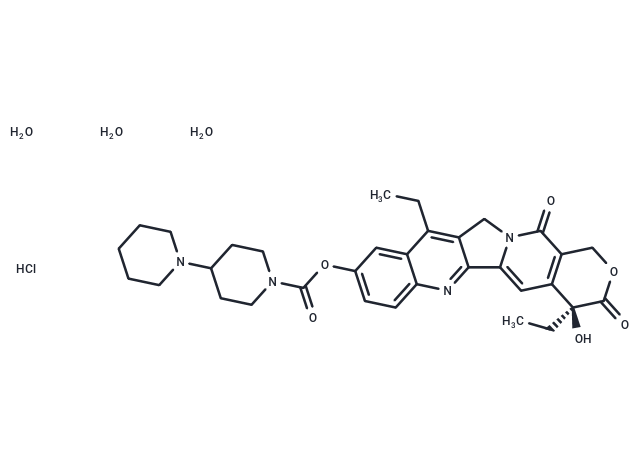
Synonyms: Irinotecan HCl Trihydrate, CPT-11 HCl Trihydrate
| Pack Size | Price | USA Stock | Global Stock | Quantity |
|---|---|---|---|---|
| 25 mg | $36 | In Stock | In Stock | |
| 50 mg | $52 | In Stock | In Stock | |
| 100 mg | $72 | In Stock | In Stock | |
| 200 mg | $96 | In Stock | In Stock | |
| 500 mg | $162 | In Stock | In Stock | |
| 1 mL x 10 mM (in DMSO) | $57 | In Stock | In Stock |
| Description | Irinotecan hydrochloride trihydrate (CPT-11 HCl Trihydrate) keeps DNA from unwinding by inhibiting topoisomerase 1. |
| In vitro | In the liver, stomach, duodenum, and colon, a single dose of Irinotecan significantly increases the covalent binding of topoisomerase I to DNA. Compared to the control group, there is a marked increase in DNA strand breaks within the colonic mucosal cells in the Irinotecan-treated group. In COLO320 xenografts, Irinotecan induces a 92% maximum growth inhibition. |
| In vivo | In LoVo and HT-29 cell lines, Irinotecan induces a similar number of cleavable complexes at IC50 concentrations, with no significant difference observed between the two. The formation of cleavable complexes by SN-38 is concentration-dependent and consistent across both cell lines. Notably, intracellular accumulation of Irinotecan differs significantly, with consistently higher levels in HT-29 cells compared to LoVo cells. Carboxylesterase activation of Irinotecan to SN-38 (primarily in the liver) facilitates interaction with its target, topoisomerase I, in plasma, intestines, and tumor tissues. The hydrolysis of Irinotecan’s lactone E-ring and SN-38 is reversible in aqueous solution, with the interconversion of their carboxylate and lactone forms dependent on temperature and pH. For the same concentration of SN-38 glucuronide and Irinotecan in tumor and normal tissues, the yield of SN-38 via β-glucuronidase mediation exceeds that of SN-38 produced from Irinotecan. In SCLC cell lines, Irinotecan exhibits markedly greater activity than in NSCLC cell lines, while tissue histology does not reveal significant differences in SN-38 efficacy. |
| Synonyms | Irinotecan HCl Trihydrate, CPT-11 HCl Trihydrate |
| Cell Research | Exponentially growing cells (LoVo and HT-29 cells) are seeded in 20 cm2 Petri dishes with an optimal cell number for each cell line (2 × 10⁴ for LoVo cells, 105 for HT-29 cells). They are treated 2 days later with increasing concentrations of Irinotecan or SN-38 for one cell doubling time (24 hours for LoVo cells, 40 hours for HT-29 cells). After washing with 0.15 M NaCl, the cells are further grown for two doubling times in normal medium, detached from the support with trypsin-EDTA and counted in a hemocytometer. The IC50 values are then estimated as the Irinotecan or SN-38 concentrations responsible for 50% growth inhibition as compared with cells incubated without Irinotecan or SN-38. (Only for Reference) |
| Molecular Weight | 677.18 |
| Formula | C33H45ClN4O9 |
| Cas No. | 136572-09-3 |
| Smiles | O.O.O.Cl.CCc1c2Cn3c(cc4c(COC(=O)[C@]4(O)CC)c3=O)-c2nc2ccc(OC(=O)N3CCC(CC3)N3CCCCC3)cc12 |
| Relative Density. | no data available |
| Storage | Powder: -20°C for 3 years | In solvent: -80°C for 1 year Shipping with blue ice/Shipping at ambient temperature. | ||||||||||||||||||||||||||||||||||||||||
| Solubility Information | H2O: 1 mg/mL (1.48 mM), Sonication is recommended. Ethanol: 7 mg/mL (10.34 mM), Sonication is recommended. DMSO: 50 mg/mL (73.84 mM), Sonication is recommended.  | ||||||||||||||||||||||||||||||||||||||||
| In Vivo Formulation | 10% DMSO+40% PEG300+5% Tween 80+45% Saline: 2 mg/mL (2.95 mM), Sonication is recommended. Please add the solvents sequentially, clarifying the solution as much as possible before adding the next one. Dissolve by heating and/or sonication if necessary. Working solution is recommended to be prepared and used immediately. The formulation provided above is for reference purposes only. In vivo formulations may vary and should be modified based on specific experimental conditions. | ||||||||||||||||||||||||||||||||||||||||
Solution Preparation Table | |||||||||||||||||||||||||||||||||||||||||
H2O/Ethanol/DMSO
Ethanol/DMSO
DMSO
Note : The dilution table applies only to solid products. For liquid products, please calculate the stock solution based on the stated concentration and/or density. | |||||||||||||||||||||||||||||||||||||||||
 For example, if the intended dosage is 10 mg/kg for animals weighing 20 g , with a dosing volume of 100 μL per animal, and a total of 10 animals are to be administered, using a formulation of
  10% DMSO+ 40% PEG300+ 5% Tween 80+ 45% Saline/PBS/ddH2O , the resulting working solution concentration would be 2 mg/mL.
Dissolve 2 mg of the compound in 100 μL DMSO to obtain a stock solution at a concentration of 20 mg/mL . If the required concentration exceeds the compound's known solubility, please contact us for technical support before proceeding.
1) Add 100 μL of the DMSO stock solution to 400 µL PEG300 and mix thoroughly until the solution becomes clear.
2) Add 50 µL Tween 80 and mix well until fully clarified.
3) Add 450 µL Saline,PBS or ddH2O and mix thoroughly until a homogeneous solution is obtained.
| Size | Quantity | Unit Price | Amount | Operation |
|---|
 Feedback
 Hello! How can I help you today?
Copyright © 2015-2026 TargetMol Chemicals Inc. All Rights Reserved.
