


Shopping Cart
Remove All Your shopping cart is currently empty

Synonyms: G749, Denfivontinib
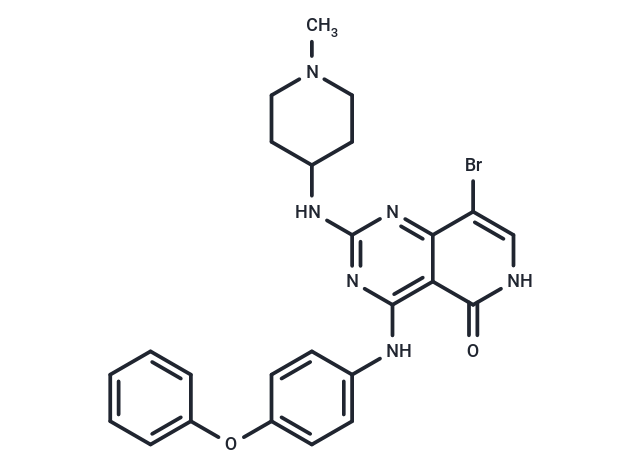
| Pack Size | Price | USA Stock | Global Stock | Quantity |
|---|---|---|---|---|
| 2 mg | $35 | In Stock | In Stock | |
| 5 mg | $51 | In Stock | In Stock | |
| 10 mg | $85 | In Stock | In Stock | |
| 25 mg | $189 | In Stock | In Stock | |
| 50 mg | $322 | - | In Stock | |
| 100 mg | $538 | - | In Stock | |
| 200 mg | $766 | - | In Stock |
| Description | G-749, a new-type FLT3 inhibitor, exhibits effective and sustained inhibition of the FLT3 wild type and mutants. |
| Targets & IC50 | FLT3 (D835Y):0.6 nM, Mer:1 nM, RET:9 nM, FLT3:0.4 nM, Aurora B:6 nM |
| In vitro | In primary cells from AML patients, G-749 was able to inhibit cell proliferation by inducing apoptosis. In BaF3 cell lines stably expressing FLT3-ITD/N676D, FLT3-ITD/F691L, FLT3-D835Y, or FLT3-D835Y/N676D (IC50 <10 nM), G-749 showed significant inhibitory activity. |
| In vivo | In primary cells from AML patients, G-749 was able to inhibit cell proliferation by inducing apoptosis. In BaF3 cell lines stably expressing FLT3-ITD/N676D, FLT3-ITD/F691L, FLT3-D835Y, or FLT3-D835Y/N676D (IC50 <10 nM), G-749 showed significant inhibitory activity. |
| Synonyms | G749, Denfivontinib |
| Kinase Assay | Kinase assay: Activity assays are conducted using Lance Ultra time-resolved fluorescence resonance energy transfer (TR-FRET) technology from Perkin-Elmer. Briefly, 10 ng/mL FLT3 enzyme, a serial diluted G-749, 80 nM substrate of ULight-poly-GT peptide and variable amounts of ATP (8.5 μM to 1088 μM) are mixed in kinase assay buffer (50 mM HEPES pH 7.5, 10 mM MgCl2, 1 mM EGTA, 2 mM DTT and 0.01% Tween-20) and are added to a 384-well OptiPlate-384 in a volume of 10 μL. Kinase reactions are incubated at room temperature for up to 1 h and then stopped by the addition of 5 μL of 10 mM EDTA. A volume of 5 μL of the specific Eu-labeled-anti-phosphopeptide antibody diluted in LANCE Detection Buffer is then added to a final concentration of 2 nM. After 30-minute incubation, assay plates are incubated at 23°C and the LANCE signal is measured on an EnVision Multilabel Reader. Excitation wavelength is set at 320 nm and emission monitored at 615 nm (donor) and 665 nm (acceptor). The IC50 is calculated using nonlinear regression analysis analysis by GradPad Prism 5. |
| Cell Research | Cells are seeded at a density of 2 ×10⁴ cells per well and treated with the indicated concentrations of test inhibitor for 72 hours at 37℃. The conditioned medium (CM) is prepared from HS-5 cell culture for 5 days under routine culture conditions, clarified by centrifugation, and used immediately. The CM is added to complete medium at a final concentration of 35%. In coculture experiments, 5 ×10⁴ AML blast cells are plated in 24-well plates containing 1 ×10⁴ HS-5 monolayers and then cultured for at least 48 hours before the exposure of inhibitors. Cell viability is determined by an ATPLite assay. (Only for Reference) |
| Molecular Weight | 521.41 |
| Formula | C25H25BrN6O2 |
| Cas No. | 1457983-28-6 |
| Smiles | CN1CCC(CC1)Nc1nc(Nc2ccc(Oc3ccccc3)cc2)c2c(n1)c(Br)c[nH]c2=O |
| Relative Density. | 1.487 g/cm3 (Predicted) |
| Storage | Powder: -20°C for 3 years | In solvent: -80°C for 1 year Shipping with blue ice/Shipping at ambient temperature. |
| Solubility Information | Ethanol: < 1 mg/mL (insoluble or slightly soluble) H2O: < 1 mg/mL (insoluble or slightly soluble) DMSO: < 1 mg/mL (insoluble or slightly soluble)  |
 For example, if the intended dosage is 10 mg/kg for animals weighing 20 g , with a dosing volume of 100 μL per animal, and a total of 10 animals are to be administered, using a formulation of
  10% DMSO+ 40% PEG300+ 5% Tween 80+ 45% Saline/PBS/ddH2O , the resulting working solution concentration would be 2 mg/mL.
Dissolve 2 mg of the compound in 100 μL DMSO to obtain a stock solution at a concentration of 20 mg/mL . If the required concentration exceeds the compound's known solubility, please contact us for technical support before proceeding.
1) Add 100 μL of the DMSO stock solution to 400 µL PEG300 and mix thoroughly until the solution becomes clear.
2) Add 50 µL Tween 80 and mix well until fully clarified.
3) Add 450 µL Saline,PBS or ddH2O and mix thoroughly until a homogeneous solution is obtained.
| Size | Quantity | Unit Price | Amount | Operation |
|---|
 Feedback
 Hello! How can I help you today?
Copyright © 2015-2026 TargetMol Chemicals Inc. All Rights Reserved.
