


Shopping Cart
Remove All Your shopping cart is currently empty


Synonyms: SNDX-275, MS-275
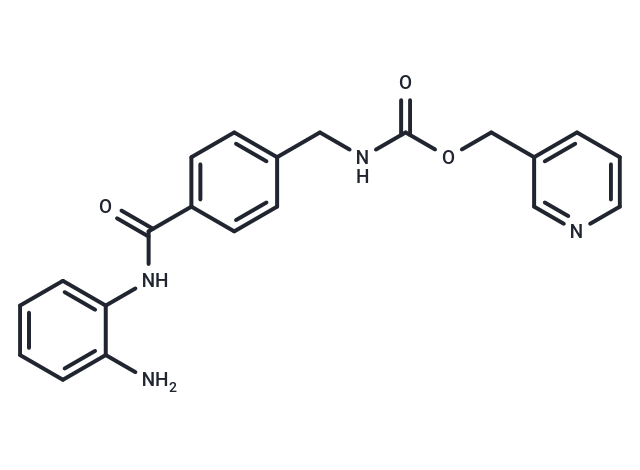

| Pack Size | Price | USA Stock | Global Stock | Quantity |
|---|---|---|---|---|
| 10 mg | $50 | In Stock | In Stock | |
| 25 mg | $72 | In Stock | In Stock | |
| 50 mg | $90 | In Stock | In Stock | |
| 100 mg | $126 | In Stock | In Stock | |
| 200 mg | $193 | In Stock | In Stock | |
| 1 mL x 10 mM (in DMSO) | $50 | In Stock | In Stock |
| Description | Entinostat (MS-275) is an HDAC class I selective inhibitor of HDAC1, HDAC2 and HDAC3 (IC50=243/453/248 nM) with oral activity. Entinostat has antitumor activity. |
| Targets & IC50 | HDAC2:453 nM, HDAC1:0.18 μM(cell free), WSU-HN6:0.54 μM, HDAC3:0.74 μM(cell free), WSU-HN12 cells:23.31 μM |
| In vitro | METHODS: A variety of tumor cells were treated with Entinostat for 72 h, and cell viability was measured by Resazurin solution. RESULTS: Entinostat inhibited tumor cell proliferation with an average IC50 of 2.57 µM.[1] METHODS: Human pancreatic cancer cells PANC-1 and SUIT2 Clone 1 were treated with Entinostat (1-50 µM) for 72 h. The expression levels of target proteins were measured by Western Blot. RESULTS: Entinostat caused a dose-dependent increase in cellular histone H3 acetylation and had no effect on total histone H3 protein levels, confirming that Entinostat inhibits the deacetylation activity of HDAC in cancer cell lines. [2] |
| In vivo | METHODS: To assay antitumor activity in vivo, Entinostat (12.5-49 mg/kg, 0.05 N HCl+0.1% Tween 80) was administered orally to nude mice bearing human tumor xenografts five times per week for four weeks. RESULTS: Entinostat at 49 mg/kg showed significant antitumor effects against KB-3-1, 4-1St, and St-4 tumor lines, and moderate effects against Capan-1 tumors. 24.5 mg/kg and 12.3 mg/kg also showed significant effects against these tumors. The dose of 24.5 mg/kg was also effective against A2780 and HT-29 and moderately effective against Calu-3. [3] |
| Synonyms | SNDX-275, MS-275 |
| Kinase Assay | The HDAC enzyme activity assay was done as described. Briefly, 40 μl HeLa cell nuclear extract, 29 μl enzyme buffer [15 mM Tris HCl pH 8.1, 0.25 mM EDTA, 250 mM NaCl, 10% (v/v) glycerol]; for recombinant HDAC isoenzymes, 0.1 mg/ml bovine serum albumin (BSA was added) and 1 μl compound were added per well of a microtiter plate. The reaction was started by addition of 30 μl substrate (Ac-NH-GGK(Ac)-AMC final 25 μM). After incubation for 90 min at 30°C, reaction was terminated by adding 25 μl stop solution (50 mM Tris HCl pH 8, 100 mM NaCl, 0.5 mg/ml trypsin, 2 μM TSA). After 40 min incubation at room temperature, fluorescence was measured using a Wallac Victor 1420 multilabel counter (Excitation 355 nm, Emission 460 nm). The HDAC1, 3, 6 and 8 assays were done with slight modifications. About 14 ng/well HDAC1, 2 ng/well HDAC3 or 10 ng/well HDAC6 were incubated with 6, 25 or 10 lM Ac-NH-GGK(Ac)-AMC, respectively, for 2 or 3 hr at 30°C. In contrast, 100 ng/well HDAC8 were incubated with 50 μM Ac-NH-RHK(Ac)K(Ac)-AMC for 3 hr at 30°C. Termination of the reaction and all further steps were done as described earlier for HeLa cell nuclear extracts. For the enzyme kinetic studies with HDAC1, selected HDAC inhibitor (around IC50 value), as well as Ac-NH-GGK(Ac)-AMC substrate (up to 100 μM) concentrations, were evaluated under standard conditions as described earlier [1]. |
| Cell Research | Cancer cells (5 × 10^3) were seeded into each well of 96-well plates and were cultured with graded concentrations of the drugs for 3 days. The cells were stained with 0.1 mg/ml neutral red for 1 h in a CO2-incubator, and, after aspiration of the medium, OD540 of the neutral red solubilized with 50 μl of ethanol and 150 μl of 0.1 M Na2HPO4 was measured. The IC50 value was determined by plotting growth inhibition of the cells against the logarithm of the drug concentration [2]. |
| Animal Research | A2780 cells (9 × 10^6) grown in vitro were suspended in PBS and were injected subcutaneously into the flank of nude mouse. For the other tumor lines, KB-3-1, HCT-15, 4-1St, Calu-3, St-4, Capan-1, and HT-29, tumors were passaged several times before starting in vivo antitumor testing, and a tumor lump (2–3 mm in diameter) was transplanted subcutaneously into the flank of a nude mouse by using a trocar needle. Treatment (four or five mice in each experimental group) with the drugs was started after the tumors were confirmed to have grown in the body (tumor size, 20–100 mm3). MS-27-275 and compound 2, both dissolved with 0.05 N HCl, 0.1% Tween 80, and 5-fluorouracil (5-FU) and diluted with physiological saline, were administered orally once daily 5 days per week for 4 weeks. Tumor length and width were monitored twice weekly, and tumor volume was calculated as described [2]. |
| Molecular Weight | 376.41 |
| Formula | C21H20N4O3 |
| Cas No. | 209783-80-2 |
| Smiles | Nc1ccccc1NC(=O)c1ccc(CNC(=O)OCc2cccnc2)cc1 |
| Relative Density. | 1.315 g/cm3 |
| Storage | Store at low temperature,Keep away from moisture,Keep away from direct sunlight Powder: -20°C for 3 years | In solvent: -80°C for 1 year Shipping with blue ice/Shipping at ambient temperature. | |||||||||||||||||||||||||||||||||||
| Solubility Information | DMSO: 237.5 mg/mL (630.96 mM), Sonication is recommended.  | |||||||||||||||||||||||||||||||||||
| In Vivo Formulation | 10% DMSO+40% PEG300+5% Tween 80+45% Saline: 3.77 mg/mL (10.02 mM), Solution. Please add the solvents sequentially, clarifying the solution as much as possible before adding the next one. Dissolve by heating and/or sonication if necessary. Working solution is recommended to be prepared and used immediately. The formulation provided above is for reference purposes only. In vivo formulations may vary and should be modified based on specific experimental conditions. | |||||||||||||||||||||||||||||||||||
Solution Preparation Table | ||||||||||||||||||||||||||||||||||||
DMSO
Note : The dilution table applies only to solid products. For liquid products, please calculate the stock solution based on the stated concentration and/or density. | ||||||||||||||||||||||||||||||||||||
 For example, if the intended dosage is 10 mg/kg for animals weighing 20 g , with a dosing volume of 100 μL per animal, and a total of 10 animals are to be administered, using a formulation of
  10% DMSO+ 40% PEG300+ 5% Tween 80+ 45% Saline/PBS/ddH2O , the resulting working solution concentration would be 2 mg/mL.
Dissolve 2 mg of the compound in 100 μL DMSO to obtain a stock solution at a concentration of 20 mg/mL . If the required concentration exceeds the compound's known solubility, please contact us for technical support before proceeding.
1) Add 100 μL of the DMSO stock solution to 400 µL PEG300 and mix thoroughly until the solution becomes clear.
2) Add 50 µL Tween 80 and mix well until fully clarified.
3) Add 450 µL Saline,PBS or ddH2O and mix thoroughly until a homogeneous solution is obtained.
| Size | Quantity | Unit Price | Amount | Operation |
|---|
 Feedback
 Hello! How can I help you today?
Copyright © 2015-2026 TargetMol Chemicals Inc. All Rights Reserved.
