


Shopping Cart
Remove All Your shopping cart is currently empty


Synonyms: Azelastinum, Azelastina, Astelin
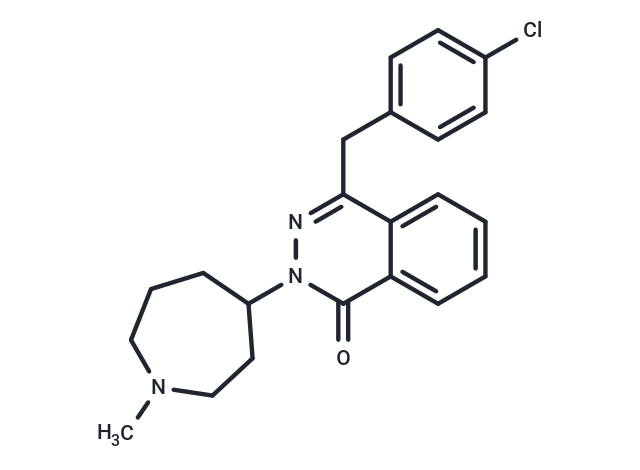
| Pack Size | Price | USA Stock | Global Stock | Quantity |
|---|---|---|---|---|
| 100 mg | $50 | In Stock | In Stock |
| Description | Azelastine (Azelastinum) is a phthalazine derivative, and is an histamine antagonist and mast cell stabilizer. |
| In vitro | Azelastine inhibits Ag- and ionomycin-induced TNF-alpha release with IC50 values of 25.7 mM and 1.66 mM, respectively, in a rat mast RBL-2H3 cell line. Azelastine also inhibits TNF-alpha mRNA expression, TNF-alpha protein synthesis and release, and, possibly related to these effects, Ca2+ influx, in Ag-stimulated cells. Azelastine inhibits TNF-alpha release to a greater extent than mRNA expression/protein synthesis and Ca2+ influx in ionomycin-stimulated cells, suggesting that Azelastine inhibits the release process more potently than transcription or production of TNF-alpha by interfering with a signal other than Ca2+. Azelastine added 1 hour after ionomycin stimulation also immediately blocks subsequent release of TNF-alpha, which has been produced in the cells, without affecting Ca2+ influx. Azelastine inhibits ionomycin-induced, but not Ag-induced, protein kinase C translocation to the membranes. [1] Azelastine hydrochloride (Azeptin) dose-dependently suppresses both DNA and protein synthesis in human gingival fibroblasts (HF) and also suppresses blastogenesis of human peripheral blood lymphocytes (PBL). Azelastine hydrochloride (Azeptin) suppresses both inducible nitric oxide synthase-mRNA level and NO generation in mouse peritoneal macrophages. [2] Azelastine inhibits secretion of IL-6, TNF-alpha and IL-8 as well as NF-kappaB activation and intracellular calcium ion levels in normal human mast cells. [3] |
| Synonyms | Azelastinum, Azelastina, Astelin |
| Molecular Weight | 381.90 |
| Formula | C22H24ClN3O |
| Cas No. | 58581-89-8 |
| Smiles | CN1CCCC(CC1)n1nc(Cc2ccc(Cl)cc2)c2ccccc2c1=O |
| Relative Density. | 1.25 g/cm3 |
| Storage | Keep away from direct sunlight Powder: -20°C for 3 years | In solvent: -80°C for 1 year Shipping with blue ice/Shipping at ambient temperature. | ||||||||||||||||||||
| Solubility Information | DMSO: 3.82 mg/mL (10 mM), Sonication is recommended.  | ||||||||||||||||||||
Solution Preparation Table | |||||||||||||||||||||
DMSO
Note : The dilution table applies only to solid products. For liquid products, please calculate the stock solution based on the stated concentration and/or density. | |||||||||||||||||||||
 For example, if the intended dosage is 10 mg/kg for animals weighing 20 g , with a dosing volume of 100 μL per animal, and a total of 10 animals are to be administered, using a formulation of
  10% DMSO+ 40% PEG300+ 5% Tween 80+ 45% Saline/PBS/ddH2O , the resulting working solution concentration would be 2 mg/mL.
Dissolve 2 mg of the compound in 100 μL DMSO to obtain a stock solution at a concentration of 20 mg/mL . If the required concentration exceeds the compound's known solubility, please contact us for technical support before proceeding.
1) Add 100 μL of the DMSO stock solution to 400 µL PEG300 and mix thoroughly until the solution becomes clear.
2) Add 50 µL Tween 80 and mix well until fully clarified.
3) Add 450 µL Saline,PBS or ddH2O and mix thoroughly until a homogeneous solution is obtained.
| Size | Quantity | Unit Price | Amount | Operation |
|---|
 Feedback
 Hello! How can I help you today?
Copyright © 2015-2026 TargetMol Chemicals Inc. All Rights Reserved.
