


Shopping Cart
Remove All Your shopping cart is currently empty


Synonyms: BMS-650032
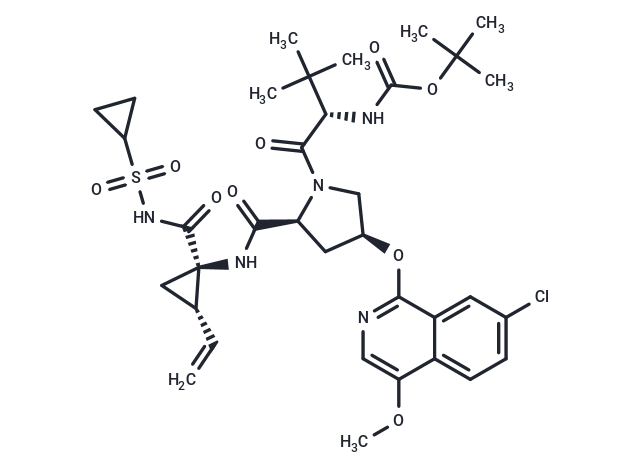
| Pack Size | Price | USA Stock | Global Stock | Quantity |
|---|---|---|---|---|
| 1 mg | $44 | In Stock | In Stock | |
| 5 mg | $113 | In Stock | In Stock | |
| 10 mg | $179 | In Stock | In Stock | |
| 25 mg | $373 | In Stock | In Stock | |
| 50 mg | $569 | In Stock | In Stock | |
| 100 mg | $793 | In Stock | In Stock | |
| 1 mL x 10 mM (in DMSO) | $183 | In Stock | In Stock |
| Description | Asunaprevir (BMS-650032) is an effective hepatitis C virus (HCV) NS3 protease inhibitor. |
| Targets & IC50 | HCV 1a H77:0.7 nM, 5a (SA13):1.7 nM, 6a (HK-6A):0.9 nM, 4a (ED43):1.6 nM, 1b J4L6S:0.3 nM |
| In vitro | Asunaprevir inhibits the NS3 proteolytic activity of genotype 1a (H77 strain) and genotype 1b (J4L6S strain), with IC50s of 0.7 and 0.3 nM, respectively. The EC50s of ASV against replicons encoding the NS3 protease domains representing genotypes 1a, 1b, and 4a, range from 1.2 to 4.0 nM[2]. Replicon cells are maintained under selective pressure with asunaprevir at concentrations of 10 and 30 times the EC50 values (50 or 150 nM final concentrations, respectively). For genotype 1b resistance selection, replicon cells are maintained in the presence of asunaprevir at 10 or 30 times the EC50 values (30 or 90 nM final concentrations, respectively)[3]. Asunaprevir, administered at single or multiple doses of 200 to 600 mg twice daily, is generally well tolerated, achieving rapid and substantial decreases in HCV RNA levels in subjects chronically infected with genotype 1 HCV[4]. |
| In vivo | Asunaprevir, administered orally at doses ranging from 3-15 mg/kg, exhibits a hepatotropic disposition, evidenced by liver-to-plasma ratios spanning from 40 to 359 across different animal species. Twenty-four hours after administration, liver exposure levels in all evaluated species were at least 110 times greater than the inhibitor EC50 noted against HCV genotype-1 replicons[2]. |
| Synonyms | BMS-650032 |
| Cell Research | Cytotoxicity is determined by incubating cells (3,000 to 10,000 cells/well) with serially diluted test compounds or DMSO for 5 days (MT-2 cells) or 4 days (all other cell types). Cell viability is quantitated using an MTS assay for MT-2 or a Cell-Titer Blue reagent assay for HEK-293, HuH-7, HepG2, and MRC5 cells, and 50% cytotoxic concentrations (CC50s) are calculated. |
| Animal Research | Mice (n=9 per group; overnight fast) receive Asunaprevir (ASV) by oral gavage (5 mg/kg; a vehicle of PEG-400-ethanol, 9:1). Blood samples (-0.2 mL) are obtained by retro-orbital bleeding at 0.25, 0.5, 1, 3, 6, 8, and 24 h after dosing. Within each group, three animals are bled at 0.25, 3, and 24 h, three at 0.5 and 6 h, and three at 1 and 8 h, resulting in a composite pharmacokinetic profile. Livers and brains are also removed from mice at the terminal sampling points. Rats (n=3 per group; overnight fast) receive ASV (amorphous free acid) by oral gavage (3, 5, 10, and 15 mg/kg) in PEG-400-ethanol (9:1). Serial blood samples (-0.3 mL) are obtained from the jugular vein predosing (0 h) and at 0.25, 0.5, 0.75, 1, 2, 4, 6, 8, 24, and 48 h post dosing. To assess tissue exposure, rats are orally administered ASV (5 or 15 mg/kg, same vehicle as above), and blood, liver, and heart samples from two rats/group are obtained at 0.17, 0.5, 1, 2, 4, 6, 8, 24, 48, and 72 h after dosing. |
| Molecular Weight | 748.29 |
| Formula | C35H46ClN5O9S |
| Cas No. | 630420-16-5 |
| Smiles | COc1cnc(O[C@H]2C[C@H](N(C2)C(=O)[C@@H](NC(=O)OC(C)(C)C)C(C)(C)C)C(=O)N[C@@]2(C[C@H]2C=C)C(=O)NS(=O)(=O)C2CC2)c2cc(Cl)ccc12 |
| Relative Density. | 1.37 g/cm3 |
| Storage | Powder: -20°C for 3 years | In solvent: -80°C for 1 year Shipping with blue ice/Shipping at ambient temperature. | ||||||||||||||||||||||||||||||||||||||||
| Solubility Information | H2O: Insoluble Ethanol: 20 mg/mL (26.73 mM), Sonication is recommended. DMSO: 250 mg/mL (334.1 mM), Sonication is recommended.  | ||||||||||||||||||||||||||||||||||||||||
| In Vivo Formulation | 10% DMSO+90% Corn oil: 10 mg/mL (13.36 mM), Solution. 10% DMSO+90% Saline: < 10 mg/mL (13.36 mM), Lower concentrations may be soluble, but exact solubility limit is unknown. 10% DMSO+90% (20% SBE-β-CD in Saline): < 10 mg/mL (13.36 mM), Lower concentrations may be soluble, but exact solubility limit is unknown. 10% DMSO+40% PEG300+5% Tween 80+45% Saline: < 10 mg/mL (13.36 mM), Lower concentrations may be soluble, but exact solubility limit is unknown. Please add the solvents sequentially, clarifying the solution as much as possible before adding the next one. Dissolve by heating and/or sonication if necessary. Working solution is recommended to be prepared and used immediately. The formulation provided above is for reference purposes only. In vivo formulations may vary and should be modified based on specific experimental conditions. | ||||||||||||||||||||||||||||||||||||||||
Solution Preparation Table | |||||||||||||||||||||||||||||||||||||||||
Ethanol/DMSO
DMSO
Note : The dilution table applies only to solid products. For liquid products, please calculate the stock solution based on the stated concentration and/or density. | |||||||||||||||||||||||||||||||||||||||||
 For example, if the intended dosage is 10 mg/kg for animals weighing 20 g , with a dosing volume of 100 μL per animal, and a total of 10 animals are to be administered, using a formulation of
  10% DMSO+ 40% PEG300+ 5% Tween 80+ 45% Saline/PBS/ddH2O , the resulting working solution concentration would be 2 mg/mL.
Dissolve 2 mg of the compound in 100 μL DMSO to obtain a stock solution at a concentration of 20 mg/mL . If the required concentration exceeds the compound's known solubility, please contact us for technical support before proceeding.
1) Add 100 μL of the DMSO stock solution to 400 µL PEG300 and mix thoroughly until the solution becomes clear.
2) Add 50 µL Tween 80 and mix well until fully clarified.
3) Add 450 µL Saline,PBS or ddH2O and mix thoroughly until a homogeneous solution is obtained.
| Size | Quantity | Unit Price | Amount | Operation |
|---|
 Feedback
 Hello! How can I help you today?
Copyright © 2015-2026 TargetMol Chemicals Inc. All Rights Reserved.
