


Shopping Cart
Remove All Your shopping cart is currently empty


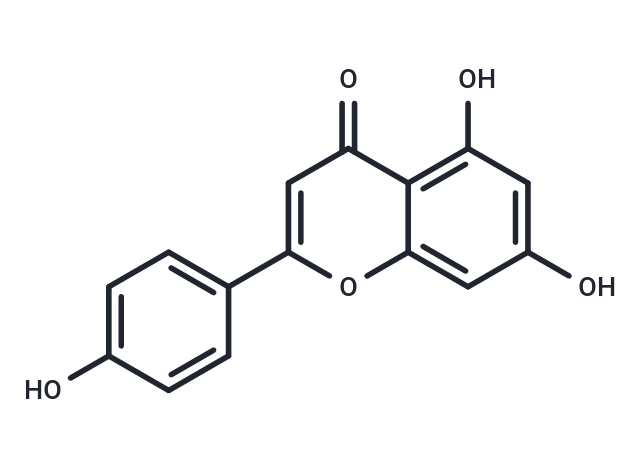
Synonyms: NSC 83244, LY 080400, C.I. Natural Yellow 1, Apigenol, 4',5,7-Trihydroxyflavone
| Pack Size | Price | USA Stock | Global Stock | Quantity |
|---|---|---|---|---|
| 25 mg | $45 | In Stock | In Stock | |
| 50 mg | $55 | In Stock | In Stock | |
| 100 mg | $89 | In Stock | In Stock | |
| 200 mg | $129 | In Stock | In Stock | |
| 500 mg | $213 | In Stock | In Stock | |
| 1 g | $315 | In Stock | In Stock | |
| 1 mL x 10 mM (in DMSO) | $30 | In Stock | In Stock |
| Description | Apigenin (NSC 83244) is an aromatic oil extracted from the flowers or leaves of the daisy-like plants. Extracts, oils and teas made from chamomile are used for its soothing qualities as a sedative, mild analgesic and sleep medication. Apigenin has not been implicated in causing serum enzyme elevations or clinically apparent liver injury. |
| Targets & IC50 | Microsomes (human):58.37 μM, CYP2C9:2 μM (Ki), Microsomes (Rat):25.73 μM |
| In vitro | Apigenin inhibits the activity of protein kinase C, mitogen-activated protein kinase, and the transformation of C3HI mouse embryo fibroblasts, as well as downstream oncogenes in NIH3T3 cells transformed by v-Ha-ras. It also suppresses the activity and expression of cyclooxygenase-2 and nitric oxide synthase-2 in mouse macrophages induced by LPS and effectively blocks the upregulation of the cell adhesion molecule-1 in human endothelial cells triggered by TNFα. Moreover, apigenin inhibits the expression of HIF-1α and VEGF in human ovarian cancer cells through the PI3K/Akt/p70S6K1 and HDM2/p53 signaling pathways, reduces the phosphorylation levels of cellular proteins induced by TPA, and inhibits the expression of c-jun and c-fos also induced by TPA. It reverses the transformed phenotype of NIH3T3 cells with v-H-ras. In Chinese hamster ovary cells, apigenin prevents mutations caused by the toxicity gene induced by nitropyrene. It blocks the peroxisome proliferator-activated kinase and MAPK in hepatocytes ex vivo. In epithelial and fibroblast cells, apigenin causes reversible blocks at G2/M and G0/G1 phases by inhibiting p34 (cdc2) kinase activity, accompanied by an increase in p53 protein stability. |
| In vivo | Apigenin at a dosage of 12.5 mg/kg enhances the proliferation of cells in the dentate gyrus region of the hippocampus in adult mice. It also downregulates the production of IL-4 in ovalbumin-immunized BALB/C mice. Additionally, apigenin significantly increases both the weight of the uterus and the overall concentration of estrogen receptor (ER)-α in female mice (64), while inhibiting the growth of prostate and breast cancer cells via the estrogen receptor β1. This compound inhibits lung metastasis of melanoma by blocking the interaction between tumor cells and endothelial cells. Furthermore, apigenin reduces IGF-I levels in prostate xenografts and increases the content of IGFBP-3, a protein that binds IGF-I in the bloodstream. |
| Synonyms | NSC 83244, LY 080400, C.I. Natural Yellow 1, Apigenol, 4',5,7-Trihydroxyflavone |
| Molecular Weight | 270.24 |
| Formula | C15H10O5 |
| Cas No. | 520-36-5 |
| Smiles | OC1=CC=C(C=C1)C1=CC(=O)C2=C(O)C=C(O)C=C2O1 |
| Relative Density. | 1.2319 g/cm3 (Estimated) |
| Storage | Powder: -20°C for 3 years | In solvent: -80°C for 1 year Shipping with blue ice/Shipping at ambient temperature. | |||||||||||||||||||||||||||||||||||
| Solubility Information | H2O: < 1 mg/mL (insoluble or slightly soluble)  Ethanol: < 1 mg/mL (insoluble or slightly soluble) DMSO: 255 mg/mL (943.61 mM), Sonication is recommended. | |||||||||||||||||||||||||||||||||||
| In Vivo Formulation | 10% DMSO+40% PEG300+5% Tween 80+45% Saline: 5 mg/mL (18.5 mM), Suspension. Please add the solvents sequentially, clarifying the solution as much as possible before adding the next one. Dissolve by heating and/or sonication if necessary. Working solution is recommended to be prepared and used immediately. The formulation provided above is for reference purposes only. In vivo formulations may vary and should be modified based on specific experimental conditions. | |||||||||||||||||||||||||||||||||||
Solution Preparation Table | ||||||||||||||||||||||||||||||||||||
DMSO
Note : The dilution table applies only to solid products. For liquid products, please calculate the stock solution based on the stated concentration and/or density. | ||||||||||||||||||||||||||||||||||||
 For example, if the intended dosage is 10 mg/kg for animals weighing 20 g , with a dosing volume of 100 μL per animal, and a total of 10 animals are to be administered, using a formulation of
  10% DMSO+ 40% PEG300+ 5% Tween 80+ 45% Saline/PBS/ddH2O , the resulting working solution concentration would be 2 mg/mL.
Dissolve 2 mg of the compound in 100 μL DMSO to obtain a stock solution at a concentration of 20 mg/mL . If the required concentration exceeds the compound's known solubility, please contact us for technical support before proceeding.
1) Add 100 μL of the DMSO stock solution to 400 µL PEG300 and mix thoroughly until the solution becomes clear.
2) Add 50 µL Tween 80 and mix well until fully clarified.
3) Add 450 µL Saline,PBS or ddH2O and mix thoroughly until a homogeneous solution is obtained.
| Size | Quantity | Unit Price | Amount | Operation |
|---|
 Feedback
 Hello! How can I help you today?
Copyright © 2015-2026 TargetMol Chemicals Inc. All Rights Reserved.
