


Shopping Cart
Remove All Your shopping cart is currently empty

Synonyms: N-(4-Aminobutyl)-1,3-diaminopropane, N-(3-Aminopropyl)-1,4-diaminobutane
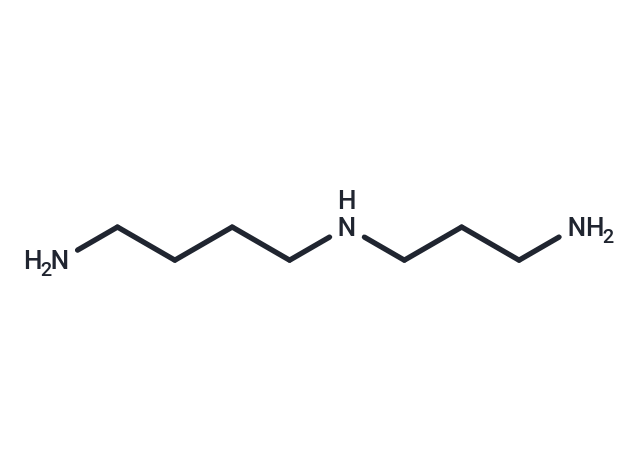
| Pack Size | Price | USA Stock | Global Stock | Quantity |
|---|---|---|---|---|
| 50 mg | $31 | In Stock | In Stock | |
| 100 mg | $44 | In Stock | In Stock | |
| 200 mg | $52 | In Stock | In Stock | |
| 500 mg | $66 | - | In Stock | |
| 1 g | $81 | - | In Stock | |
| 2 g | $97 | - | In Stock |

| Description | Spermidine (N-(3-Aminopropyl)-1,4-diaminobutane) inhibits NOS1 (nNOS). Spermidine binds and precipitates DNA and may be used for purification of DNA binding proteins. Spermidine activates PNK (polynucleotide kinase T4). Spermidine binds to and activates NMDA and has been shown to potentiate NMDA-induced currents in a concentration-dependent manner. |
| Targets & IC50 | HeLa cells:121.3 μM, c-Src:106.4 ± 13.4nM (EC50) |
| In vitro | METHODS: Human neuroblastoma cells SH-SY5Y were treated with Spermidine (0.05-10 µM) for 24-48 h. Mitochondrial metabolic activity was measured by MTT assay and ATP production assay. RESULTS: No effect of Spermidine was observed after 24 h. 0.1 and 1 µM Spermidine significantly increased cellular metabolic activity and ATP production after 48 h of treatment. The most effective concentration of Spermidine, 0.1 µM, induced an 8.2% increase in metabolic activity and a 4% increase in ATP production. [1] METHODS: The retinal pigment epithelial cell line ARPE-19 was treated with H2O2 (300 µM) and Spermidine (10 µM) for 24 h. Apoptosis was detected by Flow cytometry. RESULTS: 300 µM H2O2 significantly increased the frequency of annexin V-positive cells to approximately 25%, but Spermidine significantly inhibited this increase. The results suggest that Spermidine attenuates H2O2-mediated oxidative stress-induced apoptosis in ARPE-19 cells. [2] |
| In vivo | METHODS: To study the effects on diabetes, Spermidine (10 mM) was administered orally in water to non-obese diabetic (NOD) mice (type 1 diabetes mouse model) for thirty weeks. RESULTS: Treatment of NOD mice with Spermidine resulted in a higher incidence of diabetes, although pancreatic insulitis was not altered.Spermidine modulated pancreatic tissue polyamine levels and increased signs of autophagy.Spermidine resulted in an increase in the proportion of pro-inflammatory T-cells in the pancreatic lymph nodes (pLN) of diabetic mice. [3] |
| Synonyms | N-(4-Aminobutyl)-1,3-diaminopropane, N-(3-Aminopropyl)-1,4-diaminobutane |
| Molecular Weight | 145.25 |
| Formula | C7H19N3 |
| Cas No. | 124-20-9 |
| Smiles | NCCCCNCCCN |
| Relative Density. | 1.00 g/cm3 at 20℃ |
| Storage | Pure form: -20°C for 3 years | In solvent: -80°C for 1 year Shipping with blue ice/Shipping at ambient temperature. | |||||||||||||||||||||||||||||||||||
| Solubility Information | DMSO: 250 mg/mL (1721.17 mM), Sonication is recommended.  H2O: 100 mg/mL (688.47 mM), Sonication is recommended. | |||||||||||||||||||||||||||||||||||
| In Vivo Formulation | 5% DMSO+95% Saline: 1.67 mg/mL (11.5 mM), Solution. Please add the solvents sequentially, clarifying the solution as much as possible before adding the next one. Dissolve by heating and/or sonication if necessary. Working solution is recommended to be prepared and used immediately. The formulation provided above is for reference purposes only. In vivo formulations may vary and should be modified based on specific experimental conditions. | |||||||||||||||||||||||||||||||||||
Solution Preparation Table | ||||||||||||||||||||||||||||||||||||
H2O/DMSO
Note : The dilution table applies only to solid products. For liquid products, please calculate the stock solution based on the stated concentration and/or density. | ||||||||||||||||||||||||||||||||||||
 For example, if the intended dosage is 10 mg/kg for animals weighing 20 g , with a dosing volume of 100 μL per animal, and a total of 10 animals are to be administered, using a formulation of
  10% DMSO+ 40% PEG300+ 5% Tween 80+ 45% Saline/PBS/ddH2O , the resulting working solution concentration would be 2 mg/mL.
Dissolve 2 mg of the compound in 100 μL DMSO to obtain a stock solution at a concentration of 20 mg/mL . If the required concentration exceeds the compound's known solubility, please contact us for technical support before proceeding.
1) Add 100 μL of the DMSO stock solution to 400 µL PEG300 and mix thoroughly until the solution becomes clear.
2) Add 50 µL Tween 80 and mix well until fully clarified.
3) Add 450 µL Saline,PBS or ddH2O and mix thoroughly until a homogeneous solution is obtained.
| Size | Quantity | Unit Price | Amount | Operation |
|---|
 Feedback
 Hello! How can I help you today?
Copyright © 2015-2026 TargetMol Chemicals Inc. All Rights Reserved.
