


Shopping Cart
Remove All Your shopping cart is currently empty


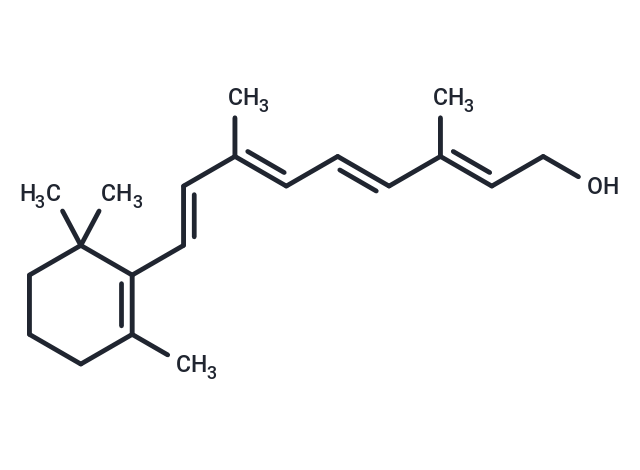
Synonyms: Vitamin A1, Alphalin, all-trans-Retinol
| Pack Size | Price | USA Stock | Global Stock | Quantity |
|---|---|---|---|---|
| 50 mg | $56 | In Stock | In Stock | |
| 100 mg | $90 | In Stock | In Stock | |
| 500 mg | $318 | In Stock | In Stock |
| Description | Retinol (Alphalin) and derivatives of retinol that play an essential role in metabolic functioning of the retina, the growth of and differentiation of epithelial tissue, the growth of bone, reproduction, and the immune response. Dietary vitamin A is derived from a variety of CAROTENOIDS found in plants. It is enriched in the liver, egg yolks, and the fat component of dairy products. |
| Targets & IC50 | RARα:14 nM, RAW 264.7 cells:140 μM, RARβ:14 nM, RARγ:14 nM |
| In vitro | METHODS: The human SH-SY5Y neuronal cell line was treated with Retinol (1-20 µM) for 24 h. Cell viability was measured by MTT assay and SRB assay. RESULTS: Retinol at 7, 10 and 20 µM significantly reduced cell viability. concentrations below 5 µM did not affect MTT reduction or SRB doping in SH-SY5Y cells, but at 7 µM these parameters decreased, indicating a reduction in the number of viable cells compared to the control group. [1] METHODS: Human hepatocellular carcinoma cells, HepG2, were treated with Retinol (1 µM) for 24 h. Retinol distribution was examined using Flow cytometry. RESULTS: After 1 day of treatment with 1 µM Retinol, the percentage of Retinol-positive HepG2 cells in the total cell population increased from 17.6% to 69.8%. Fluorescence analysis showed that Retinol was located in the cytoplasm of HepG2 cells. [2] |
| In vivo | METHODS: To study placental pharmacokinetics and teratogenicity, Retinol (10-100 mg/kg) was administered by gavage to pregnant mice on day 11 of gestation. RESULTS: No teratogenic effects were observed after administration of 10 mg/kg Retinol. Pharmacokinetic studies showed moderate increases in retinyl esters, retinol, and all-trans-retinoic acid in plasma, embryonic tissues, placenta, yolk sac membranes, and extra-embryonic fluids. 100 mg/kg Retinol administration resulted in a high incidence of severe fetal malformations. There was a significant increase in retinyl esters and retinol in all compartments, including the embryo, and the polar metabolites all-trans-retinoic acid and all-trans-4-oxoretinoic acid were produced in large amounts. [3] |
| Synonyms | Vitamin A1, Alphalin, all-trans-Retinol |
| Kinase Assay | Complementation of SCR7 Inhibition with Puri?ed Ligase IV: Complementation experiment is carried out by adding increasing concentrations of puri?ed Ligase IV/XRCC4 complex (30, 60, and 120 fmol) along with the oligomeric DNA substrates (5' compatible and 5'-5' noncompatible ends) to the SCR7-treatedextracts. Reactions are incubated for 2 h at 25℃. The reaction products are then resolved on 8% denaturing PAGE. The gel is dried and exposed and the signal is detected with a PhosphorImager and analyzed with Multi Gauge (V3.0) software. |
| Molecular Weight | 286.45 |
| Formula | C20H30O |
| Cas No. | 68-26-8 |
| Smiles | C\C(=C/CO)\C=C\C=C(/C)\C=C\C1=C(C)CCCC1(C)C |
| Relative Density. | 0.954 g/cm3 |
| Storage | Store under nitrogen,Store at low temperature Powder: -20°C for 3 years | In solvent: -80°C for 1 year Shipping with blue ice/Shipping at ambient temperature. | |||||||||||||||||||||||||||||||||||
| Solubility Information | Ethanol: 50 mg/mL (174.55 mM), Sonication is recommended.  DMSO: 245 mg/mL (855.3 mM), Sonication is recommended. | |||||||||||||||||||||||||||||||||||
Solution Preparation Table | ||||||||||||||||||||||||||||||||||||
Ethanol/DMSO
Note : The dilution table applies only to solid products. For liquid products, please calculate the stock solution based on the stated concentration and/or density. | ||||||||||||||||||||||||||||||||||||
 For example, if the intended dosage is 10 mg/kg for animals weighing 20 g , with a dosing volume of 100 μL per animal, and a total of 10 animals are to be administered, using a formulation of
  10% DMSO+ 40% PEG300+ 5% Tween 80+ 45% Saline/PBS/ddH2O , the resulting working solution concentration would be 2 mg/mL.
Dissolve 2 mg of the compound in 100 μL DMSO to obtain a stock solution at a concentration of 20 mg/mL . If the required concentration exceeds the compound's known solubility, please contact us for technical support before proceeding.
1) Add 100 μL of the DMSO stock solution to 400 µL PEG300 and mix thoroughly until the solution becomes clear.
2) Add 50 µL Tween 80 and mix well until fully clarified.
3) Add 450 µL Saline,PBS or ddH2O and mix thoroughly until a homogeneous solution is obtained.
| Size | Quantity | Unit Price | Amount | Operation |
|---|
 Feedback
 Hello! How can I help you today?
Copyright © 2015-2026 TargetMol Chemicals Inc. All Rights Reserved.
