


Shopping Cart
Remove All Your shopping cart is currently empty


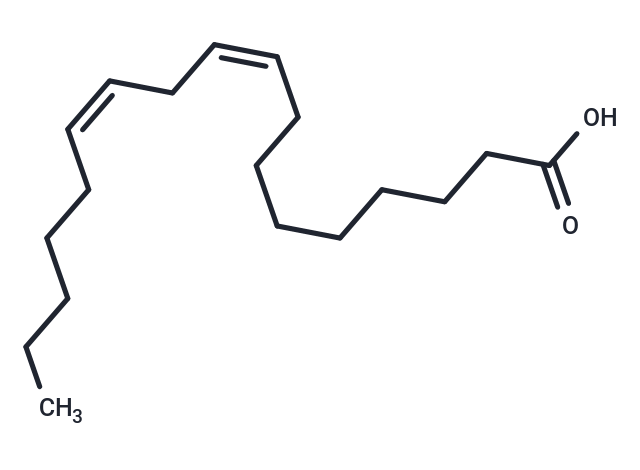
Linoleic acid (9,12-octadecadienoic acid) is a naturally occurring polyunsaturated fatty acid found in animal and vegetable oils. Linoleic acid is an essential fatty acid that is part of membrane phospholipids.
| Pack Size | Price | USA Warehouse | Global Warehouse | Quantity |
|---|---|---|---|---|
| 500 mg | $33 | In Stock | In Stock | |
| 1 g | $46 | In Stock | In Stock | |
| 2 g | $62 | In Stock | In Stock | |
| 5 g | $88 | - | In Stock | |
| 10 g | $128 | - | In Stock | |
| 25 g | $215 | - | In Stock |

| Description | Linoleic acid (9,12-octadecadienoic acid) is a naturally occurring polyunsaturated fatty acid found in animal and vegetable oils. Linoleic acid is an essential fatty acid that is part of membrane phospholipids. |
| Targets&IC50 | CHO-K1 cells:0.54 μM (EC50), RBL-2H3 cells:> 50 μM, CHO cells:1.8 μM (EC50), HEK293 cells:4.8 μM (EC50) |
| In vitro | METHODS: Bovine satellite cell BSCs were treated with Linoleic acid (10-250 µM) for 24-48 h. Cell viability was measured by MTT assay. RESULTS: At 24 h of treatment with Linoleic acid, cell proliferation increased at doses of 10-100 µM and decreased at 250 µM as compared to untreated control. 100 µM Linoleic acid at 48 h had no significant effect on cell proliferation. [1] METHODS: Human ovarian cancer cells SKOV-3 were treated with Linoleic acid (16 µM) for 24 h. Cell migration was detected by wound-healing assay. RESULTS: The average migration in the Linoleic acid treated group increased by about 20% on average compared to control untreated cells. [2] |
| In vivo | METHODS: To study the effects on endocannabinoid (EC) biology, four groups of C57BL/6 mice were fed diets containing 1% or 8% Linoleic acid (with or without G (LAG)) for eight weeks. RESULTS: Increasing dietary Linoleic acid from 1% to 8% significantly increased circulatory, small intestinal, and hepatic ECS. 1% LAG-fed mice had the lowest feed efficiencies, and hepatic levels of only two ECs were reduced by the addition of G. [3] |
| Synonyms | acidelinoleique, 9,12-octadecadienoic acid, 9,12-Linoleic acid |
| Molecular Weight | 280.45 |
| Formula | C18H32O2 |
| Cas No. | 60-33-3 |
| Smiles | C(C/C=C\C/C=C\CCCCC)CCCCCC(O)=O |
| Relative Density. | 0.902g/mLat 25°C(lit.) |
| Storage | keep away from direct sunlight | Powder: -20°C for 3 years | In solvent: -80°C for 1 year | Shipping with blue ice/Shipping at ambient temperature. | |||||||||||||||||||||||||||||||||||
| Solubility Information | DMSO: 55 mg/mL (196.11 mM), Sonication is recommended.  | |||||||||||||||||||||||||||||||||||
| In Vivo Formulation | 10% DMSO+40% PEG300+5% Tween 80+45% Saline: 4.33 mg/mL (15.44 mM), Solution. Please add the solvents sequentially, clarifying the solution as much as possible before adding the next one. Dissolve by heating and/or sonication if necessary. Working solution is recommended to be prepared and used immediately. The formulation provided above is for reference purposes only. In vivo formulations may vary and should be modified based on specific experimental conditions. | |||||||||||||||||||||||||||||||||||
Solution Preparation Table | ||||||||||||||||||||||||||||||||||||
DMSO
| ||||||||||||||||||||||||||||||||||||
 For example, if the intended dosage is 10 mg/kg for animals weighing 20 g , with a dosing volume of 100 μL per animal, and a total of 10 animals are to be administered, using a formulation of
  10% DMSO+ 40% PEG300+ 5% Tween 80+ 45% Saline/PBS/ddH2O , the resulting working solution concentration would be 2 mg/mL.
Dissolve 2 mg of the compound in 100 μL DMSO to obtain a stock solution at a concentration of 20 mg/mL . If the required concentration exceeds the compound's known solubility, please contact us for technical support before proceeding.
1) Add 100 μL of the DMSO stock solution to 400 μL PEG300 and mix thoroughly until the solution becomes clear.
2) Add 50 μL Tween 80 and mix well until fully clarified.
3) Add 450 μL Saline,PBS or ddH2O and mix thoroughly until a homogeneous solution is obtained.

| Size | Quantity | Unit Price | Amount | Operation |
|---|
 Feedback
 Hello! How can I help you today?
Copyright © 2015-2026 TargetMol Chemicals Inc. All Rights Reserved.
