


Shopping Cart
Remove All Your shopping cart is currently empty


Synonyms:
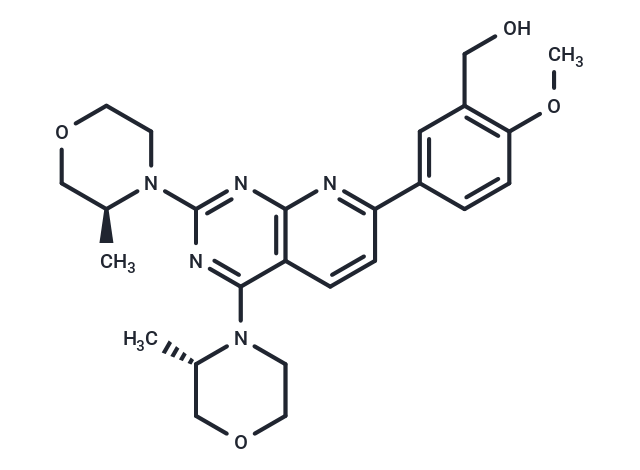
| Pack Size | Price | USA Stock | Global Stock | Quantity |
|---|---|---|---|---|
| 5 mg | $36 | In Stock | In Stock | |
| 10 mg | $52 | In Stock | In Stock | |
| 25 mg | $75 | In Stock | In Stock | |
| 50 mg | $93 | In Stock | In Stock | |
| 100 mg | $151 | In Stock | In Stock | |
| 200 mg | $280 | In Stock | In Stock | |
| 1 mL x 10 mM (in DMSO) | $36 | In Stock | In Stock |
| Description | AZD-8055 is an orally bioavailable, highly selective, ATP-competitive mTOR kinase inhibitor that directly binds to the ATP-binding pocket of the mTOR kinase domain, while potently inhibiting both mTORC1 and mTORC2 complexes (IC₅₀ values of 0.8 nM and 0.1 nM, respectively). AZD-8055 is suitable for research in oncology, metabolic diseases, and fibrotic disorders. |
| Targets & IC50 | mTOR:0.8 nM (MDA-MB-468 cells) |
| In vitro | Methods: HPCAL1 was knocked down in Huh7 human hepatocellular carcinoma cells using shRNA. Following transfection, cells were treated with AZD-8055 at gradient concentrations (0, 10, 50, 100, 500 nM) for 72 hours. Cell viability was assessed using the CCK-8 assay. Results: HPCAL1-knockdown cells exhibited increased sensitivity to AZD-8055 (lower cell viability).[1] Methods: Uveal melanoma cell lines: 92.1, Mel202, MP38, MP41. AZD-8055 (1 μM) and romidepsin (25 ng/mL) were added. After 6 hours of romidepsin treatment, fresh medium was replaced, and cells were cultured for an additional 48 hours. Apoptosis was assessed by flow cytometry (Annexin V/SYTOX Green staining). Results: The combination of AZD-8055 and romidepsin induced the highest level of apoptosis in all four cell lines, outperforming other combinations. [2] |
| In vivo | Methods: A MYC/Trp53⁻/⁻ liver cancer model was established via hydrodynamic tail-vein injection. Hpcal1 was simultaneously knocked out using CRISPR/Cas9 (sgHpcal1) or a control (sgCON). Following successful model establishment, AZD-8055 (10 mg/kg/day, once daily) was administered via intraperitoneal injection for 30 consecutive days. Results: AZD-8055 treatment significantly reduced tumor burden in sgHpcal1 mice, demonstrating superior efficacy compared to the sgCON group. [1] |
| Kinase Assay | The activity of mTOR was assayed using the recombinant mTOR technique described above. For inhibition experiments, AZD8055 was added to the reaction mixture and preincubated for 10 min before addition of ATP. Inhibition was performed at 1 to 3,000 nmol/L of AZD8055 in varying concentrations of ATP (40–200 μmol/L) [1]. |
| Cell Research | For growth inhibition and acridine staining, cells were exposed to increasing concentrations of AZD8055 for 72 to 96 h and stained for cell nuclei (0.03 mg/mL Hoechst 33342) and acidic vesicles (1 μg/mL acridine orange). Images were captured at 450 and 536 nm on an ArrayScan II platform, and the percentage of acidic vesicles and the number of cells were quantified. For LC3 assessment, cells were exposed to e64d/pepstatin (10 μg/mL) for 30 to 90 min before incubation with AZD8055. Cells were lysed on ice and analyzed by immunoblotting [1]. |
| Animal Research | Tumor cells (10^6 for U87-MG, 5 × 10^6 for A549) were injected s.c. in a volume of 0.1 mL, and mice were randomized into control and treatment groups when tumor size reached 0.2 cm^3. AZD8055 was formulated in 30% (w/v) captisol (pH 3.0). The control group received the vehicle only. Tumor volumes (measured by caliper), animal body weight, and tumor condition were recorded twice weekly for the duration of the study. The tumor volume was calculated (taking length to be the longest diameter across the tumor and width to be the corresponding perpendicular diameter) using the following formula: (length × width) × √(length × width) × (π/6) [1]. |
| Molecular Weight | 465.54 |
| Formula | C25H31N5O4 |
| Cas No. | 1009298-09-2 |
| Smiles | C[C@@H]1N(C=2C3=C(N=C(N2)N4[C@@H](C)COCC4)N=C(C=C3)C5=CC(CO)=C(OC)C=C5)CCOC1 |
| Relative Density. | 1.248 |
| Storage | Powder: -20°C for 3 years | In solvent: -80°C for 1 year Shipping with blue ice/Shipping at ambient temperature. | ||||||||||||||||||||||||||||||||||||||||
| Solubility Information | Ethanol: 3 mg/mL (6.44 mM), Sonication is recommended. H2O: < 1 mg/mL (insoluble or slightly soluble) DMSO: 91 mg/mL (195.47 mM), Sonication is recommended.  | ||||||||||||||||||||||||||||||||||||||||
| In Vivo Formulation | 10% DMSO+40% PEG300+5% Tween 80+45% Saline: 4.5 mg/mL (9.67 mM), Solution. Please add the solvents sequentially, clarifying the solution as much as possible before adding the next one. Dissolve by heating and/or sonication if necessary. Working solution is recommended to be prepared and used immediately. The formulation provided above is for reference purposes only. In vivo formulations may vary and should be modified based on specific experimental conditions. | ||||||||||||||||||||||||||||||||||||||||
Solution Preparation Table | |||||||||||||||||||||||||||||||||||||||||
Ethanol/DMSO
DMSO
Note : The dilution table applies only to solid products. For liquid products, please calculate the stock solution based on the stated concentration and/or density. | |||||||||||||||||||||||||||||||||||||||||
 For example, if the intended dosage is 10 mg/kg for animals weighing 20 g , with a dosing volume of 100 μL per animal, and a total of 10 animals are to be administered, using a formulation of
  10% DMSO+ 40% PEG300+ 5% Tween 80+ 45% Saline/PBS/ddH2O , the resulting working solution concentration would be 2 mg/mL.
Dissolve 2 mg of the compound in 100 μL DMSO to obtain a stock solution at a concentration of 20 mg/mL . If the required concentration exceeds the compound's known solubility, please contact us for technical support before proceeding.
1) Add 100 μL of the DMSO stock solution to 400 µL PEG300 and mix thoroughly until the solution becomes clear.
2) Add 50 µL Tween 80 and mix well until fully clarified.
3) Add 450 µL Saline,PBS or ddH2O and mix thoroughly until a homogeneous solution is obtained.
| Size | Quantity | Unit Price | Amount | Operation |
|---|
 Feedback
 Hello! How can I help you today?
Copyright © 2015-2026 TargetMol Chemicals Inc. All Rights Reserved.
