


Shopping Cart
Remove All Your shopping cart is currently empty


Synonyms: SKQ1
| Pack Size | Price | USA Stock | Global Stock | Quantity |
|---|---|---|---|---|
| 5 mg | $43 | In Stock | In Stock | |
| 10 mg | $68 | In Stock | In Stock | |
| 25 mg | $126 | In Stock | In Stock | |
| 50 mg | $207 | In Stock | In Stock | |
| 100 mg | $365 | In Stock | In Stock | |
| 1 mL x 10 mM (in DMSO) | $59 | In Stock | In Stock |
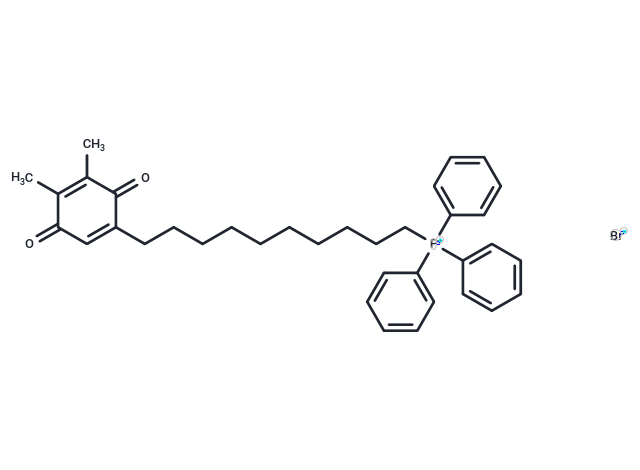
| Description | Visomitin (SKQ1) is a mitochondria-targeted antioxidant that decreases transmembrane potential and production of reactive oxygen species (ROS). |
| In vitro | Direct treatment of tumor infiltrating leukocytes with Visomitin (SkQ1) does not influence their cytotoxicity against Panc02 cells. Visomitin reduces heavily the proliferation of human PDAC cells at 500 nM concentration while not affecting the viability of the cell lines. |
| In vivo | In a study on pancreatic ductal adenocarcinoma (PDAC)-bearing mice, continuous treatment with Visomitin (SkQ1) was found to modify systemic angiogenic factors. Specifically, this treatment led to a decrease in serum KC levels and an increase in VEGF molecules, indicating altered angiogenesis. Additionally, Visomitin treatment resulted in reduced levels of MIP1a and prolactin, alongside elevated amounts of IL-6 and IL-13. The pretreatment setting showed a decrease in TGF-b levels. Contrarily, Visomitin treatment across all protocols reduced the percentage of NKT cells. Although the median survival of PDAC-bearing mice was prolonged with Visomitin treatment, the survival increase did not achieve statistical significance. |
| Synonyms | SKQ1 |
| Cell Research | Panc02 cells are treated 48 h with different concentrations of Visomitin (SkQ1). Cell viability after Visomitin treatment is measured with an EZ4U Kit as described by the manufacturers. Brie?y, 20,000 cells per well are seeded in 96-wellplates and let grow overnight. Afterwards, cells are treated without the medium exchange. A substrate compound from the kit is added and the cells are further incubated for 5 hr at 37°C to convert the yellow colored tetrazolium to its red formazan derivate by living cells. The absorbance is measured at 450 nm |
| Animal Research | Female C57BL/6 mice are used in this study. For experiments on both acute and chronic pancreatitis, mice are divided in three groups. Group A (acute pancreatitis (AP) n=8; chronic pancreatitis (CP) n=12) is treated with 5?nmol/kg Visomitin (SkQ1), group B (AP n=8; CP n=12) is the untreated control, and group C (AP n=8; CP n=7) is the sham group, which is injected intraperitoneally with 0.9% NaCl instead of cerulein and is therefore the negative control group without pancreatitis. For experiments on acute pancreatitis, mice are pretreated with Visomitin for 8 weeks prior to induction of pancreatitis. Mice designated for experiments on chronic pancreatitis receive Visomitin at the same concentration for 8 weeks in parallel with induction of pancreatitis |
| Molecular Weight | 617.61 |
| Formula | C36H42BrO2P |
| Cas No. | 934826-68-3 |
| Smiles | O=C1C(=CC(=O)C(=C1C)C)CCCCCCCCCC[P+](c1ccccc1)(c1ccccc1)c1ccccc1.[Br-] |
| Relative Density. | no data available |
| Storage | Powder: -20°C for 3 years | In solvent: -80°C for 1 year Shipping with blue ice/Shipping at ambient temperature. | ||||||||||||||||||||||||||||||
| Solubility Information | DMSO: 55 mg/mL (89.05 mM), Sonication is recommended.  | ||||||||||||||||||||||||||||||
| In Vivo Formulation | 10% DMSO+40% PEG300+5% Tween 80+45% Saline: 2 mg/mL (3.24 mM), Sonication is recommended. Please add the solvents sequentially, clarifying the solution as much as possible before adding the next one. Dissolve by heating and/or sonication if necessary. Working solution is recommended to be prepared and used immediately. The formulation provided above is for reference purposes only. In vivo formulations may vary and should be modified based on specific experimental conditions. | ||||||||||||||||||||||||||||||
Solution Preparation Table | |||||||||||||||||||||||||||||||
DMSO
Note : The dilution table applies only to solid products. For liquid products, please calculate the stock solution based on the stated concentration and/or density. | |||||||||||||||||||||||||||||||
 For example, if the intended dosage is 10 mg/kg for animals weighing 20 g , with a dosing volume of 100 μL per animal, and a total of 10 animals are to be administered, using a formulation of
  10% DMSO+ 40% PEG300+ 5% Tween 80+ 45% Saline/PBS/ddH2O , the resulting working solution concentration would be 2 mg/mL.
Dissolve 2 mg of the compound in 100 μL DMSO to obtain a stock solution at a concentration of 20 mg/mL . If the required concentration exceeds the compound's known solubility, please contact us for technical support before proceeding.
1) Add 100 μL of the DMSO stock solution to 400 µL PEG300 and mix thoroughly until the solution becomes clear.
2) Add 50 µL Tween 80 and mix well until fully clarified.
3) Add 450 µL Saline,PBS or ddH2O and mix thoroughly until a homogeneous solution is obtained.
| Size | Quantity | Unit Price | Amount | Operation |
|---|
 Feedback
 Hello! How can I help you today?
Copyright © 2015-2026 TargetMol Chemicals Inc. All Rights Reserved.
