


Shopping Cart
Remove All Your shopping cart is currently empty

Synonyms: VER155008
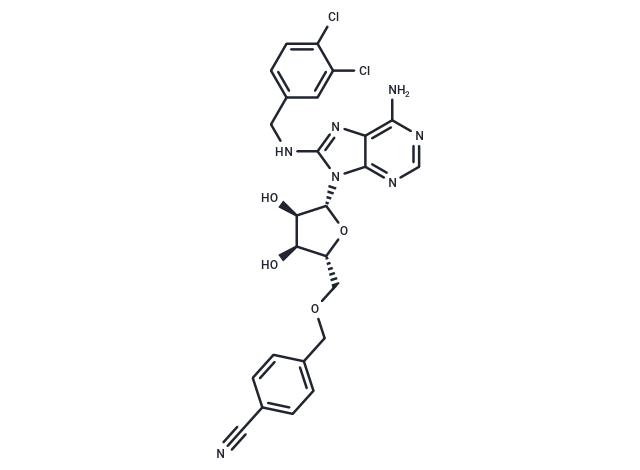

| Pack Size | Price | USA Stock | Global Stock | Quantity |
|---|---|---|---|---|
| 2 mg | $39 | In Stock | In Stock | |
| 5 mg | $63 | In Stock | In Stock | |
| 10 mg | $85 | In Stock | In Stock | |
| 25 mg | $166 | In Stock | In Stock | |
| 50 mg | $297 | In Stock | In Stock | |
| 100 mg | $492 | In Stock | In Stock | |
| 200 mg | $688 | - | In Stock | |
| 1 mL x 10 mM (in DMSO) | $77 | In Stock | In Stock |
| Description | VER-155008 is an Hsp70 inhibitor (IC50 = 0.5 μM), exhibiting over 100-fold selectivity against Hsp90, and capable of inhibiting Hsc70 and Grp78 (IC50 = 2.6 μM for both). This compound possesses good selectivity and cell permeability, and is used in anti-tumor research, showing therapeutic potential in leukemia and solid tumor models. |
| Targets & IC50 | HSC70:2.6 μM, GRP78:2.6 μM, HSP70:0.5 μM |
| In vitro | Methods: The in vitro activity of VER-155008 was validated in H1975 and H1299 cells using the MTS assay. Cells were incubated at a concentration of 10 μM for 24, 48, and 72 hours to detect its inhibitory effect on cell proliferation. Results: VER-155008 effectively inhibited LUAD cell proliferation, and H1975 cells with high SPOCK1 expression showed higher sensitivity to it.[1] Methods: Human anaplastic thyroid carcinoma cell lines 8505C and FRO were treated with 10–50 μM VER-155008 for 72 h, or with 50 μM for 24–72 h. Cell viability and the proportion of dead cells were detected using the CCK-8 assay and trypan blue staining. Results: VER-155008 reduced cell viability and increased the proportion of dead cells in a time- and dose-dependent manner.[2] Methods: Human NSCLC cell lines A549 and H1975 were incubated with 25 μM HSP70 inhibitor VER-155008 for 2 days. DNA synthesis was detected by BrdU incorporation assay, and cell viability was detected by MTT assay. Results: VER-155008 treatment significantly reduced the percentage of BrdU-positive cells and cell viability, indicating its effective inhibition of NSCLC cell proliferation.[3] |
| In vivo | Methods: The in vivo activity of VER-155008 was validated using a subcutaneous xenograft tumor model of LUAD cell lines. C57BL/6 mouse models were used, with intraperitoneal administration starting on day 7 after tumor cell injection, at a dose of 10 mg/kg every 2 days, with PBS as the vehicle. Results: Tumor growth was significantly inhibited in the VER-155008 treatment group, and tumor weight was lower than that in the control group.[1] |
| Synonyms | VER155008 |
| Kinase Assay | Hsc70, Hsp70 and Grp78 ?uorescence polarisation (FP) assay: The FP assay for Hsp70 is conducted in aqueous buffer consisting of 100 mM Tris pH 7.4, 150 mM KCl and 5 mM CaCl2, in a final assay volume of 100 μl, using 96 well black polystyrene high bind plates with a Fusion plate reader. N6-(6-amino)hexyl-ATP-5-FAM and the in-house protein preparation of GST-HSP70 3-382 have final concentrations in the assay of 20 nM and 400 nM, respectively. Compounds are tested as 10-point IC50s, with a final DMSO concentration of 5%. Assay mixtures are incubated for 3 h prior to reading on the Fusion (ex 485 nm; em 535 nm). The data is fitted using a 4 parameter logistical data model by XLFit 4. The FP assay for Hsc70 and Grp78 is carried out as described for Hsp70 using the same N6 -(6-amino)hexyl-ATP-5-FAM as the FP probe with the following modi?cations. For Hsc70, the protein and probe concentrations are 0.3 μM and 20 nM, respectively with a 30 min incubation at 22℃ while for Grp78, the protein and probe concentrations are 2 μM and 10 nM, respectively with a 2 h incubation at 22℃. The KD for the FAM-ATP probe was 0.24 μM for Hsc70 and 2 μM for Grp78. |
| Cell Research | All cell lines are grown in DMEM/10% FCS with GlutaMAX-I in a humidified atmosphere of 5% CO2 in air. Cell proliferation is determined using the sulforhodamine B (SRB) assay.(Only for Reference) |
| Molecular Weight | 556.4 |
| Formula | C25H23Cl2N7O4 |
| Cas No. | 1134156-31-2 |
| Smiles | Nc1ncnc2n([C@@H]3O[C@H](COCc4ccc(cc4)C#N)[C@@H](O)[C@H]3O)c(NCc3ccc(Cl)c(Cl)c3)nc12 |
| Relative Density. | 1.63 g/cm3 |
| Storage | Powder: -20°C for 3 years | In solvent: -80°C for 1 year Shipping with blue ice/Shipping at ambient temperature. | |||||||||||||||||||||||||||||||||||
| Solubility Information | H2O: < 1 mg/mL (insoluble)  DMSO: 79.17 mg/mL (142.29 mM), Sonication is recommended. | |||||||||||||||||||||||||||||||||||
| In Vivo Formulation | 10% DMSO+40% PEG300+5% Tween 80+45% Saline: 2 mg/mL (3.59 mM), Sonication is recommended. Please add the solvents sequentially, clarifying the solution as much as possible before adding the next one. Dissolve by heating and/or sonication if necessary. Working solution is recommended to be prepared and used immediately. The formulation provided above is for reference purposes only. In vivo formulations may vary and should be modified based on specific experimental conditions. | |||||||||||||||||||||||||||||||||||
Solution Preparation Table | ||||||||||||||||||||||||||||||||||||
DMSO
Note : The dilution table applies only to solid products. For liquid products, please calculate the stock solution based on the stated concentration and/or density. | ||||||||||||||||||||||||||||||||||||
 For example, if the intended dosage is 10 mg/kg for animals weighing 20 g , with a dosing volume of 100 μL per animal, and a total of 10 animals are to be administered, using a formulation of
  10% DMSO+ 40% PEG300+ 5% Tween 80+ 45% Saline/PBS/ddH2O , the resulting working solution concentration would be 2 mg/mL.
Dissolve 2 mg of the compound in 100 μL DMSO to obtain a stock solution at a concentration of 20 mg/mL . If the required concentration exceeds the compound's known solubility, please contact us for technical support before proceeding.
1) Add 100 μL of the DMSO stock solution to 400 µL PEG300 and mix thoroughly until the solution becomes clear.
2) Add 50 µL Tween 80 and mix well until fully clarified.
3) Add 450 µL Saline,PBS or ddH2O and mix thoroughly until a homogeneous solution is obtained.
| Size | Quantity | Unit Price | Amount | Operation |
|---|
 Feedback
 Hello! How can I help you today?
Copyright © 2015-2026 TargetMol Chemicals Inc. All Rights Reserved.
