


Shopping Cart
Remove All Your shopping cart is currently empty

Synonyms: UR1501
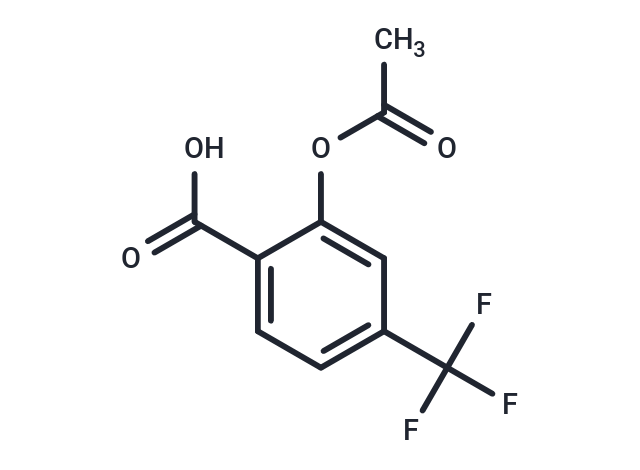

| Pack Size | Price | USA Stock | Global Stock | Quantity |
|---|---|---|---|---|
| 5 mg | $39 | In Stock | In Stock | |
| 10 mg | $52 | In Stock | In Stock | |
| 25 mg | $77 | In Stock | In Stock | |
| 50 mg | $98 | In Stock | In Stock | |
| 100 mg | $135 | In Stock | In Stock | |
| 500 mg | $247 | - | In Stock | |
| 1 mL x 10 mM (in DMSO) | $43 | In Stock | In Stock |
| Description | Triflusal (UR1501) is a 2-acetoxy-4-trifluoromethylbenzoic acid and it is an aspirin chemically-related molecule but not a derivative. |
| Targets & IC50 | COX-2:160 μM (IC50, in human blood), COX-2:280 μM (IC50) |
| In vitro | The main Triflusal metabolite, HTB, preserves 6-keto-PGF1α synthesis in porcine aortic endothelial cells (PAEC) cells without a significant decline for up to 24 h even at the higher concentration. [1] Triflusal at 10 mM, 100 mM and 1 M decreases LDH efflux in rat brain slices after anoxia/reoxygenation by 24%, 35% and 49% respectively. Triflusal also reduces inducible NO synthase activity by 18%, 21% and 30%. [2] |
| In vivo | Triflusal (10 mg/kg i.v.) reduces platelet deposition on subendothelium-induced primary thrombus by about 68% in rabbits. Triflusal (10 mg/kg i.v.) reduces platelet deposition on a fresh thrombus formed over tunica media by about 48% in rabbits. Triflusal (40 mg/kg p.o.) reduces platelet deposition on a primary thrombus triggered by subendothelium and tunica media by 53% in rabbits. Triflusal (40 mg/kg p.o.) significantly reduces Cox-2 mRNA levels and protein levels without influence Cox-1 mRNA levels on the vascular wall in rabbits. [1] Triflusal (600 mg/day for 5 days) results in an increase in NO production by neutrophils and an increase in endothelial nitric oxide synthase (eNOS) protein expression in neutrophils in healthy volunteers. [3] Triflusal (300 mg, twice-daily orally) shows a more important increase in total walking distance and in pain-free walking distance over the basal values than those treated with placebo, together with an improvement of the symptomatology correlated with claudication in patients with chronic peripheral arteriopathy. Triflusal (300 mg, twice-daily orally) shows an increase in the peak-flow recorded through strain-gauge plethysmography in patients with chronic peripheral arteriopathy. [4] Triflusal (30 mg/kg) strongly decreases iNOS immunolabeling at both survival times analyzed, attenuating iNOS immunoreactivity in astroglial cells and infiltrated neutrophils in rats. Triflusal (30 mg/kg) decreases neuronal and microglial COX-2 expression at 10 and 24 hours after lesion and microglial and astroglial expression of IL-1beta and TNF-alpha at 24 hours after lesion in rats. [5] |
| Synonyms | UR1501 |
| Molecular Weight | 248.16 |
| Formula | C10H7F3O4 |
| Cas No. | 322-79-2 |
| Smiles | CC(=O)Oc1cc(ccc1C(O)=O)C(F)(F)F |
| Relative Density. | 1.433 g/cm3 |
| Storage | Powder: -20°C for 3 years | In solvent: -80°C for 1 year Shipping with blue ice/Shipping at ambient temperature. | |||||||||||||||||||||||||||||||||||
| Solubility Information | Ethanol: 47 mg/mL (189.39 mM), Sonication is recommended. H2O: < 1 mg/mL (insoluble or slightly soluble) DMSO: 247.5 mg/mL (997.34 mM), Sonication is recommended.  | |||||||||||||||||||||||||||||||||||
| In Vivo Formulation | 10% DMSO+40% PEG300+5% Tween 80+45% Saline: 2.5 mg/mL (10.07 mM), Sonication is recommended. 10% DMSO+90% Saline: 10 mg/mL (40.3 mM), Solution. Please add the solvents sequentially, clarifying the solution as much as possible before adding the next one. Dissolve by heating and/or sonication if necessary. Working solution is recommended to be prepared and used immediately. The formulation provided above is for reference purposes only. In vivo formulations may vary and should be modified based on specific experimental conditions. | |||||||||||||||||||||||||||||||||||
Solution Preparation Table | ||||||||||||||||||||||||||||||||||||
Ethanol/DMSO
Note : The dilution table applies only to solid products. For liquid products, please calculate the stock solution based on the stated concentration and/or density. | ||||||||||||||||||||||||||||||||||||
 For example, if the intended dosage is 10 mg/kg for animals weighing 20 g , with a dosing volume of 100 μL per animal, and a total of 10 animals are to be administered, using a formulation of
  10% DMSO+ 40% PEG300+ 5% Tween 80+ 45% Saline/PBS/ddH2O , the resulting working solution concentration would be 2 mg/mL.
Dissolve 2 mg of the compound in 100 μL DMSO to obtain a stock solution at a concentration of 20 mg/mL . If the required concentration exceeds the compound's known solubility, please contact us for technical support before proceeding.
1) Add 100 μL of the DMSO stock solution to 400 µL PEG300 and mix thoroughly until the solution becomes clear.
2) Add 50 µL Tween 80 and mix well until fully clarified.
3) Add 450 µL Saline,PBS or ddH2O and mix thoroughly until a homogeneous solution is obtained.
| Size | Quantity | Unit Price | Amount | Operation |
|---|
 Feedback
 Hello! How can I help you today?
Copyright © 2015-2026 TargetMol Chemicals Inc. All Rights Reserved.
