


Shopping Cart
Remove All Your shopping cart is currently empty


Synonyms:

| Pack Size | Price | USA Stock | Global Stock | Quantity |
|---|---|---|---|---|
| 1 mg | $34 | In Stock | In Stock | |
| 2 mg | $48 | In Stock | In Stock | |
| 5 mg | $79 | In Stock | In Stock | |
| 10 mg | $100 | In Stock | In Stock | |
| 25 mg | $178 | In Stock | In Stock | |
| 50 mg | $340 | In Stock | In Stock | |
| 100 mg | $533 | In Stock | In Stock | |
| 1 mL x 10 mM (in DMSO) | $88 | In Stock | In Stock |
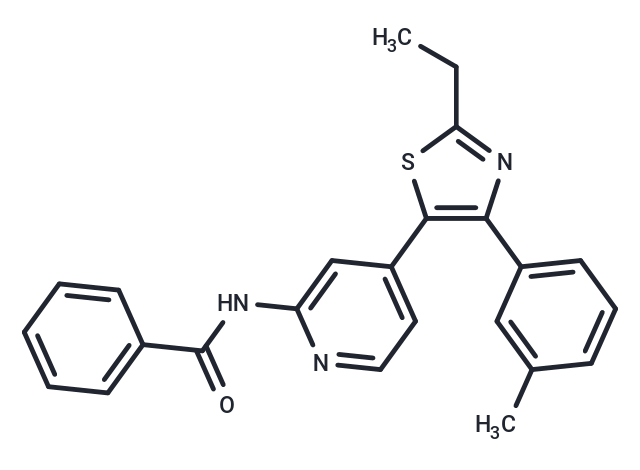
| Description | TAK-715 is a p38 MAPK inhibitor for p38α. |
| Targets & IC50 | p38α:7.1 nM, p38γ:>10 μM, p38δ:>10 μM, p38β:0.20 μM |
| In vitro | TAK 715 inhibits LPS-stimulated release of TNF-alpha from THP-1 with IC50 of 48 nM. [1] TAK 715 (10 μM) inhibits Wnt-3a-induced hDvl2 phosphorylation and the hDvl2 shift in U2OS-EFC cells. [2] The amide NH of TAK 715 is hydrogen bonded to the main-chain carbonyl of Met109 of p38 alpha. TAK 715 binds relatively high in the ATP pocket, occupying the hydrophobic back pocket, the adenine region and the front pocket of p38 as well as extending to most of the length of the Gly-rich loop. [3] |
| In vivo | TAK 715 (10 mg/kg, po) inhibits LPS-induced TNF-alpha production in mice with 87.6% inhibition. TAK 715 has a modest mouse bioavailability of 18.4% and a slightly improved rat bioavailability of 21.1%. TAK 715 has a modest mouse bioavailability of 18.4% and a slightly improved rat bioavailability of 21.1%. TAK 715 results in Cmax of 0.19 μg/mL and AUC(0-24 hours) of 1.16 μg·h/mL in rats. TAK 715 (30 mg/kg, po) significantly reduces the secondary paw volume with 25 % inhibition in a rat adjuvant-induced arthritis (AA) model. [1] |
| Kinase Assay | Assay of PI3K enzyme inhibition: The inhibition of PI3Kβ, PI3Kα, PI3Kγ, and PI3Kδ is evaluated in an AlphaScreen based enzyme activity assay using human recombinant enzymes. The assay measures PI3K-mediated conversion of PIP2 to PIP3. Biotinylated PIP3, a GST-tagged pleckstrin homology (PH) domain and the two AlphaScreen beads form a complex that elicits a signal upon laser excitation at 680 nm. The PIP3 formed in the enzyme reaction competes with the biotinylated PIP3 for binding to the PH domain thus reducing the signal with increasing enzyme product. The AZD6482 is dissolved in DMSO and added to 384 well plates. PBKβ, PBKα, PBKγ, or PBKδ is added in a Tris buffer (50 mM Tris pH 7.6, 0.05% CHAPS, 5 mM DTT, and 24 mM MgCl2) and allowed to preincubate with AZD6482 for 20 minutes prior to the addition of substrate solution containing PIP2 and ATP. The enzyme reaction is stopped after 20 minutes by addition of stop solution containing EDTA and biotin-PIP3, followed by addition of detection solution containing GST-grpl PH and AlphaScreen beads. Plates are left for a minimum of 5 hours in the dark prior to analysis. The final concentration of DMSO, ATP and PIP2 in the assay are, 0.8%, 4 μM, and 40 μM, respectively. IC50 values are calculated according to the equation, y = {a+[(b-a)/(l+(x/IC50)s)]}, where y = % inhibition; a = 0%; b = 100%; s = the slope of the concentration-response curve; x = AZD6482 concentration. |
| Molecular Weight | 399.51 |
| Formula | C24H21N3OS |
| Cas No. | 303162-79-0 |
| Smiles | CCc1nc(c(s1)-c1ccnc(NC(=O)c2ccccc2)c1)-c1cccc(C)c1 |
| Relative Density. | 1.233 g/cm3 |
| Storage | Powder: -20°C for 3 years | In solvent: -80°C for 1 year Shipping with blue ice/Shipping at ambient temperature. | ||||||||||||||||||||||||||||||||||||||||
| Solubility Information | Ethanol: 20 mg/mL (50.06 mM), Sonication is recommended. DMSO: 122.5 mg/mL (306.63 mM), Sonication is recommended.  | ||||||||||||||||||||||||||||||||||||||||
| In Vivo Formulation | 10% DMSO+40% PEG300+5% Tween 80+45% Saline: 10 mg/mL (25.03 mM), Solution. 10% DMSO+90% Saline: < 10 mg/mL (25.03 mM), Lower concentrations may be soluble, but exact solubility limit is unknown. Please add the solvents sequentially, clarifying the solution as much as possible before adding the next one. Dissolve by heating and/or sonication if necessary. Working solution is recommended to be prepared and used immediately. The formulation provided above is for reference purposes only. In vivo formulations may vary and should be modified based on specific experimental conditions. | ||||||||||||||||||||||||||||||||||||||||
Solution Preparation Table | |||||||||||||||||||||||||||||||||||||||||
Ethanol/DMSO
DMSO
Note : The dilution table applies only to solid products. For liquid products, please calculate the stock solution based on the stated concentration and/or density. | |||||||||||||||||||||||||||||||||||||||||
 For example, if the intended dosage is 10 mg/kg for animals weighing 20 g , with a dosing volume of 100 μL per animal, and a total of 10 animals are to be administered, using a formulation of
  10% DMSO+ 40% PEG300+ 5% Tween 80+ 45% Saline/PBS/ddH2O , the resulting working solution concentration would be 2 mg/mL.
Dissolve 2 mg of the compound in 100 μL DMSO to obtain a stock solution at a concentration of 20 mg/mL . If the required concentration exceeds the compound's known solubility, please contact us for technical support before proceeding.
1) Add 100 μL of the DMSO stock solution to 400 µL PEG300 and mix thoroughly until the solution becomes clear.
2) Add 50 µL Tween 80 and mix well until fully clarified.
3) Add 450 µL Saline,PBS or ddH2O and mix thoroughly until a homogeneous solution is obtained.
| Size | Quantity | Unit Price | Amount | Operation |
|---|
 Feedback
 Hello! How can I help you today?
Copyright © 2015-2026 TargetMol Chemicals Inc. All Rights Reserved.
