


Shopping Cart
Remove All Your shopping cart is currently empty

Synonyms: Fujimycin, FR900506, FK506
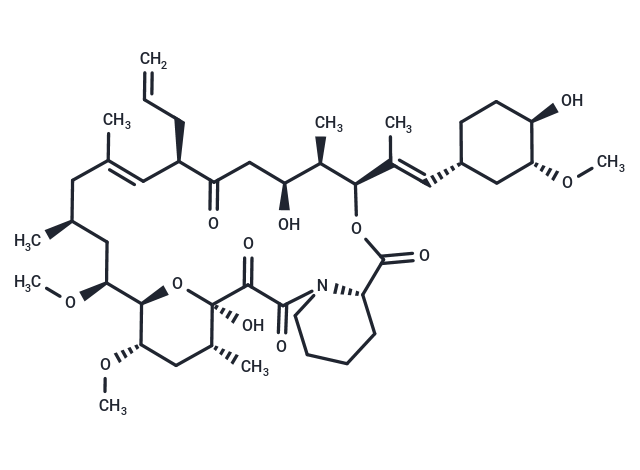
| Pack Size | Price | USA Stock | Global Stock | Quantity |
|---|---|---|---|---|
| 10 mg | $38 | In Stock | In Stock | |
| 25 mg | $55 | In Stock | In Stock | |
| 50 mg | $68 | In Stock | In Stock | |
| 100 mg | $106 | In Stock | In Stock | |
| 200 mg | $150 | In Stock | In Stock | |
| 500 mg | $256 | - | In Stock | |
| 1 mL x 10 mM (in DMSO) | $46 | In Stock | In Stock |
| Description | Tacrolimus (FK506, Fujimycin) is a macrolide immunosuppressant that binds to FKBP12 to form a high-affinity complex (Ki = 0.2 nM), which inhibits calcineurin phosphatase activity, thereby suppressing T lymphocyte signal transduction and the transcription and release of IL-2. It exerts potent immunosuppressive effects and can be used to induce immunosuppression models. |
| Targets & IC50 | Lymphocyte proliferation:0.47 nM, SN-38 glucuronidation (rat liver microsomes):10.33 μM, SN-38 glucuronidation (human liver microsomes):3.58 μM, Number of circulating helper-T cells:6.7 ng/mL, FKBP12:0.2 nM (Kd) |
| In vitro | FKBP12 was first isolated from the cytosol of Jurkat T cells, as an abundant, high-affinity receptor for Tacrolimus (FK506; Kd: 0.2 nM) [1]. FK506 (100?1,000 μg/l) significantly promoted the proliferation of MH3924A cells. The invasiveness of MH3924A cells was significantly enhanced following treatment with FK506 [2]. FK506 specifically inhibits cellular calcineurin at drug concentrations that inhibit interleukin 2 productions in activated T cells [3]. |
| In vivo | The liver of rats of the normal saline (NS) group was large, with an average weight at 15.56±11.17 g, and the liver of rats of the FK506 group was oversize, with an average weight at 28.19±3.89 g. The rate of lymph node metastasis, as well as the number of pulmonary nodules, were significantly increased in the FK506 compared to the NS group [2]. Behavioral pain assessment revealed an increase in the paw and tail withdrawal threshold in tacrolimus-treated groups against hyperalgesic and allodynic stimuli as compared to the sham control group [4]. |
| Synonyms | Fujimycin, FR900506, FK506 |
| Disease Modeling Protocol | Hereditary Peripheral Demyelinating Disease Exacerbation Model
*Precautions: |
| Cell Research | Tumor cell proliferation was determined by the MTT. Briefly, after MH3924A cells had reached the logarithmic growth phase, a 0.2-ml cell suspension at 1×10^4 cells/ml was added into each well of a 96-well plate and cultured in DMEM with 10% FBS, 10 μg/l vascular endothelial growth factor and 0.1 g/l heparin for 24 h. When adherent growth was established, different concentrations of FK506 (10, 100 and 1,000 μg/l), AMD3100 (10, 50 and 100 μg/l) and FK506 (0 and 100 μg/l) + AMD3100 (0, 10, 50 and 100 μg/l) were added into the plates. Untreated cells cultured in medium alone were used as controls. After culturing for 48 h, 10 μl MTT (5 g/l) was added, and each well was incubated for 6 h; next, 150 μl/well dimethyl sulfoxide was added, followed by measurements of the absorbance at 570 mm on a spectrophotometer reader. Each well was measured three times, and each sample was assayed in triplicate [2]. |
| Animal Research | Experiments were performed in 16 healthy August Copenhagen Irish rats (male, 16–20 weeks, weighing 240–300 g). The rat model of liver tumor was established as follows: First, MH3924A cells were collected and injected into the alar skin of rats. The tumors were removed from alar skin when grown to 2×1×1 mm3, and intrahepatic tumor implantation of rats was performed under aseptic conditions as described previously (25,26). Five days later, rats were randomly divided into two groups: one group was subcutaneously injected with normal saline for 14 days (NS group, n=8, 3 mg/kg/day), and the second group was subcutaneously injected with FK506 for 14 days (FK506 group, n=8, 0.3 mg/kg/day). Forty days following implantation, rats were sacrificed, and the weight of tumor, the volume of the fluid in the ascites, the incidence of lymphatic metastasis in the abdominal cavity and of abdominal wall metastasis were measured. In addition, the lungs were irrigated with 15% Indian ink, followed by counting of the number of metastatic nodules in the lung. The tumor and adjacent tissues, as well as healthy liver tissues, were harvested and preserved in 4% formalin for later use [2]. |
| Molecular Weight | 804.02 |
| Formula | C44H69NO12 |
| Cas No. | 104987-11-3 |
| Smiles | CO[C@@H]1C[C@@H](CC[C@H]1O)\C=C(/C)[C@H]1OC(=O)[C@@H]2CCCCN2C(=O)C(=O)[C@]2(O)O[C@@H]([C@H](C[C@H]2C)OC)[C@H](C[C@@H](C)C\C(C)=C\[C@@H](CC=C)C(=O)C[C@H](O)[C@H]1C)OC |
| Relative Density. | 1.19 g/cm3 |
| Storage | Keep away from direct sunlight,Store under nitrogen,Store at low temperature Powder: -20°C for 3 years | In solvent: -80°C for 1 year Shipping with blue ice/Shipping at ambient temperature. | |||||||||||||||||||||||||||||||||||
| Solubility Information | Ethanol: 80.4 mg/mL (100 mM), Sonication is recommended. DMSO: 247.5 mg/mL (307.83 mM), Sonication is recommended.  | |||||||||||||||||||||||||||||||||||
| In Vivo Formulation | 10% DMSO+40% PEG300+5% Tween 80+45% Saline: 8.05 mg/mL (10.01 mM), Solution. Please add the solvents sequentially, clarifying the solution as much as possible before adding the next one. Dissolve by heating and/or sonication if necessary. Working solution is recommended to be prepared and used immediately. The formulation provided above is for reference purposes only. In vivo formulations may vary and should be modified based on specific experimental conditions. | |||||||||||||||||||||||||||||||||||
Solution Preparation Table | ||||||||||||||||||||||||||||||||||||
Ethanol/DMSO
Note : The dilution table applies only to solid products. For liquid products, please calculate the stock solution based on the stated concentration and/or density. | ||||||||||||||||||||||||||||||||||||
 For example, if the intended dosage is 10 mg/kg for animals weighing 20 g , with a dosing volume of 100 μL per animal, and a total of 10 animals are to be administered, using a formulation of
  10% DMSO+ 40% PEG300+ 5% Tween 80+ 45% Saline/PBS/ddH2O , the resulting working solution concentration would be 2 mg/mL.
Dissolve 2 mg of the compound in 100 μL DMSO to obtain a stock solution at a concentration of 20 mg/mL . If the required concentration exceeds the compound's known solubility, please contact us for technical support before proceeding.
1) Add 100 μL of the DMSO stock solution to 400 µL PEG300 and mix thoroughly until the solution becomes clear.
2) Add 50 µL Tween 80 and mix well until fully clarified.
3) Add 450 µL Saline,PBS or ddH2O and mix thoroughly until a homogeneous solution is obtained.
| Size | Quantity | Unit Price | Amount | Operation |
|---|
 Feedback
 Hello! How can I help you today?
Copyright © 2015-2026 TargetMol Chemicals Inc. All Rights Reserved.
