


Shopping Cart
Remove All Your shopping cart is currently empty


Synonyms: AZD0530
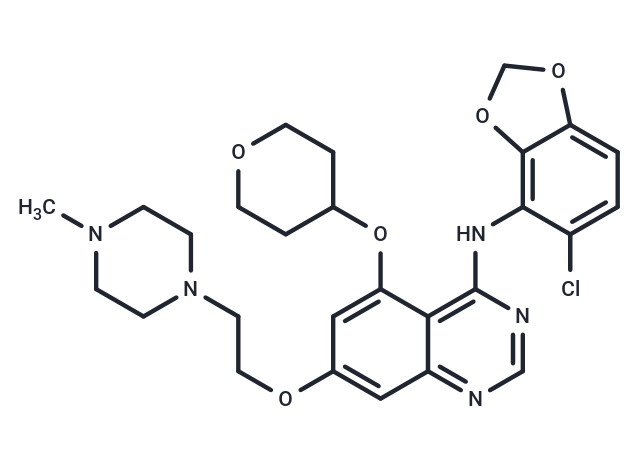
| Pack Size | Price | USA Stock | Global Stock | Quantity |
|---|---|---|---|---|
| 10 mg | $59 | In Stock | - | |
| 25 mg | $97 | In Stock | - | |
| 50 mg | $148 | In Stock | - | |
| 100 mg | $239 | In Stock | - | |
| 1 mL x 10 mM (in DMSO) | $44 | In Stock | In Stock |
| Description | Saracatinib (AZD0530) is a small molecule inhibitor belonging to the Src family kinase inhibitors (IC50=2.7–11 nM), featuring high selectivity, cell permeability, and oral bioavailability, with anti-fibrotic, anti-inflammatory, and potential anti-tumor activities. |
| Targets & IC50 | c-YES:4 nM (cell free), c-Src:2.7 nM (cell free), Lyn:5 nM (cell free), Lck:< 4 nM (cell free), EGFR (L861Q):4 nM (cell free), EGFR (L858R):5 nM (cell free) |
| In vitro | Methods:BRE-Luc reporter gene assays were performed in C2C12 cells to evaluate the inhibitory activity of Saracatinib against caALK2, with an IC50 of 14 nM; in MDA-MB-231 cells, the IC50 of Saracatinib for BMP6-induced BRE-Luc signal inhibition was 8.9 nM. Results: Western blot showed that 100 nM Saracatinib completely inhibited BMP7-induced SMAD1/5 phosphorylation in C2C12 cells; in FOP patient primary fibroblasts, 100 nM Saracatinib effectively inhibited Activin A-induced SMAD1/5 phosphorylation. [1] Methods: In NRK-49F cells, Western blot experiments were performed. Src inhibitor Saracatinib was used for 1-hour pretreatment, followed by Vitronectin stimulation. Results: Saracatinib inhibited Vitronectin-induced Src phosphorylation and downstream fibrosis-related protein expression, confirming that it blocks fibroblast activation by inhibiting Src signaling. [2] |
| In vivo | Methods: In the HCC-1954 breast cancer xenograft nude mouse model, Saracatinib was administered at 25 mg/kg by daily oral gavage, with 0.25% sodium carboxymethyl cellulose as the vehicle, for 28 consecutive days. Results: Saracatinib monotherapy effectively inhibited tumor growth, and the antitumor effect was significantly enhanced when combined with the anti-ErbB2 antibody H2-18, with no obvious toxicity observed. [3] |
| Synonyms | AZD0530 |
| Kinase Assay | Inhibition of tyrosine kinase activity was examined using an ELISA with recombinant catalytic domains of a panel of receptor and non‐receptor tyrosine kinases (in some cases only part of the catalytic domain was used). This method has been described previously. AZD0530 dose ranges varied depending on the activity versus the particular kinase tested, but were typically 0.001–10μM. Specificity assays against a panel of serine/threonine kinases were performed using a filter capture assay with 32P. Briefly, multidrop 384 plates containing 0.5μL AZD0530 or controls (DMSO alone or pH 3.0 buffer controls) were incubated with 15μL of enzyme plus peptide/protein substrate for 5min before the reaction was initiated by the addition of 10μL of 20mM Mg.ATP. For all enzymes the final concentration was approximated to the Michaelis constant (Km). Assays were carried out for 30min at room temperature before termination by the addition of 5μL orthophosphoric acid. After mixing, the well contents were harvested onto a P81 Unifilter plate, using orthophosphoric acid as the wash buffer. Microcal Origin software was used to interpolate IC50 values by nonlinear regression [1]. |
| Cell Research | Cell proliferation was assessed using a colorimetric 5‐bromo‐2′‐deoxyuridine (BrdU) Cell Proliferation ELISA kit, as described previously. Briefly, cells were plated onto 96‐well plates (1.5×10^4 cells/well), the following day 0.039–20μM AZD0530 in DMSO (at a final concentration of 0.5%) was added and the cells were incubated for 24h. The cells were pulse-labeled with BrdU for 2h and fixed. Cellular DNA was then denatured with the provided solution and incubated with anti-BrdU peroxidase for 90min. Following three washes with phosphate‐buffered saline, tetramethylbenzidine substrate solution was added and the plates were incubated on a plate shaker for 10–30min until the positive control absorbance at 690nm was approximately 1.5 absorbance units [1]. |
| Animal Research | Female athymic mice (nu/nu: Alpk) and rats (RH‐rnu/rnu) were housed and maintained as previously described. Src3T3 and human tumor lines (as indicated in Table 3) were inoculated subcutaneously in the left flank of animals. Tumor growth was monitored by bi‐dimensional caliper measurements twice weekly. The tumor volume was calculated by the following formula: (length×width)×√(length×width)×(π/6) and supported by excision and weighing of tumors at the end of the studies. Dosing started when the average tumor volume reached 0.2–0.5cm3 (except MDA‐MB‐231 and HT29). Animals were treated once daily by oral gavage with either vehicle alone or AZD0530 6.25–50mg/kg for 10–91 days. Tumor growth inhibition was calculated as described previously. For pharmacokinetic and pharmacodynamic analysis animals were humanely sacrificed and samples (plasma and tumor) were collected. Tumor samples were homogenized with 5 volumes of water and extracted with chloroform. Plasma and tumor samples were analyzed for AZD0530 concentration using high‐performance liquid chromatography with tandem mass spectrometric detection after solid‐phase extraction [1]. |
| Molecular Weight | 542.03 |
| Formula | C27H32ClN5O5 |
| Cas No. | 379231-04-6 |
| Smiles | CN1CCN(CCOc2cc(OC3CCOCC3)c3c(Nc4c5OCOc5ccc4Cl)ncnc3c2)CC1 |
| Relative Density. | 1.348 g/cm3 |
| Storage | Store at low temperature,Keep away from moisture Powder: -20°C for 3 years | In solvent: -80°C for 1 year Shipping with blue ice/Shipping at ambient temperature. | ||||||||||||||||||||||||||||||||||||||||
| Solubility Information | DMSO: 260 mg/mL (479.68 mM), Sonication is recommended.  Ethanol: 29 mg/mL (53.5 mM), Sonication is recommended. | ||||||||||||||||||||||||||||||||||||||||
| In Vivo Formulation | 10% DMSO+40% PEG300+5% Tween 80+45% Saline: 5 mg/mL (9.22 mM), Sonication is recommended. Please add the solvents sequentially, clarifying the solution as much as possible before adding the next one. Dissolve by heating and/or sonication if necessary. Working solution is recommended to be prepared and used immediately. The formulation provided above is for reference purposes only. In vivo formulations may vary and should be modified based on specific experimental conditions. | ||||||||||||||||||||||||||||||||||||||||
Solution Preparation Table | |||||||||||||||||||||||||||||||||||||||||
Ethanol/DMSO
DMSO
Note : The dilution table applies only to solid products. For liquid products, please calculate the stock solution based on the stated concentration and/or density. | |||||||||||||||||||||||||||||||||||||||||
 For example, if the intended dosage is 10 mg/kg for animals weighing 20 g , with a dosing volume of 100 μL per animal, and a total of 10 animals are to be administered, using a formulation of
  10% DMSO+ 40% PEG300+ 5% Tween 80+ 45% Saline/PBS/ddH2O , the resulting working solution concentration would be 2 mg/mL.
Dissolve 2 mg of the compound in 100 μL DMSO to obtain a stock solution at a concentration of 20 mg/mL . If the required concentration exceeds the compound's known solubility, please contact us for technical support before proceeding.
1) Add 100 μL of the DMSO stock solution to 400 µL PEG300 and mix thoroughly until the solution becomes clear.
2) Add 50 µL Tween 80 and mix well until fully clarified.
3) Add 450 µL Saline,PBS or ddH2O and mix thoroughly until a homogeneous solution is obtained.
| Size | Quantity | Unit Price | Amount | Operation |
|---|
 Feedback
 Hello! How can I help you today?
Copyright © 2015-2026 TargetMol Chemicals Inc. All Rights Reserved.
