


Shopping Cart
Remove All Your shopping cart is currently empty


Synonyms: Quinine HCl Dihydrate
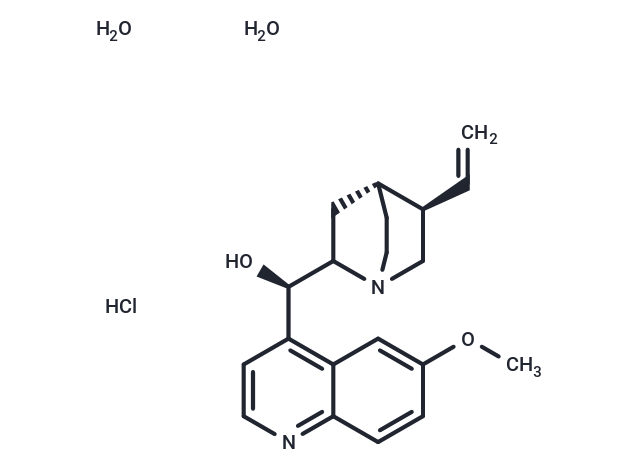
| Pack Size | Price | USA Stock | Global Stock | Quantity |
|---|---|---|---|---|
| 1 g | $29 | In Stock | In Stock | |
| 1 mL x 10 mM (in DMSO) | $29 | In Stock | In Stock |
| Description | Quinine hydrochloride dihydrate (Quinine HCl Dihydrate) is a white crystalline K+ channel blocker, used to treat malaria. |
| In vitro | Quinine blocks Cx36 and Cx50 junctional currents in a reversible and concentration-dependent manner with half maximal blocking concentrations of 32 mM and 73 mM, respectively. Quinine induces slow transitions between open and fully closed states that decreased open probability of the channel. Quinine thus offers a potentially useful method to block certain types of gap junction channels, including those between neurons that are formed by Cx36. [1] Quinine, a K+ channel blocker, prevents formation of tumor necrosis factor (TNF) as well as the subsequent hepatic DNA fragmentation and liver enzyme leakage. [2] Quinine elicits Fos-like immunoreactivity (FLI) concentrated in the medial third of the nucleus; acid elicited more broadly distributed FLI concentrated farther laterally. [3] Quinine has a relatively weak effect on doxorubicin accumulation but was able to completely restore doxorubicin sensitivity in the resistant cells. Quinine also modifies the intracellular tolerance to doxorubicin, which suggests that it is able to modify drug distribution within the cells. [4] Quinine primarily blocks the whole cell potassium currents (IK) in a voltage-dependent manner. Quinine also reduces the size of sodium currents (INa) in a use-dependent manner, while leaving calcium currents (ICa) relatively unaffected. [5] |
| Synonyms | Quinine HCl Dihydrate |
| Molecular Weight | 396.91 |
| Formula | C20H24N2O2·HCl·2H2O |
| Cas No. | 6119-47-7 |
| Smiles | O.O.Cl.COc1ccc2nccc([C@@H](O)C3C[C@H]4CCN3C[C@@H]4C=C)c2c1 |
| Relative Density. | no data available |
| Storage | Powder: -20°C for 3 years | In solvent: -80°C for 1 year Shipping with blue ice/Shipping at ambient temperature. | |||||||||||||||||||||||||||||||||||
| Solubility Information | DMSO: 50 mg/mL (125.97 mM), Sonication is recommended.  Ethanol: 79 mg/mL (199.04 mM), Sonication is recommended. H2O: 43 mg/mL (108.34 mM), Sonication is recommended. | |||||||||||||||||||||||||||||||||||
Solution Preparation Table | ||||||||||||||||||||||||||||||||||||
H2O/DMSO/Ethanol
Note : The dilution table applies only to solid products. For liquid products, please calculate the stock solution based on the stated concentration and/or density. | ||||||||||||||||||||||||||||||||||||
 For example, if the intended dosage is 10 mg/kg for animals weighing 20 g , with a dosing volume of 100 μL per animal, and a total of 10 animals are to be administered, using a formulation of
  10% DMSO+ 40% PEG300+ 5% Tween 80+ 45% Saline/PBS/ddH2O , the resulting working solution concentration would be 2 mg/mL.
Dissolve 2 mg of the compound in 100 μL DMSO to obtain a stock solution at a concentration of 20 mg/mL . If the required concentration exceeds the compound's known solubility, please contact us for technical support before proceeding.
1) Add 100 μL of the DMSO stock solution to 400 µL PEG300 and mix thoroughly until the solution becomes clear.
2) Add 50 µL Tween 80 and mix well until fully clarified.
3) Add 450 µL Saline,PBS or ddH2O and mix thoroughly until a homogeneous solution is obtained.
| Size | Quantity | Unit Price | Amount | Operation |
|---|
 Feedback
 Hello! How can I help you today?
Copyright © 2015-2026 TargetMol Chemicals Inc. All Rights Reserved.
