


Shopping Cart
Remove All Your shopping cart is currently empty

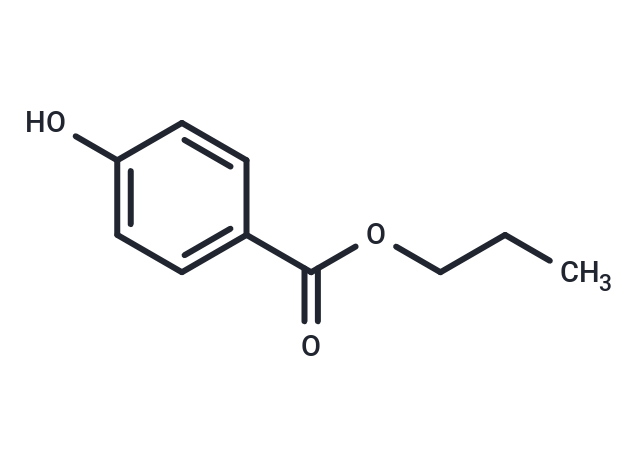
Synonyms: Propyl parahydroxybenzoate, Propyl 4-hydroxybenzoate
| Pack Size | Price | USA Stock | Global Stock | Quantity |
|---|---|---|---|---|
| 5 g | $29 | - | In Stock | |
| 10 g | $38 | - | In Stock | |
| 1 mL x 10 mM (in DMSO) | $29 | In Stock | In Stock |
| Description | Propylparaben (Propyl parahydroxybenzoate) is an antimicrobial agent, preservative, and flavoring agent. |
| In vitro | Propylparaben(PPB) suppressed the epileptiform activity in registered neurons.?This effect disappeared when PPB was removed from the solution of incubation.?PPB exerts an antiepileptic effect on CA1 pyramidal neurons in vitro.?Therefore, PPB may represent an effective antiepileptic compound[1]. propylparaben disrupts antral follicle growth and steroidogenic function by altering the cell-cycle, apoptosis, and steroidogenesis pathways[1]. |
| Synonyms | Propyl parahydroxybenzoate, Propyl 4-hydroxybenzoate |
| Cell Research | Experimental conditions were as follows: a) basal recordings during which artificial cerebrospinal fluid (ACSF) (in mM: NaCl,125; KCl, 3; Na2HPO4, 1.25; NaHCO3, 25; MgCl2, 2; CaCl2, 2-D-(+)-glucose, 10; gassed with a mixture of 95% O2–5% CO2) was perfused; b) ACSF plus Propylparaben(PPB) (500 μM); c) 4-AP (100 μM) in Mg2+free-ACSF; d) 4-AP in Mg2+free-ACSF plus vehicle (dimethyl sulfoxide, DMSO at 0.04%); e) 4-AP in Mg2+free-ACSF plus drugs (phenytoin (PHT), 200 μM; PPB, 200 and 7500 μM). Each experimental condition lasted for 10 min. The onset of 4-AP-induced epileptiform activity was considered when bursts of 5 of more consecutive action potentials (APs) were present. The number of APs and excitatory postsynaptic potentials (EPSPs) greater than 1 mV and less than 10 mV of amplitude were quantified during periods of 5 min for each experimental condition[2] |
| Molecular Weight | 180.20 |
| Formula | C10H12O3 |
| Cas No. | 94-13-3 |
| Smiles | C(OCCC)(=O)C1=CC=C(O)C=C1 |
| Relative Density. | 1.287 g/cm3. Temperature:20 °C. |
| Storage | Powder: -20°C for 3 years | In solvent: -80°C for 1 year Shipping with blue ice/Shipping at ambient temperature. | |||||||||||||||||||||||||||||||||||
| Solubility Information | DMSO: 60 mg/mL (332.96 mM), Sonication is recommended.  | |||||||||||||||||||||||||||||||||||
| In Vivo Formulation | 10% DMSO+40% PEG300+5% Tween 80+45% Saline: 2 mg/mL (11.1 mM), Sonication is recommended. Please add the solvents sequentially, clarifying the solution as much as possible before adding the next one. Dissolve by heating and/or sonication if necessary. Working solution is recommended to be prepared and used immediately. The formulation provided above is for reference purposes only. In vivo formulations may vary and should be modified based on specific experimental conditions. | |||||||||||||||||||||||||||||||||||
Solution Preparation Table | ||||||||||||||||||||||||||||||||||||
DMSO
Note : The dilution table applies only to solid products. For liquid products, please calculate the stock solution based on the stated concentration and/or density. | ||||||||||||||||||||||||||||||||||||
 For example, if the intended dosage is 10 mg/kg for animals weighing 20 g , with a dosing volume of 100 μL per animal, and a total of 10 animals are to be administered, using a formulation of
  10% DMSO+ 40% PEG300+ 5% Tween 80+ 45% Saline/PBS/ddH2O , the resulting working solution concentration would be 2 mg/mL.
Dissolve 2 mg of the compound in 100 μL DMSO to obtain a stock solution at a concentration of 20 mg/mL . If the required concentration exceeds the compound's known solubility, please contact us for technical support before proceeding.
1) Add 100 μL of the DMSO stock solution to 400 µL PEG300 and mix thoroughly until the solution becomes clear.
2) Add 50 µL Tween 80 and mix well until fully clarified.
3) Add 450 µL Saline,PBS or ddH2O and mix thoroughly until a homogeneous solution is obtained.
| Size | Quantity | Unit Price | Amount | Operation |
|---|
 Feedback
 Hello! How can I help you today?
Copyright © 2015-2026 TargetMol Chemicals Inc. All Rights Reserved.
