


Shopping Cart
Remove All Your shopping cart is currently empty

Synonyms: PIK 93
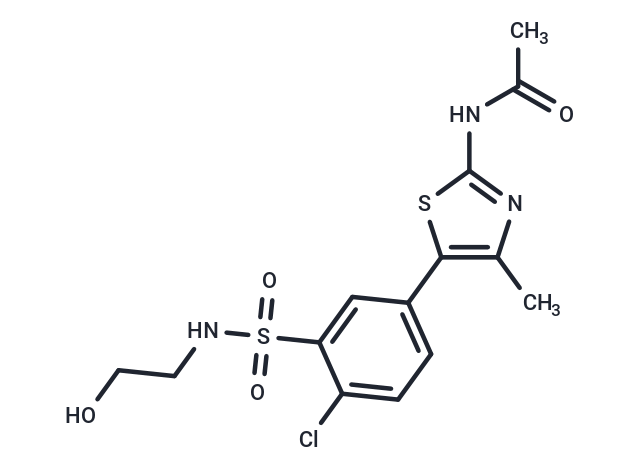

| Pack Size | Price | USA Stock | Global Stock | Quantity |
|---|---|---|---|---|
| 1 mg | $37 | In Stock | In Stock | |
| 5 mg | $82 | In Stock | In Stock | |
| 10 mg | $113 | In Stock | In Stock | |
| 25 mg | $222 | In Stock | In Stock | |
| 50 mg | $339 | In Stock | In Stock | |
| 100 mg | $475 | In Stock | In Stock | |
| 200 mg | $682 | - | In Stock | |
| 1 mL x 10 mM (in DMSO) | $90 | In Stock | In Stock |
| Description | PIK-93, the first potent synthetic PI4K inhibitor, exhibits an IC50 of 19 nM and also inhibits PI3Kα with an IC50 of 39 nM. |
| Targets & IC50 | ATM:490 nM, hsVPS34:320 nM, PI4K:19 nM, p110β:590 nM, PI3KC2β:140 nM, PI4KIIIα:1.1 μM, p110γ:16 nM, ATR:17 μM, DNA-PK:64 nM, PI3Kα:39 nM, mTORC1:1.38 μM, p110δ:120 nM, PI3KC2α:16 μM |
| In vivo | At concentrations ranging from 0.5 μM to 1 μM, PIK-93 impairs the stability of aggregates formed in differentiated HL60 cells treated with f-Met-Leu-Phe. In COS-7 cells, 250 nM of PIK-93 effectively eliminates the accumulation of the CERT-PH domain and FL-Cer in the Golgi apparatus. Additionally, in T6.11 cells, 300 nM of PIK-93 reduces Carbachol-induced translocation of TRPC6 to the plasma membrane and subsequent Ca2+ entry. The same concentration of PIK-93 also significantly inhibits the conversion of [3H]-labeled serine to endogenous sphingomyelin, indicating the critical role of PI4KIIIβ in the endoplasmic reticulum and Golgi apparatus for ceramide transfer and sphingomyelin synthesis regulation. Research demonstrates that PIK-93 possesses antiviral capabilities, inhibiting replication of the poliovirus and hepatitis C virus with EC50 values of 0.14 μM and 1.9 μM, respectively. PIK-93 effectively inhibits PI3Kγ and PI4KIIIβ, with IC50 values of 16 nM and 19 nM, respectively, and other PI3K members, including PI3Kα, β, and δ, with IC50 values of 39 nM, 0.59 μM, and 0.12 μM, while showing negligible inhibition effects on other kinases at concentrations up to 10 μM. |
| Synonyms | PIK 93 |
| Kinase Assay | Assay of PI3Ks: IC50 values are measured using a standard TLC assay for lipid kinase activity. Kinase reactions are performed by preparing areaction mixture containing kinase, PIK-93 (2% DMSO final concentration), buffer (25 mM HEPES, pH 7.4, 10 mM MgCl2), and freshly sonicated phosphatidylinositol (100 μg/ml). Reactions are initiated by the addition of ATP containing 10 μCi of γ-32P-ATP to a final concentration 10 or 100 μM, and allowed to proceed for 20 min at room temperature. For TLC analysis, reactions are then terminated by the addition of 105 μL 1N HCl followed by 160 μL CHCl3:MeOH (1:1). The biphasic mixture is vortexed, briefly centrifuged, and the organic phase transferred to a new tube using a gel loading pipette tip precoated with CHCl3. This extract is spotted on TLC plates and developed for 3 hours–4 hours in a 65:35 solution of n-propanol:1M acetic acid. The TLC plates are then dried, exposed to a phosphorimager screen, and quantitated. Kinase activity is typically measured at 10–12 concentrations of PIK-93 representing two-fold dilutions from the highest concentration of 100 μM. |
| Cell Research | For actin staining, dHL60 cells are preincubated in suspension with PIK-93 or vehicle for 40 min, centrifuged for 5 min at 2000 rpm at room temperature in a J6-B centrifuge, resuspended in mHBSS containing the respective agent at the same concentration, allowed to stick to fibronectin-covered coverslips, and subjected to stimulation with a uniform concentration of 100 nM f-Met-Leu-Phe (fMLP) for 3 min. Cellsare fixed in 3.7% PFA and stained with 10 units/mL rhodamine-phalloidin for 15 min.(Only for Reference) |
| Molecular Weight | 389.88 |
| Formula | C14H16ClN3O4S2 |
| Cas No. | 593960-11-3 |
| Smiles | CC(=O)Nc1nc(C)c(s1)-c1ccc(Cl)c(c1)S(=O)(=O)NCCO |
| Relative Density. | 1.48 g/cm3 |
| Storage | Powder: -20°C for 3 years | In solvent: -80°C for 1 year Shipping with blue ice/Shipping at ambient temperature. | |||||||||||||||||||||||||||||||||||
| Solubility Information | DMSO: 39 mg/mL (100.03 mM), Sonication is recommended. | |||||||||||||||||||||||||||||||||||
| In Vivo Formulation | 10% DMSO+40% PEG300+5% Tween 80+45% Saline: 4 mg/mL (10.26 mM), Sonication is recommended. Please add the solvents sequentially, clarifying the solution as much as possible before adding the next one. Dissolve by heating and/or sonication if necessary. Working solution is recommended to be prepared and used immediately. The formulation provided above is for reference purposes only. In vivo formulations may vary and should be modified based on specific experimental conditions. | |||||||||||||||||||||||||||||||||||
Solution Preparation Table | ||||||||||||||||||||||||||||||||||||
DMSO
Note : The dilution table applies only to solid products. For liquid products, please calculate the stock solution based on the stated concentration and/or density. | ||||||||||||||||||||||||||||||||||||
 For example, if the intended dosage is 10 mg/kg for animals weighing 20 g , with a dosing volume of 100 μL per animal, and a total of 10 animals are to be administered, using a formulation of
  10% DMSO+ 40% PEG300+ 5% Tween 80+ 45% Saline/PBS/ddH2O , the resulting working solution concentration would be 2 mg/mL.
Dissolve 2 mg of the compound in 100 μL DMSO to obtain a stock solution at a concentration of 20 mg/mL . If the required concentration exceeds the compound's known solubility, please contact us for technical support before proceeding.
1) Add 100 μL of the DMSO stock solution to 400 µL PEG300 and mix thoroughly until the solution becomes clear.
2) Add 50 µL Tween 80 and mix well until fully clarified.
3) Add 450 µL Saline,PBS or ddH2O and mix thoroughly until a homogeneous solution is obtained.
| Size | Quantity | Unit Price | Amount | Operation |
|---|
 Feedback
 Hello! How can I help you today?
Copyright © 2015-2026 TargetMol Chemicals Inc. All Rights Reserved.
