


Shopping Cart
Remove All Your shopping cart is currently empty

Synonyms:
| Pack Size | Price | USA Stock | Global Stock | Quantity |
|---|---|---|---|---|
| 1 mg | $81 | - | In Stock |
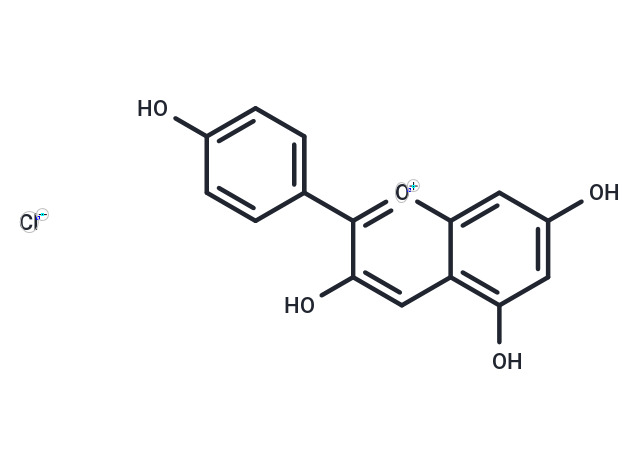
| Description | Pelargonidin chloride shows protective effect against CTN-induced oxidative stress in HepG2 cells and up-regulated the activity of detoxification enzyme levels through Keap1/Nrf2 signaling pathway. |
| In vitro | The effect of PC in ameliorating citrinin (CTN) induced cytotoxicity and oxidative stress. The cytotoxicity of CTN was evaluated by treating HepG2 (Human hepatocellular carcinoma) cells with CTN (0-150 μM) in a dose dependent manner for 24 h, and the IC50 was determined to be 96.16 μM. CTN increased lactate dehydrogenase leakage (59%), elevated reactive oxygen species (2.5-fold), depolarized mitochondrial membrane potential as confirmed by JC-1 monomers and arrested cell cycle at G2/M phase. Further, apoptotic and necrotic analysis revealed significant changes followed by DNA damage. To overcome these toxicological effects, PC was pretreated for 2 h followed by CTN exposure for 24 h. Pretreatment with PC resulted in significant increase in cell viability (84.5%), restored membrane integrity, reactive oxygen species level were maintained and cell cycle phases were normal. PC significantly up-regulated the activity of detoxification enzymes: heme oxygenase 1 (HO-1), glutathione transferase, glutathione peroxidase, superoxide dismutase and quinone reductase. Nrf2 translocation into the nucleus was also observed by immunocytochemistry analysis[1] |
| Molecular Weight | 306.70 |
| Formula | C15H11ClO5 |
| Cas No. | 134-04-3 |
| Smiles | [Cl-].Oc1ccc(cc1)-c1[o+]c2cc(O)cc(O)c2cc1O |
| Relative Density. | 1.3164 g/cm3 (Estimated) |
| Storage | Store at low temperature,Keep away from direct sunlight Powder: -20°C for 3 years | In solvent: -80°C for 1 year Shipping with blue ice/Shipping at ambient temperature. | ||||||||||||||||||||
| Solubility Information | DMSO: 10 mM, Sonication is recommended. | ||||||||||||||||||||
Solution Preparation Table | |||||||||||||||||||||
DMSO
Note : The dilution table applies only to solid products. For liquid products, please calculate the stock solution based on the stated concentration and/or density. | |||||||||||||||||||||
 For example, if the intended dosage is 10 mg/kg for animals weighing 20 g , with a dosing volume of 100 μL per animal, and a total of 10 animals are to be administered, using a formulation of
  10% DMSO+ 40% PEG300+ 5% Tween 80+ 45% Saline/PBS/ddH2O , the resulting working solution concentration would be 2 mg/mL.
Dissolve 2 mg of the compound in 100 μL DMSO to obtain a stock solution at a concentration of 20 mg/mL . If the required concentration exceeds the compound's known solubility, please contact us for technical support before proceeding.
1) Add 100 μL of the DMSO stock solution to 400 µL PEG300 and mix thoroughly until the solution becomes clear.
2) Add 50 µL Tween 80 and mix well until fully clarified.
3) Add 450 µL Saline,PBS or ddH2O and mix thoroughly until a homogeneous solution is obtained.
| Size | Quantity | Unit Price | Amount | Operation |
|---|
 Feedback
 Hello! How can I help you today?
Copyright © 2015-2026 TargetMol Chemicals Inc. All Rights Reserved.
