Shopping Cart
Remove All
  • TargetMol
    Your shopping cart is currently empty

Mepacrine

Copy Product Info
😃Good
Catalog No. T24449Cas No. 83-89-6
Alias Haffkinine, Erion

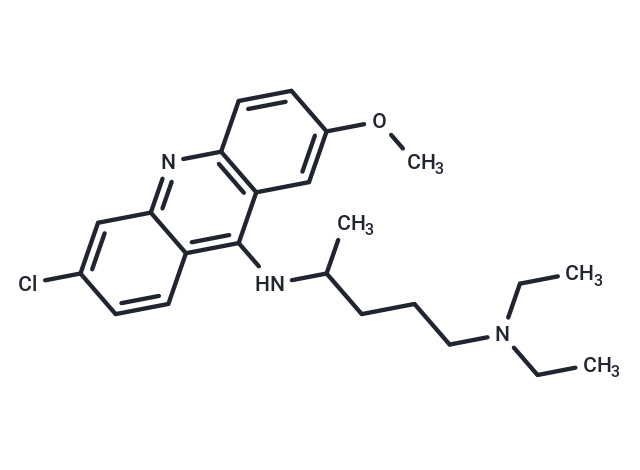
Mepacrine (Erion) is an acridine derivative formerly widely used as an antimalarial. It is used in cell biological experiments as an inhibitor of phospholipase A2.

Mepacrine

Mepacrine

Copy Product Info
😃Good
Purity: 98.78%
Catalog No. T24449Alias Haffkinine, ErionCas No. 83-89-6
Mepacrine (Erion) is an acridine derivative formerly widely used as an antimalarial. It is used in cell biological experiments as an inhibitor of phospholipase A2.
Pack SizePriceUSA WarehouseGlobal WarehouseQuantity
5 mg$30In StockIn Stock
10 mg$51In StockIn Stock
25 mg$103In StockIn Stock
50 mg$169-In Stock
100 mg$272-In Stock
200 mg$396-In Stock
1 mL x 10 mM (in DMSO)$31-In Stock
Add to Cart
Add to Quotation
In Stock Estimated shipping dateUSA Warehouse[1-2 days] Global Warehouse[5-7 days]
This molecule is a custom-made product. TargetMol has an excellent synthesis team with the experience and capability to provide you with cost-effective products.If you have any questions, please feel free to contact us. We are committed to serving you wholeheartedly.
All TargetMol products are for research purposes only and cannot be used for human consumption. We do not provide products or services to individuals. Please comply with the intended use and do not use TargetMol products for any other purpose.
Questions
TargetMol
View More

Batch Information

Select Batch
Purity:98.78%
Appearance:Oil
Color:Yellow
Contact us for more batch information

Resource Download

Product Introduction

Mepacrine AI Summary
Mepacrine demonstrates a wide range of bioactivities, indicative of its diverse interactions and pharmacological potential. It has a volume of distribution (Vdss) in humans of 223.0 L.kg-1 and a low unbound fraction in plasma (Fu = 0.103) and tissues (Fu = 0.0002), suggesting limited protein binding. Its lipophilicity is indicated by an HPLC capacity factor (eLog D) of 1.1. The compound's ionization constant (pKa) is 10.2, and the fraction ionized at pH 7.4 is 1.664, which may influence solubility and bioavailability. In terms of bioactivities, Mepacrine exhibits inhibitory effects against various cellular targets and enzymes: - Inhibits mast cell degranulation (IC50 for histamine and beta-glucuronidase release), - Inhibits colony formation in human colon carcinoma HT-29 cells (IC50 = 55,000 nM), - Inhibits the binding of [3H]BTX-B to sodium channels (IC50 = 3300 nM, 73.3% inhibition at 10 uM), - Inhibits trypanothione reductase (Ki = 19,000 nM) and human glutathione reductase, - Demonstrates antiprion activity in ScN2a cells (EC50 = 300-500 nM), - Inhibits the mTORC1 signaling pathway, telomerase activity, multiple enzymes tied to inflammation (phospholipase-A2, 5-lipoxygenase, prostaglandin synthetase), - Displays antimalarial activity against Plasmodium falciparum strains (low EC50 nM values), and - Shows antiviral activity against SARS-CoV-2 and other viruses, with variable IC50 and CC50 values. Additionally, it has demonstrated cytotoxicity across multiple cell lines, such as HepG2, CRL8155, MCF7, and U2OS cells. Its inhibitory effects extend to several receptors (e.g., serotonin 5-HT2A, dopamine D3, androgen receptor) and enzymes (e.g., trypanothione reductase, acetylcholinesterase, secretory phospholipase A2). Mepacrine also exhibits binding affinity to human serum albumin and antimicrobial properties against various pathogens. However, it shows in vitro signs of potential hepatotoxicity and general cytotoxicity which necessitates a cautious approach in therapeutic development..
Note: Summary generated by AI. Data source: ChEMBL
Bioactivity
Description
Mepacrine (Erion) is an acridine derivative formerly widely used as an antimalarial. It is used in cell biological experiments as an inhibitor of phospholipase A2.
SynonymsHaffkinine, Erion
Chemical Properties
Molecular Weight399.96
FormulaC23H30ClN3O
Cas No.83-89-6
SmilesN(C(CCCN(CC)CC)C)C=1C2=C(N=C3C1C=CC(Cl)=C3)C=CC(OC)=C2
Relative Density.1.0989 g/cm3 (Estimated)
Storage & Solubility Information
StoragePowder: -20°C for 3 years | In solvent: -80°C for 1 year | Shipping with blue ice/Shipping at ambient temperature.
Solubility Information
DMSO: 60 mg/mL (150.02 mM), Sonication is recommended.

In Vivo Formulation
10% DMSO+40% PEG300+5% Tween 80+45% Saline: 5 mg/mL (12.5 mM), Sonication is recommended.
Please add the solvents sequentially, clarifying the solution as much as possible before adding the next one. Dissolve by heating and/or sonication if necessary. Working solution is recommended to be prepared and used immediately. The formulation provided above is for reference purposes only. In vivo formulations may vary and should be modified based on specific experimental conditions.
Solution Preparation Table
DMSO
1mg5mg10mg50mg
1 mM2.5003 mL12.5013 mL25.0025 mL125.0125 mL
5 mM0.5001 mL2.5003 mL5.0005 mL25.0025 mL
10 mM0.2500 mL1.2501 mL2.5003 mL12.5013 mL
20 mM0.1250 mL0.6251 mL1.2501 mL6.2506 mL
50 mM0.0500 mL0.2500 mL0.5001 mL2.5003 mL
100 mM0.0250 mL0.1250 mL0.2500 mL1.2501 mL

Calculator

  • Molarity Calculator
  • Dilution Calculator
  • Reconstitution Calculator
  • Molecular Weight Calculator

In Vivo Formulation Calculator (Clear solution)

Please enter your animal experiment information in the following box and click Calculate to obtain the stock solution preparation method and in vivo formula preparation method:
TargetMol | Animal experiments For example, if the intended dosage is 10 mg/kg for animals weighing 20 g , with a dosing volume of 100 μL per animal, TargetMol | Animal experiments and a total of 10 animals are to be administered, using a formulation of TargetMol | reagent 10% DMSO+ 40% PEG300+ 5% Tween 80+ 45% Saline/PBS/ddH2O , the resulting working solution concentration would be 2 mg/mL.

Stock Solution Preparation:

Dissolve 2 mg of the compound in 100 μL DMSOTargetMol | reagent to obtain a stock solution at a concentration of 20 mg/mL . If the required concentration exceeds the compound's known solubility, please contact us for technical support before proceeding.

Preparation of the In Vivo Formulation:

1) Add 100 μL of the DMSOTargetMol | reagent stock solution to 400 μL PEG300TargetMol | reagent and mix thoroughly until the solution becomes clear.

2) Add 50 μL Tween 80 and mix well until fully clarified.

3) Add 450 μL Saline,PBS or ddH2OTargetMol | reagent and mix thoroughly until a homogeneous solution is obtained.

This example is provided solely to demonstrate the use of the In Vivo Formulation Calculator and does not constitute a recommended formulation for any specific compound. Please select an appropriate dissolution and formulation strategy based on your experimental model and route of administration.
All co-solvents required for this protocol, includingDMSO, PEG300/PEG400, Tween 80, SBE-β-CD, and Corn oil, are available for purchase on the TargetMol website.
1 Enter information below:
mg/kg
g
μL
2 Enter the in vivo formulation:
% DMSO
%
% Tween 80
% Saline/PBS/ddH2O

Dose Conversion

You can also refer to dose conversion for different animals. More Dose Conversion

Tech Support

Please see Inhibitor Handling Instructions for more frequently ask questions. Topics include: how to prepare stock solutions, how to store products, and cautions on cell-based assays & animal experiments, etc

Keywords

Related Tags: buy Mepacrine | purchase Mepacrine | Mepacrine cost | order Mepacrine | Mepacrine chemical structure | Mepacrine formula | Mepacrine molecular weight