


Shopping Cart
Remove All Your shopping cart is currently empty


Synonyms: CDZ173
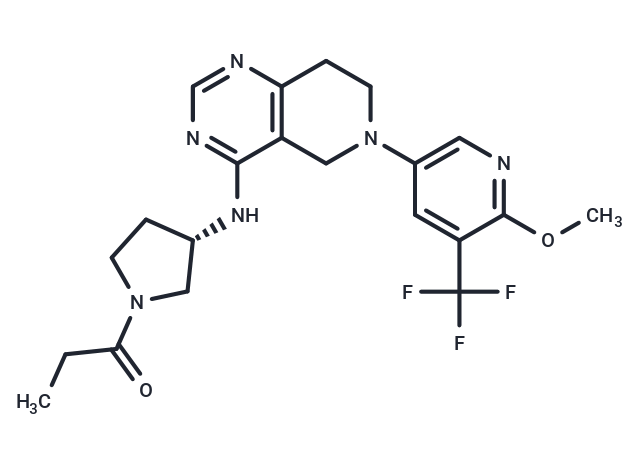
| Pack Size | Price | USA Stock | Global Stock | Quantity |
|---|---|---|---|---|
| 1 mg | $72 | In Stock | In Stock | |
| 5 mg | $156 | In Stock | In Stock | |
| 10 mg | $235 | In Stock | In Stock | |
| 25 mg | $442 | In Stock | In Stock | |
| 50 mg | $687 | In Stock | In Stock | |
| 100 mg | $993 | In Stock | In Stock | |
| 1 mL x 10 mM (in DMSO) | $168 | In Stock | In Stock |
| Description | Leniolisib (CDZ173) (CDZ173) is a potent and selective PI3Kδ inhibitor (IC50: 11 nM). |
| Targets & IC50 | PI3Kδ:11 nM (cell free), PI3Kβ:480 nM (cell free), PI3Kγ:2.57 μM, PI3Kα:280 nM (cell free), DNA-PK:880 nM (cell free) |
| In vitro | Leniolisib (CDZ173) inhibits a large spectrum of immune cell functions, as demonstrated in B and T cells, neutrophils, monocytes, basophils, plasmocytoid dendritic cells, and mast cells [1]. Treatment with CDZ173 caused dose-dependent suppression of PI3Kδ pathway hyperactivation (measured as phosphorylation of AKT/S6) in cell lines ectopically expressing APDS-causative p110δ variants and in T-cell blasts derived from patients [2]. |
| In vivo | In vivo, CDZ173 inhibits B cell activation in rats and monkeys in a concentration- and time-dependent manner. After prophylactic or therapeutic dosing, CDZ173 potently inhibited antigen-specific antibody production and reduced disease symptoms in a rat collagen-induced arthritis model [1]. Oral leniolisib led to a dose-dependent reduction in PI3K/AKT pathway activity assessed ex vivo and improved immune dysregulation. After 12 weeks of treatment, all patients showed amelioration of lymphoproliferation with lymph node sizes and spleen volumes reduced by 39% and 40%, respectively [2]. |
| Synonyms | CDZ173 |
| Cell Research | Studies in transfected Rat-1 fibroblasts and in primary immune cells isolated from patients with APDS were done to assess the in vitro potency of leniolisib on endogenously activated PI3Kδ. PIK3CD mutants encoding published forms of p110δ variants were generated by site-directed mutagenesis using human PIK3CD complementary DNA and transiently transfected in mammalian Rat-1 fibroblasts. The effects of leniolisib and mTOR inhibition on endogenous PI3K/AKT pathway activity in the transfectants were evaluated by measuring phosphorylated AKT (pAKT; S473) using homogeneous time-resolved fluorescence. T-cell blasts from healthy donors as well as APDS patients were generated from isolated T cells by stimulation with anti-CD3 and anti-CD28 antibodies for 3 days. Cells were then incubated with titrated amounts of leniolisib, stimulated with anti-CD3, and the phosphorylation of AKT(S473) and S6(S240/244) was determined by flow cytometry [2]. |
| Animal Research | Female wild-type Sprague Dawley rats were kept in standard cages and conditions according to Swiss Animal Welfare guidelines (12h light/dark cycles, RT at 22-24 °C, humidity at least 45 % but <70 %) with free access to Ringer solution (glucose 5%, NaCl 0.9% and KCl 0.5%) and pelleted rodent chow. 96-120 hours before administration of the test substance the animals were anesthetized with isoflurane and catheters were surgically implanted under aseptic precautions (use of sterile instruments and surgical material in combination with local antibiotic prophylaxis) into the femoral artery and vein. The catheters were exteriorized in the neck region, connected to a Harvard swivel system and filled with 0.9% saline containing 100 U/mL heparin. After recovery from anesthesia, the animals were housed individually in special cages with free access to food and tap water until and throughout the experiment. Analgesic treatment with Temgesic (10 μg/kg s.c., application volume 1 mL/kg) was performed in the evening following surgery and in the next morning. Compound administration was in the morning (6-8 AM). Blood samples were collected at various time points from the femoral artery catheter into Eppendorf tubes coated with sodium EDTA. Blood samples were immediately frozen at –20 °C until final processing (maximum storage was 8 days). Intravenous and oral dosing was performed in the same animals after a 48 h wash-out interval between the single dose applications. The test substance was administered intravenously as a solution in 1-methyl-2-pyrrolidone and polyethylene glycol 200 (30:70, v/v) at a dose of 1 mg/kg and orally as a homogenous aqueous suspension in Tween 80 and carboxymethyl cellulose sodium 0.5/0.5/99 (w/w) at a dose of 3 mg/kg [1]. |
| Molecular Weight | 450.46 |
| Formula | C21H25F3N6O2 |
| Cas No. | 1354690-24-6 |
| Smiles | CCC(=O)N1CC[C@@H](C1)Nc1ncnc2CCN(Cc12)c1cnc(OC)c(c1)C(F)(F)F |
| Relative Density. | no data available |
| Storage | Powder: -20°C for 3 years | In solvent: -80°C for 1 year Shipping with blue ice/Shipping at ambient temperature. | |||||||||||||||||||||||||
| Solubility Information | Ethanol: 10 mg/mL (22.2 mM), Sonication is recommended. DMSO: 16.67 mg/mL (37.01 mM), Sonication is recommended.  H2O: Insoluble | |||||||||||||||||||||||||
| In Vivo Formulation | 10% DMSO+40% PEG300+5% Tween 80+45% Saline: 2 mg/mL (4.44 mM), Sonication is recommended. Please add the solvents sequentially, clarifying the solution as much as possible before adding the next one. Dissolve by heating and/or sonication if necessary. Working solution is recommended to be prepared and used immediately. The formulation provided above is for reference purposes only. In vivo formulations may vary and should be modified based on specific experimental conditions. | |||||||||||||||||||||||||
Solution Preparation Table | ||||||||||||||||||||||||||
Ethanol/DMSO
Note : The dilution table applies only to solid products. For liquid products, please calculate the stock solution based on the stated concentration and/or density. | ||||||||||||||||||||||||||
 For example, if the intended dosage is 10 mg/kg for animals weighing 20 g , with a dosing volume of 100 μL per animal, and a total of 10 animals are to be administered, using a formulation of
  10% DMSO+ 40% PEG300+ 5% Tween 80+ 45% Saline/PBS/ddH2O , the resulting working solution concentration would be 2 mg/mL.
Dissolve 2 mg of the compound in 100 μL DMSO to obtain a stock solution at a concentration of 20 mg/mL . If the required concentration exceeds the compound's known solubility, please contact us for technical support before proceeding.
1) Add 100 μL of the DMSO stock solution to 400 µL PEG300 and mix thoroughly until the solution becomes clear.
2) Add 50 µL Tween 80 and mix well until fully clarified.
3) Add 450 µL Saline,PBS or ddH2O and mix thoroughly until a homogeneous solution is obtained.
| Size | Quantity | Unit Price | Amount | Operation |
|---|
 Feedback
 Hello! How can I help you today?
Copyright © 2015-2026 TargetMol Chemicals Inc. All Rights Reserved.
