


Shopping Cart
Remove All
  • TargetMol
    Your shopping cart is currently empty

Homovanillic acid

Copy Product Info
🥰Excellent
Catalog No. T3S0507Cas No. 306-08-1
Alias Vanillacetic acid, Vanilacetic acid, Homovaniuic acid
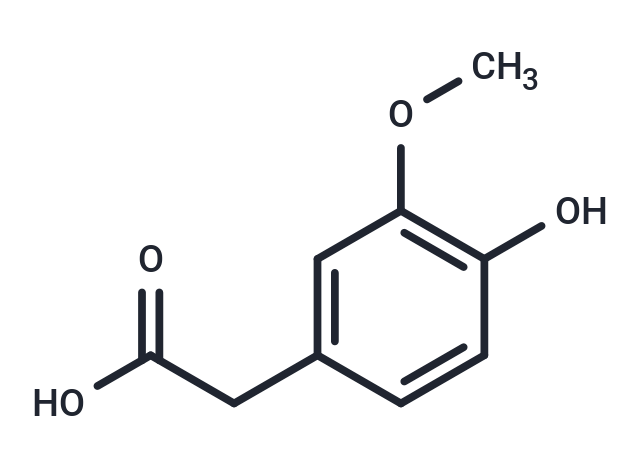
Homovanillic acid (Vanillacetic acid), a dopamine metabolite, is linked to aromatic L-amino acid decarboxylase deficiency, growth hormone deficiency, celiac disease, and sepiapterin reductase deficiency.

Homovanillic acid

Homovanillic acid

Copy Product Info
🥰Excellent
Purity: 99.67%
Catalog No. T3S0507Alias Vanillacetic acid, Vanilacetic acid, Homovaniuic acidCas No. 306-08-1
Homovanillic acid (Vanillacetic acid), a dopamine metabolite, is linked to aromatic L-amino acid decarboxylase deficiency, growth hormone deficiency, celiac disease, and sepiapterin reductase deficiency.
Pack SizePriceUSA WarehouseGlobal WarehouseQuantity
500 mg$40In StockIn Stock
1 g$73In StockIn Stock
Add to Cart
Add to Quotation
In Stock Estimated shipping dateUSA Warehouse[1-2 days] Global Warehouse[5-7 days]
All TargetMol products are for research purposes only and cannot be used for human consumption. We do not provide products or services to individuals. Please comply with the intended use and do not use TargetMol products for any other purpose.
Questions
TargetMol
View More

Batch Information

Select Batch
Purity:99.67%
Appearance:Solid
Color:White to Gray
Contact us for more batch information

Resource Download

Product Introduction

Homovanillic acid AI Summary
Homovanillic acid exhibits a broad spectrum of bioactivities, including antiplasmodial, anti-inflammatory, cytotoxic, and antiviral properties. It effectively inhibits Plasmodium falciparum W2 with an IC50 value of 316.23 nM, demonstrating its potential in malaria treatment. The compound is also a potent agonist of the NFkB Signaling Pathway and Thyroid Stimulating Hormone Receptor, with potencies of 3.5 nM and 3162.3 nM, respectively. Additionally, Homovanillic acid shows inhibitory effects on various enzymes such as Tyrosyl-DNA Phosphodiesterase (TDP1), Aldehyde Dehydrogenase 1 (ALDH1A1), and the Acetylcholine Muscarinic M1 Receptor, with potencies from 8.9 nM to 25118.9 nM. It also impacts alpha-Glucosidase, Histone Lysine Methyltransferase G9a, T. brucei phosphofructokinase, HP1-beta Chromodomain Interactions, and ELG1-dependent DNA repair, with potencies ranging between 6.0 nM and 8912.5 nM. Moreover, the compound inhibits human Selenoprotein Thioredoxin Reductase 1, Regulator of G Protein Signaling (RGS) 4, and ClpP with potencies between 18526.0 nM and 42284.1 nM. In cellular assays, Homovanillic acid has shown anti-inflammatory activity in human U937-3xkB-luc cells by inhibiting LPS-induced NFkappaB activation, while not significantly inhibiting the secretion of TNF-alpha, IL-1beta, IL-8, or IL-6 in PMA-differentiated human U937 cells. It is not cytotoxic to PMA-differentiated human U937 macrophages at high concentrations and shows limited cytotoxicity against human U937-derived macrophage-like cells at concentrations greater than 1000 μM. In transport assays, Homovanillic acid inhibits the uptake of Indoxyl sulfate in Xenopus laevis oocytes with 29.9% activity and hinders benzylpenicillin uptake by Homovanillic acid at a concentration of 1000 μM in Oat3-expressing oocyte cells, resulting in 40.9% activity. It also shows uptake in Xenopus laevis oocytes in the TP_TRANSPORTER assay with a Km value of 274000 nM. Additionally, the compound has demonstrated antiviral activity by inhibiting SARS-CoV-2 3CL-Pro protease by 8.31% at 20 µM concentration and reducing SARS-CoV-2 induced cytotoxicity in VERO-6 cells at 10 µM, though its efficacy in antiviral assays remains modest. Homovanillic acid exhibits no activity in assays for human recombinant UGT1A6 and UGT1A9 enzymes..
Note: Summary generated by AI. Data source: ChEMBL
Bioactivity
Description
Homovanillic acid (Vanillacetic acid), a dopamine metabolite, is linked to aromatic L-amino acid decarboxylase deficiency, growth hormone deficiency, celiac disease, and sepiapterin reductase deficiency.
SynonymsVanillacetic acid, Vanilacetic acid, Homovaniuic acid
Chemical Properties
Molecular Weight182.17
FormulaC9H10O4
Cas No.306-08-1
SmilesCOC1=C(O)C=CC(CC(O)=O)=C1
Relative Density.1.307g/cm3
Storage & Solubility Information
Storagekeep away from direct sunlight,store under nitrogen | Powder: -20°C for 3 years | In solvent: -80°C for 1 year | Shipping with blue ice/Shipping at ambient temperature.
Solubility Information
H2O: 9.1 mg/mL (49.95 mM), Sonication is recommended.
DMSO: 60 mg/mL (329.36 mM), Sonication is recommended.

In Vivo Formulation
10% DMSO+40% PEG300+5% Tween 80+45% Saline: 2 mg/mL (10.98 mM), Sonication is recommended.
Please add the solvents sequentially, clarifying the solution as much as possible before adding the next one. Dissolve by heating and/or sonication if necessary. Working solution is recommended to be prepared and used immediately. The formulation provided above is for reference purposes only. In vivo formulations may vary and should be modified based on specific experimental conditions.
Solution Preparation Table
H2O/DMSO
1mg5mg10mg50mg
1 mM5.4894 mL27.4469 mL54.8938 mL274.4689 mL
5 mM1.0979 mL5.4894 mL10.9788 mL54.8938 mL
10 mM0.5489 mL2.7447 mL5.4894 mL27.4469 mL
20 mM0.2745 mL1.3723 mL2.7447 mL13.7234 mL
DMSO
1mg5mg10mg50mg
50 mM0.1098 mL0.5489 mL1.0979 mL5.4894 mL
100 mM0.0549 mL0.2745 mL0.5489 mL2.7447 mL

Calculator

  • Molarity Calculator
  • Dilution Calculator
  • Reconstitution Calculator
  • Molecular Weight Calculator

In Vivo Formulation Calculator (Clear solution)

Please enter your animal experiment information in the following box and click Calculate to obtain the stock solution preparation method and in vivo formula preparation method:
TargetMol | Animal experiments For example, if the intended dosage is 10 mg/kg for animals weighing 20 g , with a dosing volume of 100 μL per animal, TargetMol | Animal experiments and a total of 10 animals are to be administered, using a formulation of TargetMol | reagent 10% DMSO+ 40% PEG300+ 5% Tween 80+ 45% Saline/PBS/ddH2O , the resulting working solution concentration would be 2 mg/mL.

Stock Solution Preparation:

Dissolve 2 mg of the compound in 100 μL DMSOTargetMol | reagent to obtain a stock solution at a concentration of 20 mg/mL . If the required concentration exceeds the compound's known solubility, please contact us for technical support before proceeding.

Preparation of the In Vivo Formulation:

1) Add 100 μL of the DMSOTargetMol | reagent stock solution to 400 μL PEG300TargetMol | reagent and mix thoroughly until the solution becomes clear.

2) Add 50 μL Tween 80 and mix well until fully clarified.

3) Add 450 μL Saline,PBS or ddH2OTargetMol | reagent and mix thoroughly until a homogeneous solution is obtained.

This example is provided solely to demonstrate the use of the In Vivo Formulation Calculator and does not constitute a recommended formulation for any specific compound. Please select an appropriate dissolution and formulation strategy based on your experimental model and route of administration.
All co-solvents required for this protocol, includingDMSO, PEG300/PEG400, Tween 80, SBE-β-CD, and Corn oil, are available for purchase on the TargetMol website.
1 Enter information below:
mg/kg
g
μL
2 Enter the in vivo formulation:
% DMSO
%
% Tween 80
% Saline/PBS/ddH2O

Dose Conversion

You can also refer to dose conversion for different animals. More Dose Conversion

Tech Support

Please see Inhibitor Handling Instructions for more frequently ask questions. Topics include: how to prepare stock solutions, how to store products, and cautions on cell-based assays & animal experiments, etc

Keywords

Related Tags: buy Homovanillic acid | purchase Homovanillic acid | Homovanillic acid cost | order Homovanillic acid | Homovanillic acid chemical structure | Homovanillic acid formula | Homovanillic acid molecular weight





