


Shopping Cart
Remove All Your shopping cart is currently empty


Synonyms: Desoxycholic acid, Deoxycholate, DCA, Cholorebic, Cholerebic, Cholanoic Acid
| Pack Size | Price | USA Stock | Global Stock | Quantity |
|---|---|---|---|---|
| 50 mg | $30 | In Stock | In Stock | |
| 100 mg | $40 | In Stock | In Stock | |
| 500 mg | $56 | In Stock | In Stock | |
| 1 g | $68 | In Stock | In Stock | |
| 1 mL x 10 mM (in DMSO) | $44 | In Stock | In Stock |
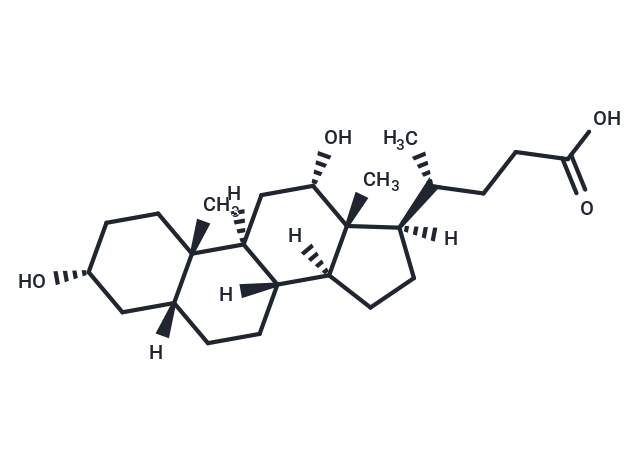
| Description | Deoxycholic acid (DCA) is a natural product and a TGR5 receptor agonist with cell permeability and oral activity. As a metabolite of intestinal flora, this compound is widely used in research on bile acid signal transduction, glucose and lipid metabolism, and anti-inflammatory mechanisms, and has shown therapeutic potential in diabetes and liver disease models. |
| Targets & IC50 | CSNK1E:7.22 μM (EC50), Nicastrin:6.03 μM (EC50), FATP5:0.19 μM, NTCP:2.14 µM, FATP2:5 μM |
| In vitro | Methods: Primary rat hepatocytes were treated with 25–200 μM deoxycholic acid (DCA) for 24 h. miR-21 expression was detected by Real-Time RT-PCR, NF-κB activity was detected by luciferase reporter gene assay, PDCD4 was detected by Western blot, and cell apoptosis was detected by Hoechst staining and caspase-3/7 activity assay. Results :Deoxycholic acid dose-dependently inhibited miR-21 expression, decreased NF-κB activity, and increased PDCD4 expression and cell apoptosis. [1] Methods: C2C12 myoblasts were treated with Deoxycholic acid (50 μM) for 5 days to induce differentiation. Myosin heavy chain (MYH) was detected by immunofluorescence, and gene expression of myogenic differentiation and energy metabolism markers was detected by RT-qPCR. Results: Deoxycholic acid significantly increased myotube differentiation index and fusion capacity, upregulated Myh1/2, Pgc-1α and other gene expression; these effects were blocked by TGR5 antagonist SBI-115. [2] |
| In vivo | Methods: Primary rat hepatocytes were treated with 100 μM Deoxycholic acid (DCA) for 16 or 24 hours; relevant parameters were detected by Real-Time RT-PCR, immunoblotting, and H₂DCFDA fluorescence assay. Results: Short-term DCA treatment led to downregulation of miR-21 expression, accompanied by PIDD processing and caspase-2 activation, thereby promoting liver injury. [1] |
| Synonyms | Desoxycholic acid, Deoxycholate, DCA, Cholorebic, Cholerebic, Cholanoic Acid |
| Cell Research | Primary rat hepatocytes were isolated from male rats (100 to 150 g) by collagenase perfusion. After isolation, hepatocytes were resuspended in complete Williams E medium and plated on BD Primaria™ culture dishes at 5 × 10⁴ cells/cm2. Cells are kept at 37 °C in a humidified atmosphere of 5% CO2 for 4-6 h to allow attachment. Plates are then washed with phosphate buffered saline (PBS) 1× in order to remove dead cells and incubated in Williams E medium supplemented with 25 to 200 μM DCA or no addition (control) for 24 h. Primary rat hepatocytes are processed for total RNA and protein isolation, cell viability, cytotoxicity and caspase activity assays and Hoechst staining. (Only for Reference) |
| Molecular Weight | 392.57 |
| Formula | C24H40O4 |
| Cas No. | 83-44-3 |
| Smiles | C[C@@]12[C@]([C@]3([C@@]([C@]4(C)[C@](CC3)(C[C@H](O)CC4)[H])(C[C@@H]1O)[H])[H])(CC[C@@]2([C@@H](CCC(O)=O)C)[H])[H] |
| Relative Density. | 1.128 g/cm3 |
| Storage | Keep away from direct sunlight,Keep away from moisture Powder: -20°C for 3 years | In solvent: -80°C for 1 year Shipping with blue ice/Shipping at ambient temperature. | |||||||||||||||||||||||||||||||||||
| Solubility Information | DMSO: 145 mg/mL (369.36 mM), Sonication is recommended.  Ethanol: 56 mg/mL (142.65 mM), Sonication is recommended. H2O: < 1 mg/mL (insoluble or slightly soluble) | |||||||||||||||||||||||||||||||||||
Solution Preparation Table | ||||||||||||||||||||||||||||||||||||
Ethanol/DMSO
Note : The dilution table applies only to solid products. For liquid products, please calculate the stock solution based on the stated concentration and/or density. | ||||||||||||||||||||||||||||||||||||
 For example, if the intended dosage is 10 mg/kg for animals weighing 20 g , with a dosing volume of 100 μL per animal, and a total of 10 animals are to be administered, using a formulation of
  10% DMSO+ 40% PEG300+ 5% Tween 80+ 45% Saline/PBS/ddH2O , the resulting working solution concentration would be 2 mg/mL.
Dissolve 2 mg of the compound in 100 μL DMSO to obtain a stock solution at a concentration of 20 mg/mL . If the required concentration exceeds the compound's known solubility, please contact us for technical support before proceeding.
1) Add 100 μL of the DMSO stock solution to 400 µL PEG300 and mix thoroughly until the solution becomes clear.
2) Add 50 µL Tween 80 and mix well until fully clarified.
3) Add 450 µL Saline,PBS or ddH2O and mix thoroughly until a homogeneous solution is obtained.
| Size | Quantity | Unit Price | Amount | Operation |
|---|
 Feedback
 Hello! How can I help you today?
Copyright © 2015-2026 TargetMol Chemicals Inc. All Rights Reserved.
