


Shopping Cart
Remove All Your shopping cart is currently empty

Synonyms: Grape sugar, Glucopyranose, Dextrose, D(+)-Glucose
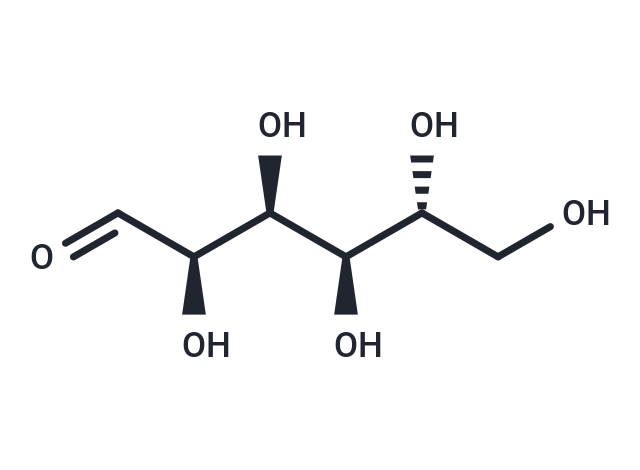
| Pack Size | Price | USA Stock | Global Stock | Quantity |
|---|---|---|---|---|
| 5 g | $35 | - | In Stock | |
| 1 mL x 10 mM (in DMSO) | $39 | In Stock | In Stock |

| Description | D-Glucose (Glucopyranose) is a monosaccharide, a natural glucose, a sweetener. D-Glucose is the main functional substance of living organisms, and is used as a nutrient in medicine, with diuretic, detoxification and cardiotonic effects. |
| In vitro | METHODS: Differentiated Caco-2 cells were stimulated with D-Glucose (125-500 mM) for 5 min and serotonin levels were measured. RESULTS: Caco-2 cells released 5-hydroxytryptamine in response to D-Glucose similar to enterochromaffin cells. In response to the highest tested concentration of 500 mM D-Glucose, 5-hydroxytryptamine levels in the supernatant of Caco-2 cells increased by 81.9±25.0%. [1] METHODS: Retinal endothelial cells were treated with D-Glucose (30 mM) for 7 days and cell viability was measured by MTT assay. RESULTS: The viability of endothelial cells exposed to high glucose was significantly reduced to 76.0±2.6% of the control. [2] |
| In vivo | METHODS: For oral glucose tolerance test (OGTT), rats were starved for 6 h and orally administered MET (200 mg/kg) 1 h before glucose loading. Only distilled water was used as the vehicle in the control group. Wistar rats were fed 50% D-Glucose solution (4 g/kg) and GK diabetic rats were fed at 50% D-Glucose solution (1 g/kg). All blood samples were collected by tail flow 0-120 min after glucose administration and blood glucose was determined. RESULTS: Rats receiving MET had a lower apical density of SGLT1 in the jejunum, lower levels of phosphorylated PKA substrate in enterocytes, and lower PGR compared to rats treated with excipients. [3] |
| Synonyms | Grape sugar, Glucopyranose, Dextrose, D(+)-Glucose |
| Molecular Weight | 180.16 |
| Formula | C6H12O6 |
| Cas No. | 50-99-7 |
| Smiles | [C@H]([C@@H]([C@H](C=O)O)O)([C@@H](CO)O)O |
| Relative Density. | 1.544g/cm3 |
| Storage | Powder: -20°C for 3 years | In solvent: -80°C for 1 year Shipping with blue ice/Shipping at ambient temperature. | |||||||||||||||||||||||||||||||||||
| Solubility Information | Ethanol: < 1 mg/mL (insoluble or slightly soluble) DMSO: 240 mg/mL (1332.15 mM), Sonication is recommended.  H2O: 33 mg/mL (183.17 mM), Sonication is recommended. | |||||||||||||||||||||||||||||||||||
Solution Preparation Table | ||||||||||||||||||||||||||||||||||||
H2O/DMSO
Note : The dilution table applies only to solid products. For liquid products, please calculate the stock solution based on the stated concentration and/or density. | ||||||||||||||||||||||||||||||||||||
 For example, if the intended dosage is 10 mg/kg for animals weighing 20 g , with a dosing volume of 100 μL per animal, and a total of 10 animals are to be administered, using a formulation of
  10% DMSO+ 40% PEG300+ 5% Tween 80+ 45% Saline/PBS/ddH2O , the resulting working solution concentration would be 2 mg/mL.
Dissolve 2 mg of the compound in 100 μL DMSO to obtain a stock solution at a concentration of 20 mg/mL . If the required concentration exceeds the compound's known solubility, please contact us for technical support before proceeding.
1) Add 100 μL of the DMSO stock solution to 400 µL PEG300 and mix thoroughly until the solution becomes clear.
2) Add 50 µL Tween 80 and mix well until fully clarified.
3) Add 450 µL Saline,PBS or ddH2O and mix thoroughly until a homogeneous solution is obtained.
| Size | Quantity | Unit Price | Amount | Operation |
|---|
 Feedback
 Hello! How can I help you today?
Copyright © 2015-2026 TargetMol Chemicals Inc. All Rights Reserved.
