Shopping Cart
Remove All
  • TargetMol
    Your shopping cart is currently empty

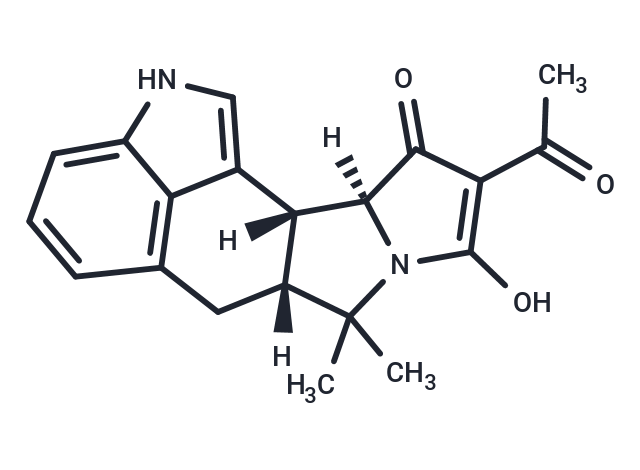
Cyclopiazonic acid

Copy Product Info
😃Good
Catalog No. T15027Cas No. 18172-33-3

Cyclopiazonic acid (CPA) is a neurotoxic secondary metabolite (SM) made by A. flavus. Cyclopiazonic acid (CPA) is an endoplasmic reticulum calcium ATPase (Ca2+ATPase; SERCA)nanomolar inhibitor and a potent inducer of cell death in plants.

Cyclopiazonic acid

Cyclopiazonic acid

Copy Product Info
😃Good
Purity: 99.80%
Catalog No. T15027Cas No. 18172-33-3
Cyclopiazonic acid (CPA) is a neurotoxic secondary metabolite (SM) made by A. flavus. Cyclopiazonic acid (CPA) is an endoplasmic reticulum calcium ATPase (Ca2+ATPase; SERCA)nanomolar inhibitor and a potent inducer of cell death in plants.
Pack SizePriceUSA WarehouseGlobal WarehouseQuantity
1 mg$52-In Stock
2 mg$74-In Stock
5 mg$123In StockIn Stock
10 mgPreferential-In Stock
25 mgPreferential-In Stock
1 mL x 10 mM (in DMSO)$135-In Stock
Add to Cart
Add to Quotation
In Stock Estimated shipping dateUSA Warehouse[1-2 days] Global Warehouse[5-7 days]
All TargetMol products are for research purposes only and cannot be used for human consumption. We do not provide products or services to individuals. Please comply with the intended use and do not use TargetMol products for any other purpose.
Questions
TargetMol
View More

Batch Information

Select Batch
Purity:99.80%
Appearance:Solid
Color:White to Yellow
Contact us for more batch information

Resource Download

Product Introduction

Cyclopiazonic acid AI Summary
Cyclopiazonic acid exhibits a diverse range of bioactivities, including modulation of autophagy, inhibition of key enzymes and proteins, as well as antiviral and antimalarial activities. It induces light chain 3-GFP levels and modulates autophagosome vesicle properties in human H4 cells, suggesting its influence on autophagic processes and vesicle dynamics. The compound also enhances long-lived protein degradation, indicating a role in cellular turnover mechanisms. Toxicity in rats shows an LC50 value of 30.0 mg kg-1. It inhibits the ATPase activity of SERCA in rabbit hind leg tissue microsomes with an IC50 value of 120.0 nM and shows antispasmodic activity in the guinea pig ileum, inhibiting acetylcholine-induced contraction at 10 µM with a 52.3% activity level. Against Plasmodium falciparum, including NITD609-resistant clones, it has an IC50 range of 3240.0 to 4160.0 nM and for strains FcB1 and 3D7, IC50 values of 4900.0 nM and 8800.0 nM, respectively. It exhibits antiviral activity against SARS-CoV-2 in various cell lines and inhibits the SARS-CoV-2 3CL-Pro protease. Additionally, it shows inhibitory activity on electric eel AChE, horse BChE, and human HDAC6 enzyme. The compound also targets a spectrum of other biological entities, including Tau fibril formation, Histone Lysine Methyltransferase G9a, tyrosyl-DNA phosphodiesterase 1 (TDP1), and the Human Apurinic/apyrimidinic Endonuclease 1 (APE1). These bioactivities suggest that Cyclopiazonic acid has potential applications in therapeutic interventions for a variety of conditions..
Note: Summary generated by AI. Data source: ChEMBL
Bioactivity
Description
Cyclopiazonic acid (CPA) is a neurotoxic secondary metabolite (SM) made by A. flavus. Cyclopiazonic acid (CPA) is an endoplasmic reticulum calcium ATPase (Ca2+ATPase; SERCA)nanomolar inhibitor and a potent inducer of cell death in plants.
Chemical Properties
Molecular Weight336.38
FormulaC20H20N2O3
Cas No.18172-33-3
Smiles[H][C@@]12Cc3cccc4[nH]cc(c34)[C@]1([H])[C@]1([H])N(C(O)=C(C(C)=O)C1=O)C2(C)C
Relative Density.1.42g/cm3
Storage & Solubility Information
Storagestore at low temperature,keep away from direct sunlight,keep away from moisture | Powder: -20°C for 3 years | In solvent: -80°C for 1 year | Shipping with blue ice/Shipping at ambient temperature.
Solubility Information
DMSO: 100 mg/mL (297.28 mM), Sonication is recommended.
In Vivo Formulation
10% DMSO+40% PEG300+5% Tween 80+45% Saline: 4 mg/mL (11.89 mM), Sonication is recommended.
Please add the solvents sequentially, clarifying the solution as much as possible before adding the next one. Dissolve by heating and/or sonication if necessary. Working solution is recommended to be prepared and used immediately. The formulation provided above is for reference purposes only. In vivo formulations may vary and should be modified based on specific experimental conditions.
Solution Preparation Table
DMSO
1mg5mg10mg50mg
1 mM2.9728 mL14.8641 mL29.7283 mL148.6414 mL
5 mM0.5946 mL2.9728 mL5.9457 mL29.7283 mL
10 mM0.2973 mL1.4864 mL2.9728 mL14.8641 mL
20 mM0.1486 mL0.7432 mL1.4864 mL7.4321 mL
50 mM0.0595 mL0.2973 mL0.5946 mL2.9728 mL
100 mM0.0297 mL0.1486 mL0.2973 mL1.4864 mL

Calculator

  • Molarity Calculator
  • Dilution Calculator
  • Reconstitution Calculator
  • Molecular Weight Calculator

In Vivo Formulation Calculator (Clear solution)

Please enter your animal experiment information in the following box and click Calculate to obtain the stock solution preparation method and in vivo formula preparation method:
TargetMol | Animal experiments For example, if the intended dosage is 10 mg/kg for animals weighing 20 g , with a dosing volume of 100 μL per animal, TargetMol | Animal experiments and a total of 10 animals are to be administered, using a formulation of TargetMol | reagent 10% DMSO+ 40% PEG300+ 5% Tween 80+ 45% Saline/PBS/ddH2O , the resulting working solution concentration would be 2 mg/mL.

Stock Solution Preparation:

Dissolve 2 mg of the compound in 100 μL DMSOTargetMol | reagent to obtain a stock solution at a concentration of 20 mg/mL . If the required concentration exceeds the compound's known solubility, please contact us for technical support before proceeding.

Preparation of the In Vivo Formulation:

1) Add 100 μL of the DMSOTargetMol | reagent stock solution to 400 μL PEG300TargetMol | reagent and mix thoroughly until the solution becomes clear.

2) Add 50 μL Tween 80 and mix well until fully clarified.

3) Add 450 μL Saline,PBS or ddH2OTargetMol | reagent and mix thoroughly until a homogeneous solution is obtained.

This example is provided solely to demonstrate the use of the In Vivo Formulation Calculator and does not constitute a recommended formulation for any specific compound. Please select an appropriate dissolution and formulation strategy based on your experimental model and route of administration.
All co-solvents required for this protocol, includingDMSO, PEG300/PEG400, Tween 80, SBE-β-CD, and Corn oil, are available for purchase on the TargetMol website.
1 Enter information below:
mg/kg
g
μL
2 Enter the in vivo formulation:
% DMSO
%
% Tween 80
% Saline/PBS/ddH2O

Dose Conversion

You can also refer to dose conversion for different animals. More Dose Conversion

Tech Support

Please see Inhibitor Handling Instructions for more frequently ask questions. Topics include: how to prepare stock solutions, how to store products, and cautions on cell-based assays & animal experiments, etc

Keywords

Related Tags: buy Cyclopiazonic acid | purchase Cyclopiazonic acid | Cyclopiazonic acid cost | order Cyclopiazonic acid | Cyclopiazonic acid chemical structure | Cyclopiazonic acid formula | Cyclopiazonic acid molecular weight