


Shopping Cart
Remove All Your shopping cart is currently empty


Synonyms: SC 58635
| Pack Size | Price | USA Stock | Global Stock | Quantity |
|---|---|---|---|---|
| 25 mg | $30 | In Stock | In Stock | |
| 50 mg | $39 | In Stock | In Stock | |
| 100 mg | $53 | In Stock | In Stock | |
| 200 mg | $68 | In Stock | In Stock | |
| 1 g | $217 | In Stock | In Stock | |
| 1 mL x 10 mM (in DMSO) | $57 | In Stock | In Stock |
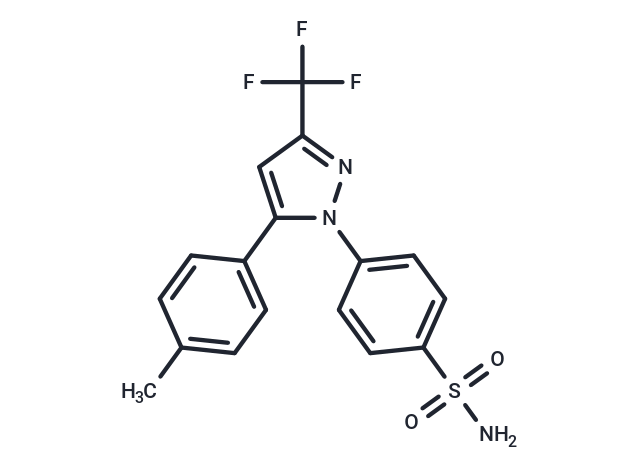
| Description | Celecoxib (SC 58635) is a Nonsteroidal Anti-inflammatory Drug. The mechanism of action of celecoxib is as a Cyclooxygenase Inhibitor. |
| Targets & IC50 | Hone-1 cells:49.68 ± 1.12 μM, COX-1:15 μM, A2058 cells:63 ± 4 µM, COX-2:40 nM, HK-1 cells:51.74 ± 3.89 μM, CNE-2 cells:41.04 ± 1.22 μM |
| In vitro | In rats, Celecoxib at doses ranging from 200 to 600 mg/kg does not induce acute gastrointestinal (GI) toxicity. Furthermore, continuous treatment with Celecoxib at these dosages for over ten days fails to produce GI toxicity. In the adjuvant-induced arthritis model, Celecoxib mitigates chronic inflammation with an effective dose 50 (ED50) of 0.37 mg/kg. Additionally, the compound exhibits analgesic activity in the Hargreaves pain model, with an ED50 of 34.5 mg/kg. |
| In vivo | Celecoxib inhibits cell proliferation in nasopharyngeal carcinoma cell lines HNE1 (IC50=32.86 μM) and CNE1-LMP1 (IC50= 61.31 μM). It also selectively inhibits COX-1 (IC50=15 μM) and COX-2 (IC50=40 nM) with effective selectivity. |
| Synonyms | SC 58635 |
| Kinase Assay | COX enzyme assay in vitro: Expression of COX protein in insect cells is determined by assessing PG-synthetic capability in homogenates from cells incubated for 3 days with COX-1 or COX-2 baculovirus. Cells expressing COX-1 or COX-2 are homogenized and incubated with arachidonic acid (10 μM). COX activity is determined by monitoring PG production. No COX activity is detected in mock-infected Sf9 cells. Celecoxib are preincubated with crude 1% CHAPS homogenates (2-10 μg of protein) for 10 minutes before addition of arachidonic acid. PGE2 formed is detected by ELISA after 10 minute incubation. |
| Cell Research | The antiproliferative effect of Celecoxib on NPC cells is assessed using an MTT assay. Cells are seeded into 96-well plates and allowed to attach for 24 hours. The cells are then treated with increasing concentrations of Celecoxib (0 to 75 μM) dissolved in DMSO (final concentration ≤0.1%) and incubated for up to 48 hours. After the incubation, 20 μL of MTT dye (5 mg/mL) are added to each well and cells are incubated at 37 °C for 4 hours. After removing the supernatants, the crystals are dissolved in DMSO and the absorbance is measured at 490 nm. The half-maximal inhibitory concentration (IC50) values and the 95% confidence intervals are calculated using probit regression using SPSS 15.0 software. The experiment is performed in triplicate and repeated at least three times.(Only for Reference) |
| Molecular Weight | 381.37 |
| Formula | C17H14F3N3O2S |
| Cas No. | 169590-42-5 |
| Smiles | C(F)(F)(F)C1=NN(C(=C1)C2=CC=C(C)C=C2)C3=CC=C(S(N)(=O)=O)C=C3 |
| Relative Density. | 1.43 g/cm3 (Predicted) |
| Storage | Powder: -20°C for 3 years | In solvent: -80°C for 1 year Shipping with blue ice/Shipping at ambient temperature. | ||||||||||||||||||||||||||||||||||||||||
| Solubility Information | Ethanol: 31 mg/mL (81.29 mM), Sonication is recommended. DMSO: 260 mg/mL (681.75 mM), Sonication is recommended.  | ||||||||||||||||||||||||||||||||||||||||
| In Vivo Formulation | 10% DMSO+40% PEG300+5% Tween 80+45% Saline: 7.1 mg/mL (18.62 mM), Solution. 2% DMSO+40% PEG300+5% Tween 80+53% H2O: 3 mg/mL (7.87 mM), Solution. Please add the solvents sequentially, clarifying the solution as much as possible before adding the next one. Dissolve by heating and/or sonication if necessary. Working solution is recommended to be prepared and used immediately. The formulation provided above is for reference purposes only. In vivo formulations may vary and should be modified based on specific experimental conditions. | ||||||||||||||||||||||||||||||||||||||||
Solution Preparation Table | |||||||||||||||||||||||||||||||||||||||||
Ethanol/DMSO
DMSO
Note : The dilution table applies only to solid products. For liquid products, please calculate the stock solution based on the stated concentration and/or density. | |||||||||||||||||||||||||||||||||||||||||
 For example, if the intended dosage is 10 mg/kg for animals weighing 20 g , with a dosing volume of 100 μL per animal, and a total of 10 animals are to be administered, using a formulation of
  10% DMSO+ 40% PEG300+ 5% Tween 80+ 45% Saline/PBS/ddH2O , the resulting working solution concentration would be 2 mg/mL.
Dissolve 2 mg of the compound in 100 μL DMSO to obtain a stock solution at a concentration of 20 mg/mL . If the required concentration exceeds the compound's known solubility, please contact us for technical support before proceeding.
1) Add 100 μL of the DMSO stock solution to 400 µL PEG300 and mix thoroughly until the solution becomes clear.
2) Add 50 µL Tween 80 and mix well until fully clarified.
3) Add 450 µL Saline,PBS or ddH2O and mix thoroughly until a homogeneous solution is obtained.
| Size | Quantity | Unit Price | Amount | Operation |
|---|
 Feedback
 Hello! How can I help you today?
Copyright © 2015-2026 TargetMol Chemicals Inc. All Rights Reserved.
