


Shopping Cart
Remove All Your shopping cart is currently empty

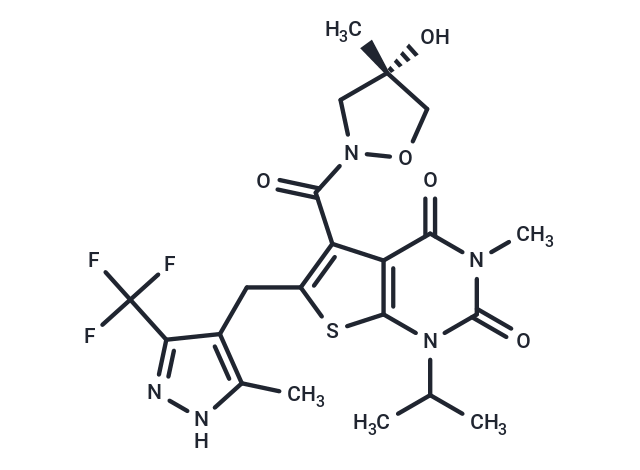
Synonyms: AZD-3965, AZD 3965

| Pack Size | Price | USA Stock | Global Stock | Quantity |
|---|---|---|---|---|
| 1 mg | $50 | In Stock | In Stock | |
| 2 mg | $72 | In Stock | In Stock | |
| 5 mg | $119 | In Stock | In Stock | |
| 10 mg | $148 | In Stock | In Stock | |
| 50 mg | $449 | - | In Stock | |
| 1 mL x 10 mM (in DMSO) | $135 | In Stock | In Stock |
| Description | AZD3965 (AZD-3965) belongs to small molecule inhibitors, serving as a monocarboxylate transporter 1 (MCT1) inhibitor (Ki=1.6 nM), with 6-fold higher selectivity for MCT1 over MCT2, featuring favorable selectivity, cell permeability, and oral activity, for antitumor research. |
| Targets & IC50 | MCT1:1.6 nM (Ki) |
| In vitro | Methods: In 4T1 mouse breast cancer cells, an L-lactate uptake assay was used to evaluate the in vitro activity of AZD3965. Cells were pre-incubated with 200 nM AZD3965 for different durations to observe its inhibitory effect on L-lactate uptake; after inhibitor washout, recovery of inhibition was monitored. Results: AZD3965 inhibited L-lactate uptake in a time-dependent manner, reaching maximum inhibition after 5 min pre-incubation and persisting thereafter; inhibition was completely reversed 12 h after washout, indicating slowly reversible inhibitory effects. [1] Methods: In Raji human lymphoma cells, an intracellular L-lactate level detection assay was used to evaluate AZD3965 activity. Cells were incubated with 2–500 nM AZD3965 for 24 h, or with 25 nM AZD3965 for different durations. Results: AZD3965 increased intracellular lactate in a concentration-dependent manner, with 2 nM being effective (P=0.01), and 25 nM achieving maximum accumulation; time-dependent analysis showed significant lactate elevation after 90 min (P=0.02), peaking at 3 h. [2] |
| In vivo | Methods: NOD/LtSz-scid IL2Rγ⁰ (NSG) mice were used, and a Burkitt lymphoma model was established by tail vein injection of luciferase-labeled CA46 cells. AZD3965 was administered by oral gavage at 100 mg/kg twice daily for 24 consecutive days; the control group received vehicle. Results: AZD3965 monotherapy significantly inhibited tumor growth, with no significant increase in tumor burden compared to pre-treatment, and also markedly reduced spleen weight and bone marrow infiltration, confirming its potent in vivo antitumor activity. [3] Methods: In a BALB/c mouse 4T1 triple-negative breast cancer model, after subcutaneous xenograft tumor volume reached 100 mm³, AZD3965 was administered by intraperitoneal injection (100 mg/kg, twice daily, dissolved in 20% cyclodextrin saline, control was solvent) for 17 consecutive days. Results: AZD3965 reduced tumor volume and proliferation marker Ki67 expression, increased intratumoral lactate concentration, but did not alter tumor weight, and increased lung metastatic nodules. [4] |
| Synonyms | AZD-3965, AZD 3965 |
| Kinase Assay | Cells are plated overnight and treated with 100 nM AZD3965 or vehicle for 24 hours. The cells are then washed, once in PBS and twice with lysis buffer (50 mM Mops, 100 mM KCl, 5 mM MgCl2, 1 mM EDTA, 0.1 mM DTT, 1 mM PMSF supplemented with 1× mini complete protease inhibitor cocktail tablets. The cells are harvested by scraping and centrifugation, and the pellet snap frozen without buffer in liquid nitrogen. Frozen aliquots of cells are thawed on ice and re-suspended in lysis buffer. Cells are lysed by 3 rounds of freezing in liquid nitrogen and thawing at 37°C for 2 minutes each. Lysates are subsequently centrifuged (13000 g, 10min, 4°C) until clear and then stored on ice. Enzyme activity in the cell lysates is determined using a micro-plate reader to measure either production or depletion of NADH/NADPH, through its absorbance at 340/10 nm, occurring as a result of direct or coupled enzyme reactions. The 96 well plates used for the assays are pre-heated to 37°C for 10 minutes prior to starting reactions, initiated by the addition of 5 μL cell lysate to 95 μL of reaction buffer (50 mM Mops pH 7.4, 100 mM KCl, 5 mM free magnesium). The standard reaction buffer is supplemented to assay the kinetics of the different enzymes. Absorbance values for controls are subtracted from absorbance of corresponding reactions. Graphpad prism 6 is used to plot V0 values against substrate concentration and determine Vmax and Km values. The Vmax is then normalised to the protein concentration in the cell lysate[1]. |
| Molecular Weight | 515.51 |
| Formula | C21H24F3N5O5S |
| Cas No. | 1448671-31-5 |
| Smiles | CC(C)n1c2sc(Cc3c(C)[nH]nc3C(F)(F)F)c(C(=O)N3C[C@](C)(O)CO3)c2c(=O)n(C)c1=O |
| Relative Density. | 1.483 g/cm3 (Predicted) |
| Storage | Store at low temperature Powder: -20°C for 3 years | In solvent: -80°C for 1 year Shipping with blue ice/Shipping at ambient temperature. | |||||||||||||||||||||||||||||||||||
| Solubility Information | Ethanol: 100 mg/mL (193.98 mM), Sonication is recommended. DMSO: 100 mg/mL (193.98 mM), Sonication is recommended.  H2O: < 1 mg/mL (insoluble or slightly soluble) | |||||||||||||||||||||||||||||||||||
| In Vivo Formulation | 10% DMSO+40% PEG300+5% Tween 80+45% Saline: 4 mg/mL (7.76 mM), Sonication is recommended. Please add the solvents sequentially, clarifying the solution as much as possible before adding the next one. Dissolve by heating and/or sonication if necessary. Working solution is recommended to be prepared and used immediately. The formulation provided above is for reference purposes only. In vivo formulations may vary and should be modified based on specific experimental conditions. | |||||||||||||||||||||||||||||||||||
Solution Preparation Table | ||||||||||||||||||||||||||||||||||||
Ethanol/DMSO
Note : The dilution table applies only to solid products. For liquid products, please calculate the stock solution based on the stated concentration and/or density. | ||||||||||||||||||||||||||||||||||||
 For example, if the intended dosage is 10 mg/kg for animals weighing 20 g , with a dosing volume of 100 μL per animal, and a total of 10 animals are to be administered, using a formulation of
  10% DMSO+ 40% PEG300+ 5% Tween 80+ 45% Saline/PBS/ddH2O , the resulting working solution concentration would be 2 mg/mL.
Dissolve 2 mg of the compound in 100 μL DMSO to obtain a stock solution at a concentration of 20 mg/mL . If the required concentration exceeds the compound's known solubility, please contact us for technical support before proceeding.
1) Add 100 μL of the DMSO stock solution to 400 µL PEG300 and mix thoroughly until the solution becomes clear.
2) Add 50 µL Tween 80 and mix well until fully clarified.
3) Add 450 µL Saline,PBS or ddH2O and mix thoroughly until a homogeneous solution is obtained.
| Size | Quantity | Unit Price | Amount | Operation |
|---|
 Feedback
 Hello! How can I help you today?
Copyright © 2015-2026 TargetMol Chemicals Inc. All Rights Reserved.
