Shopping Cart
Remove All
  • TargetMol
    Your shopping cart is currently empty

Acriflavine Hydrochloride (Synonyms: Acriflavine HCl)

Catalog No. T19832 Copy Product Info
Purity: 99.8%
😃Good
Acriflavine Hydrochloride (Acriflavine HCl) is a HIF-1α inhibitor. It acts by targeting HIF-1α-mediated pathways and decreasing the level of PGK1, VEGF, and HIF-1α in vitro and in vivo.

Acriflavine Hydrochloride

Copy Product Info
😃Good
Catalog No. T19832
Synonyms Acriflavine HCl

Acriflavine Hydrochloride (Acriflavine HCl) is a HIF-1α inhibitor. It acts by targeting HIF-1α-mediated pathways and decreasing the level of PGK1, VEGF, and HIF-1α in vitro and in vivo.

Acriflavine Hydrochloride
Cas No. 8063-24-9
Pack SizePriceUSA StockGlobal StockQuantity
500 mg$41In StockIn Stock
1 mL x 10 mM (in DMSO)$45In StockIn Stock
For In stock only · Estimated delivery: USA Stock (1-2 days) Global Stock (5-7 days)
Add to Cart
Add to Quotation
For research use only—not for human use. No sales to individuals. Use as intended only.
Questions
TargetMol
View More

Batch Information

Select Batch
Purity:99.8%
Appearance:Solid
Color:Red
Contact us for more batch information

Resource Download

Product Introduction

Acriflavine Hydrochloride AI Summary
Acriflavine Hydrochloride is a multifaceted bioactive molecule with a partition coefficient (logD7.4) of 1.6, indicating moderate lipophilicity. It has demonstrated significant trypanocidal activity against Trypanosoma brucei, with increasing efficacy under higher concentrations and light exposure. Notably, it impacts the cross resistance of CHO cells resistant to colchicine (CHRC5) with a log CR value of 0.84. The compound exhibits strong antimicrobial properties against a variety of bacterial strains, including Escherichia coli, Enterobacter cloacae, methicillin-resistant Staphylococcus aureus (MRSA), and Burkholderia pseudomallei. Its Minimum Inhibitory Concentrations (MIC) against these strains vary widely, reflecting differential efficacy based on specific genetic and resistance profiles. For example, MICs against multidrug-resistant E. coli with mutated GyrA gene exceed 128.0 µg/mL, while against other strains, MICs range from 2.0 to 4.0 µg/mL. The compound also affects the AcrAB-TolC efflux pump system, with an MIC of 400.0 µg/mL in Escherichia coli, and demonstrates efficacy against MRSA, with MIC50 at 12.5 µg/mL and MIC90 at 50.0 µg/mL. Furthermore, Acriflavine Hydrochloride shows potent antiviral activity, including a 74.97% inhibition of SARS-CoV-2 induced cytotoxicity in Caco-2 cells at 10 µM, and a 98.59% inhibition of SARS-CoV-2 3CL-Pro protease at 20 µM. It also inhibits HIF-1 dimerization in HEK293 cells with an IC50 of 1000 nM. In addition to its antimicrobial and antiviral activities, Acriflavine Hydrochloride impacts protein interactions and enzymatic activities, including Menin-MLL, BRCT-Phosphoprotein, Caspase-1, and Cytochrome P450 3A4. It also influences cellular responses such as ER Stress Response and DNA re-replication and exhibits antagonistic effects on proteins like MgcRacGAP. Overall, Acriflavine Hydrochloride is a versatile compound with significant potential in antimicrobial, antiviral, and cellular bioactivity modulation applications..
Note: Summary generated by AI. Data source: ChEMBL
Bioactivity
Description
Acriflavine Hydrochloride (Acriflavine HCl) is a HIF-1α inhibitor. It acts by targeting HIF-1α-mediated pathways and decreasing the level of PGK1, VEGF, and HIF-1α in vitro and in vivo.
SynonymsAcriflavine HCl
Chemical Properties
Molecular Weight259.73
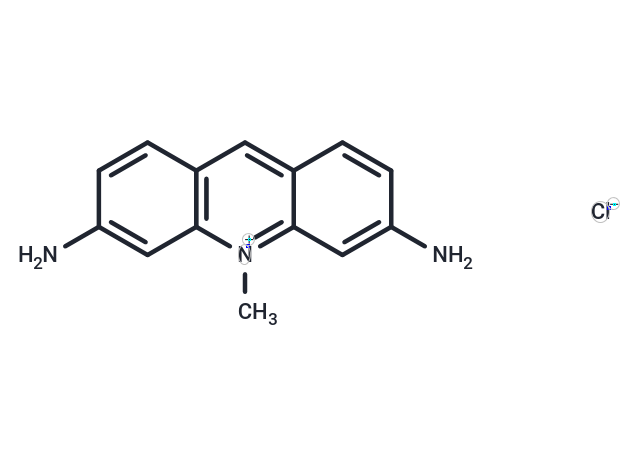
FormulaC14H14ClN3
Cas No.8063-24-9
SmilesC[N+]1=C2C=C(N)C=CC2=CC3=C1C=C(N)C=C3.[Cl-]
Relative Density.no data available
Storage & Solubility Information
StoragePowder: -20°C for 3 years | In solvent: -80°C for 1 year | Shipping with blue ice/Shipping at ambient temperature.
Solubility Information
DMSO: 30 mg/mL (115.5 mM), Sonication is recommended.
Solution Preparation Table
DMSO
1mg5mg10mg50mg
1 mM3.8502 mL19.2508 mL38.5015 mL192.5076 mL
5 mM0.7700 mL3.8502 mL7.7003 mL38.5015 mL
10 mM0.3850 mL1.9251 mL3.8502 mL19.2508 mL
20 mM0.1925 mL0.9625 mL1.9251 mL9.6254 mL
50 mM0.0770 mL0.3850 mL0.7700 mL3.8502 mL
100 mM0.0385 mL0.1925 mL0.3850 mL1.9251 mL
Note : The dilution table applies only to solid products. For liquid products, please calculate the stock solution based on the stated concentration and/or density.

Calculator

  • Molarity Calculator
  • Dilution Calculator
  • Reconstitution Calculator
  • Molecular Weight Calculator

In Vivo Formulation Calculator (Clear solution)

Please enter your animal experiment information in the following box and click Calculate to obtain the stock solution preparation method and in vivo formula preparation method:
TargetMol | Animal experiments For example, if the intended dosage is 10 mg/kg for animals weighing 20 g , with a dosing volume of 100 μL per animal, TargetMol | Animal experiments and a total of 10 animals are to be administered, using a formulation of TargetMol | reagent 10% DMSO+ 40% PEG300+ 5% Tween 80+ 45% Saline/PBS/ddH2O , the resulting working solution concentration would be 2 mg/mL.

Stock Solution Preparation:

Dissolve 2 mg of the compound in 100 μL DMSOTargetMol | reagent to obtain a stock solution at a concentration of 20 mg/mL . If the required concentration exceeds the compound's known solubility, please contact us for technical support before proceeding.

Preparation of the In Vivo Formulation:

1) Add 100 μL of the DMSOTargetMol | reagent stock solution to 400 μL PEG300TargetMol | reagent and mix thoroughly until the solution becomes clear.

2) Add 50 μL Tween 80 and mix well until fully clarified.

3) Add 450 μL Saline,PBS or ddH2OTargetMol | reagent and mix thoroughly until a homogeneous solution is obtained.

This example is provided solely to demonstrate the use of the In Vivo Formulation Calculator and does not constitute a recommended formulation for any specific compound. Please select an appropriate dissolution and formulation strategy based on your experimental model and route of administration.
All co-solvents required for this protocol, includingDMSO, PEG300/PEG400, Tween 80, SBE-β-CD, and Corn oil, are available for purchase on the TargetMol website.
1 Enter information below:
mg/kg
g
μL
2 Enter the in vivo formulation:
% DMSO
%
% Tween 80
% Saline/PBS/ddH2O

Dose Conversion

You can also refer to dose conversion for different animals. More Dose Conversion

Tech Support

Please see Inhibitor Handling Instructions for more frequently ask questions. Topics include: how to prepare stock solutions, how to store products, and cautions on cell-based assays & animal experiments, etc

Keywords

Related Tags: buy Acriflavine Hydrochloride | purchase Acriflavine Hydrochloride | Acriflavine Hydrochloride cost | order Acriflavine Hydrochloride | Acriflavine Hydrochloride chemical structure | Acriflavine Hydrochloride formula | Acriflavine Hydrochloride molecular weight