


Shopping Cart
Remove All Your shopping cart is currently empty

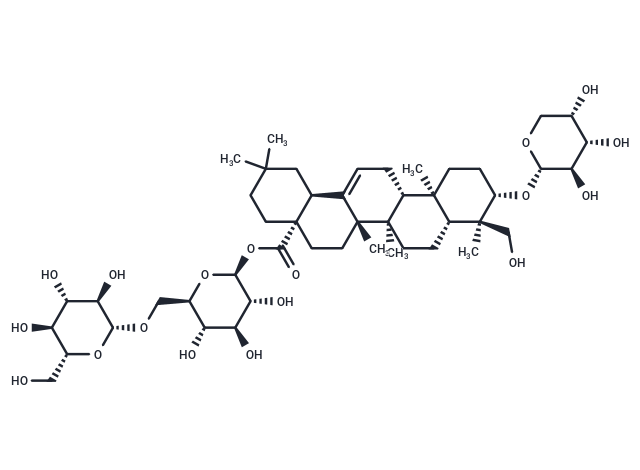
Synonyms: Asperosaponin Ⅵ, Akebia saponin D
| Pack Size | Price | USA Stock | Global Stock | Quantity |
|---|---|---|---|---|
| 5 mg | $32 | In Stock | In Stock | |
| 10 mg | $43 | In Stock | In Stock | |
| 25 mg | $67 | In Stock | In Stock | |
| 50 mg | $95 | In Stock | In Stock | |
| 100 mg | $138 | - | In Stock | |
| 1 mL x 10 mM (in DMSO) | $55 | In Stock | In Stock |
| Description | Asperosaponin VI (Akebia saponin D) , the most abundant constituent of the rhizome of Dipsacus asper, has been used for the treatment of lower back pain, traumatic hematoma and bone fractures. |
| Synonyms | Asperosaponin Ⅵ, Akebia saponin D |
| Kinase Assay | Cells are grown on 12-mm diameter glass coverslips in DMEM 100% serum and various concentrations of KN-93 or KN-92. After 0, 1, 2, and 3 days of culture in the presence of drug, coverslips are removed from culture, rinsed once in PBS, and then submerged in 100% methanol at -20°C for 3 min. Fixed cells are stored in PBS until staining using the TUNEL assay. Cells are overlaid on 20 μL PBS/1 mg/mL BSA for 30 min, rinsed in PBS, and then overlaid on 20 μL containing 100 mM sodium cacodylate (pH 6.8), 1 mM CoCl2, 0.1 mM DTT, 0.1 mg/mL BSA, 20 μM fluorescein-12-dUTP, and 0.1 unit/μL terminal transferase at 37°C for 60 min. Coverslips are rinsed in PBS twice, mounted on slides, and photographed using an OLYMPUS BX5O epifluorescent microscope using a UPLAN APO 40X oil immersion objective. |
| Molecular Weight | 929.10 |
| Formula | C47H76O18 |
| Cas No. | 39524-08-8 |
| Smiles | CC1(C)CC[C@@]2(CC[C@]3(C)C(=CC[C@@H]4[C@@]5(C)CC[C@H](O[C@@H]6OC[C@H](O)[C@H](O)[C@H]6O)[C@@](C)(CO)[C@@H]5CC[C@@]34C)[C@@H]2C1)C(=O)O[C@@H]1O[C@H](CO[C@@H]2O[C@H](CO)[C@@H](O)[C@H](O)[C@H]2O)[C@@H](O)[C@H](O)[C@H]1O |
| Relative Density. | 1.43 g/cm3 |
| Storage | Store at low temperature,Keep away from direct sunlight,Keep away from moisture Powder: -20°C for 3 years | In solvent: -80°C for 1 year Shipping with blue ice/Shipping at ambient temperature. | |||||||||||||||||||||||||||||||||||
| Solubility Information | H2O: < 1 mg/mL (insoluble)  DMSO: 99.41 mg/mL (107.00 mM), Sonication is recommended. | |||||||||||||||||||||||||||||||||||
| In Vivo Formulation | 10% DMSO+40% PEG300+5% Tween 80+45% Saline: 3.30 mg/mL (3.55 mM), Sonication is recommended. Please add the solvents sequentially, clarifying the solution as much as possible before adding the next one. Dissolve by heating and/or sonication if necessary. Working solution is recommended to be prepared and used immediately. The formulation provided above is for reference purposes only. In vivo formulations may vary and should be modified based on specific experimental conditions. | |||||||||||||||||||||||||||||||||||
Solution Preparation Table | ||||||||||||||||||||||||||||||||||||
DMSO
Note : The dilution table applies only to solid products. For liquid products, please calculate the stock solution based on the stated concentration and/or density. | ||||||||||||||||||||||||||||||||||||
 For example, if the intended dosage is 10 mg/kg for animals weighing 20 g , with a dosing volume of 100 μL per animal, and a total of 10 animals are to be administered, using a formulation of
  10% DMSO+ 40% PEG300+ 5% Tween 80+ 45% Saline/PBS/ddH2O , the resulting working solution concentration would be 2 mg/mL.
Dissolve 2 mg of the compound in 100 μL DMSO to obtain a stock solution at a concentration of 20 mg/mL . If the required concentration exceeds the compound's known solubility, please contact us for technical support before proceeding.
1) Add 100 μL of the DMSO stock solution to 400 µL PEG300 and mix thoroughly until the solution becomes clear.
2) Add 50 µL Tween 80 and mix well until fully clarified.
3) Add 450 µL Saline,PBS or ddH2O and mix thoroughly until a homogeneous solution is obtained.
| Size | Quantity | Unit Price | Amount | Operation |
|---|
 Feedback
 Hello! How can I help you today?
Copyright © 2015-2026 TargetMol Chemicals Inc. All Rights Reserved.
