


Shopping Cart
Remove All Your shopping cart is currently empty

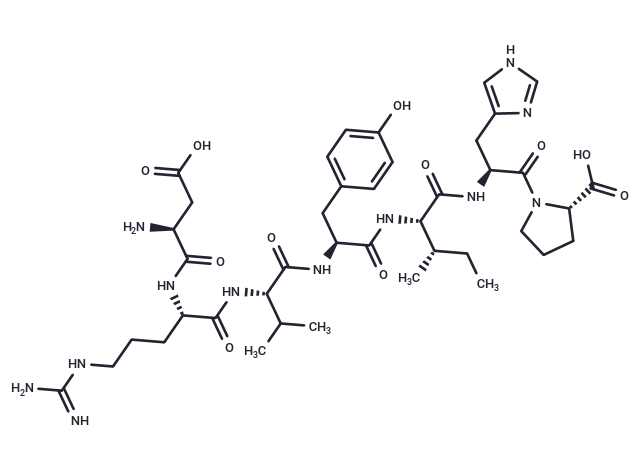
Synonyms: ASP-ARG-VAL-TYR-ILE-HIS-PRO, Angiotensin 1-7, Ang-(1-7)
| Pack Size | Price | USA Stock | Global Stock | Quantity |
|---|---|---|---|---|
| 2 mg | $33 | In Stock | In Stock | |
| 5 mg | $52 | In Stock | In Stock | |
| 10 mg | $81 | In Stock | In Stock | |
| 25 mg | $120 | In Stock | In Stock | |
| 50 mg | $207 | - | In Stock | |
| 100 mg | $270 | - | In Stock |
| Description | Angiotensin (1-7) (ASP-ARG-VAL-TYR-ILE-HIS-PRO) is a synthetic heptapeptide identical to endogenous angiotensin-(1-7) , inhibits purified canine ACE activity (IC50=0.65 μM) with vasodilator and antiproliferative activities. |
| Targets & IC50 | ACE:0.65 μM (IC50) |
| In vitro | ANG-(1-7) significantly attenuated ANG II-induced cardiac hypertrophy and perivascular fibrosis in these rats. These effects of ANG-(1-7) were confirmed in cultured cardiomyocytes, in which ANG-(1-7) significantly attenuated ANG II-induced increases in cell size[1]. |
| In vivo | Ang-(1-7) treatment attenuated the shortening of the atrial effective refractory period and the increase in the atrial fibrillation inducibility level. Immunohistochemistry and Western blotting showed sympathetic nerve hyperinnervation in the pacing group, while Ang-(1-7) attenuated sympathetic nerve proliferation. Ang-(1-7) alleviated the pacing-induced increases in tyrosine hydroxylase and nerve growth factor mRNA expression levels[2]. |
| Synonyms | ASP-ARG-VAL-TYR-ILE-HIS-PRO, Angiotensin 1-7, Ang-(1-7) |
| Cell Research | Cultured cardiomyocytes were treated with PBS (control), ANG II (100 nM), ANG-(1–7) (100 nM), ANG II + ANG-(1–7), ANG II + ANG-(1–7) + A779 (10 μM), ANG II + ANG-(1–7) + Sirt3 short hairpin (sh)RNA, lentiviral particles (1 × 10^6 TU) containing a Sirt3 shRNA viral vector, or ANG II + Mito-TEMPO (0.1 μM) for 24 h. Each treatment was performed in triplicate wells. Monoclonal anti-α-sarcomeric actin antibody was used for identification and measurement of cardiomyocytes via immunofluorescence staining. Cells were fixed in methanol at ?10°C and washed with fresh washing solution (0.1% Triton X-100 in PBS) three times. After preincubation with 3% BSA for 20 min, cells were incubated with primary antibody, which was diluted to 1:100 with PBS containing 3% BSA, overnight at 4°C. After three washings with the washing solution, cells were incubated with fluorescence-conjugated anti-mouse IgG (1:500 diluted in PBS) for 1 h at room temperature. Photographic images of cardiomyocytes were taken with a fluorescence microscope. Image-analysis software was used to measure the cell surface area of cardiomyocytes that were positively stained for sarcomeric actin. Variations in cell size were expressed as relative cell surface area versus the control. At least 50 cells in each dish were randomly selected for surface area analysis[1]. |
| Animal Research | Eighteen dogs were randomly assigned to sham group, pacing group and Ang-(1-7) group. Rapid atrial pacing was maintained for 14 days in the pacing and Ang-(1-7) groups. Ang-(1-7) was administered intravenously in the Ang-(1-7) group. The atrial effective refractory period and atrial fibrillation inducibility level were measured at baseline and under sympathetic nerve stimulation after 14 days of measurement. The atrial sympathetic nerves labeled with tyrosine hydroxylase were detected using immunohistochemistry and Western blotting, and tyrosine hydroxylase and nerve growth factor mRNA levels were measured by reverse transcription polymerase chain reaction[2]. |
| Molecular Weight | 899 |
| Formula | C41H62N12O11 |
| Cas No. | 51833-78-4 |
| Smiles | CC[C@H](C)[C@H](NC(=O)[C@H](Cc1ccc(O)cc1)NC(=O)[C@@H](NC(=O)[C@H](CCCNC(N)=N)NC(=O)[C@@H](N)CC(O)=O)C(C)C)C(=O)N[C@@H](Cc1c[nH]cn1)C(=O)N1CCC[C@H]1C(O)=O |
| Relative Density. | 1.47 g/cm3 |
| Sequence | Asp-Arg-Val-Tyr-Ile-His-Pro |
| Sequence Short | DRVYIHP |
| Storage | Keep away from moisture,Store at low temperature Powder: -20°C for 3 years | In solvent: -80°C for 1 year Shipping with blue ice/Shipping at ambient temperature. | ||||||||||||||||||||
| Solubility Information | H2O: 8.99 mg/mL (10 mM), Sonication is recommended.  | ||||||||||||||||||||
Solution Preparation Table | |||||||||||||||||||||
H2O
Note : The dilution table applies only to solid products. For liquid products, please calculate the stock solution based on the stated concentration and/or density. | |||||||||||||||||||||
 For example, if the intended dosage is 10 mg/kg for animals weighing 20 g , with a dosing volume of 100 μL per animal, and a total of 10 animals are to be administered, using a formulation of
  10% DMSO+ 40% PEG300+ 5% Tween 80+ 45% Saline/PBS/ddH2O , the resulting working solution concentration would be 2 mg/mL.
Dissolve 2 mg of the compound in 100 μL DMSO to obtain a stock solution at a concentration of 20 mg/mL . If the required concentration exceeds the compound's known solubility, please contact us for technical support before proceeding.
1) Add 100 μL of the DMSO stock solution to 400 µL PEG300 and mix thoroughly until the solution becomes clear.
2) Add 50 µL Tween 80 and mix well until fully clarified.
3) Add 450 µL Saline,PBS or ddH2O and mix thoroughly until a homogeneous solution is obtained.
| Size | Quantity | Unit Price | Amount | Operation |
|---|
 Feedback
 Hello! How can I help you today?
Copyright © 2015-2026 TargetMol Chemicals Inc. All Rights Reserved.
