


Shopping Cart
Remove All Your shopping cart is currently empty


Synonyms: VX-478, Prozei, KVX-478, 141W94
| Pack Size | Price | USA Stock | Global Stock | Quantity |
|---|---|---|---|---|
| 5 mg | $45 | In Stock | In Stock | |
| 10 mg | $77 | In Stock | In Stock | |
| 25 mg | $128 | In Stock | In Stock | |
| 50 mg | $213 | In Stock | In Stock | |
| 100 mg | $318 | In Stock | In Stock | |
| 1 mL x 10 mM (in DMSO) | $58 | In Stock | In Stock |
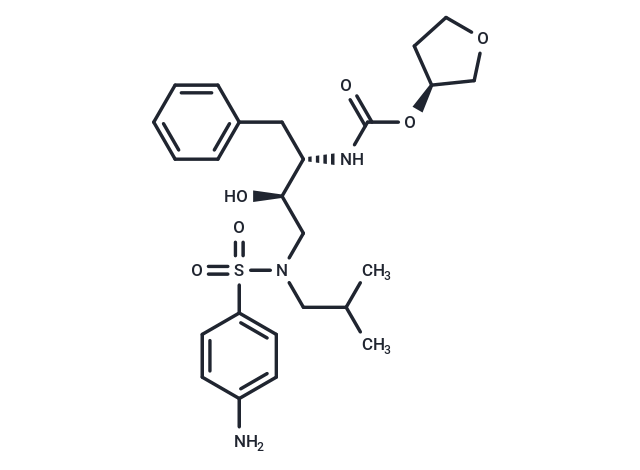
| Description | Amprenavir (KVX-478) is a synthetic derivative of hydroxyethylamine sulfonamide that selectively binds to and inhibits human immunodeficiency virus (HIV) protease. |
| Targets & IC50 | HIV protease:14.6 ng/mL |
| In vitro | Amprenavir promotes the specific interactions between the nuclear receptor pregnane X receptor (PXR) and the coactivators SRC-1 and PBP. Amprenavir is docked into the high-resolution crystal structure of human PXR in complex with SR12813. Amprenavir occupies all four subpockets, and its hydroxyl group forms a hydrogen bond with Ser247, which is located in the connection region of PXR, to help to position the drug in the optimal orientation inside the receptor. Amprenavir forms direct contacts with one residue on αAF of the PXR activation function-2 (AF-2) surface, Phe429, which may stabilize the active AF-2 conformation of the receptor and contribute to the agonist activity of amprenavir on PXR. Amprenavir induces the expression of bona fide PXR target genes involved in phase I (CYP3A4), phase II (UGT1A1), and phase III (MDR1) metabolism in both HepaRG cells and LS180 cells. [1] |
| In vivo | Amprenavir increases atherogenic LDL cholesterol fractions in WT mice, but not in PXR?/? mice. Amprenavir stimulates expression of known PXR target genes, including CYP3A11, glutathione transferase A1, and MDR1a, in the intestine of WT mice but not in PXR?/? mice. Amprenavir-mediated PXR activation stimulates the expression of both LipF and LipA in the intestine of WT mice, but not in PXR?/? mice, indicating a possible role of intestinal PXR in mediating dietary lipid breakdown and absorption in mammals. [1] |
| Synonyms | VX-478, Prozei, KVX-478, 141W94 |
| Kinase Assay | PARP Enzyme Assay: The enzyme assay is conducted in buffer containing 50 mM Tris, pH 8.0, 1 mM dithiothreitol(DTT), and 4 mM MgCl2. PARP reactions contains 1.5 μM [3H]-NAD+ (1.6 μCi/mmol), 200 nM biotinylated histone H1, 200 nM slDNA, and 1 nM PARP-1 or 4 nM PARP-2 enzyme. Autoreactions utilizing SPA bead-based detection are carried out in 100 μL volumes in white 96-well plates. Reactions are initiated by adding 50 μL of 2X NAD+ substrate mixture to 50 μL of 2× enzyme mixture containing PARP and DNA. These reactions are terminated by the addition of 150 μL of 1.5 mM benzamide (~1 × 10³-fold over its IC50). A 170 μL amount of the stopped reaction mixtures is transferred to streptavidin-coated Flash Plates, incubated for 1 hour, and counted using a TopCount microplate scintillation counter. Ki data are determined from inhibition curves at various substrate concentrations. |
| Molecular Weight | 505.63 |
| Formula | C25H35N3O6S |
| Cas No. | 161814-49-9 |
| Smiles | CC(C)CN(C[C@@H](O)[C@H](Cc1ccccc1)NC(=O)O[C@H]1CCOC1)S(=O)(=O)c1ccc(N)cc1 |
| Relative Density. | 1.3 g/cm3 |
| Storage | Store at low temperature Powder: -20°C for 3 years | In solvent: -80°C for 1 year Shipping with blue ice/Shipping at ambient temperature. | |||||||||||||||||||||||||||||||||||
| Solubility Information | DMSO: 125 mg/mL (247.22 mM), Sonication is recommended.  Ethanol: 93 mg/mL (183.93 mM), Sonication is recommended. H2O: < 1 mg/mL (insoluble or slightly soluble) | |||||||||||||||||||||||||||||||||||
| In Vivo Formulation | 10% DMSO+40% PEG300+5% Tween 80+45% Saline: 10 mg/mL (19.78 mM), Solution. 10% DMSO+90% Saline: < 10 mg/mL (19.78 mM), Lower concentrations may be soluble, but exact solubility limit is unknown. Please add the solvents sequentially, clarifying the solution as much as possible before adding the next one. Dissolve by heating and/or sonication if necessary. Working solution is recommended to be prepared and used immediately. The formulation provided above is for reference purposes only. In vivo formulations may vary and should be modified based on specific experimental conditions. | |||||||||||||||||||||||||||||||||||
Solution Preparation Table | ||||||||||||||||||||||||||||||||||||
Ethanol/DMSO
Note : The dilution table applies only to solid products. For liquid products, please calculate the stock solution based on the stated concentration and/or density. | ||||||||||||||||||||||||||||||||||||
 For example, if the intended dosage is 10 mg/kg for animals weighing 20 g , with a dosing volume of 100 μL per animal, and a total of 10 animals are to be administered, using a formulation of
  10% DMSO+ 40% PEG300+ 5% Tween 80+ 45% Saline/PBS/ddH2O , the resulting working solution concentration would be 2 mg/mL.
Dissolve 2 mg of the compound in 100 μL DMSO to obtain a stock solution at a concentration of 20 mg/mL . If the required concentration exceeds the compound's known solubility, please contact us for technical support before proceeding.
1) Add 100 μL of the DMSO stock solution to 400 µL PEG300 and mix thoroughly until the solution becomes clear.
2) Add 50 µL Tween 80 and mix well until fully clarified.
3) Add 450 µL Saline,PBS or ddH2O and mix thoroughly until a homogeneous solution is obtained.
| Size | Quantity | Unit Price | Amount | Operation |
|---|
 Feedback
 Hello! How can I help you today?
Copyright © 2015-2026 TargetMol Chemicals Inc. All Rights Reserved.
