Shopping Cart
Remove All
  • TargetMol
    Your shopping cart is currently empty

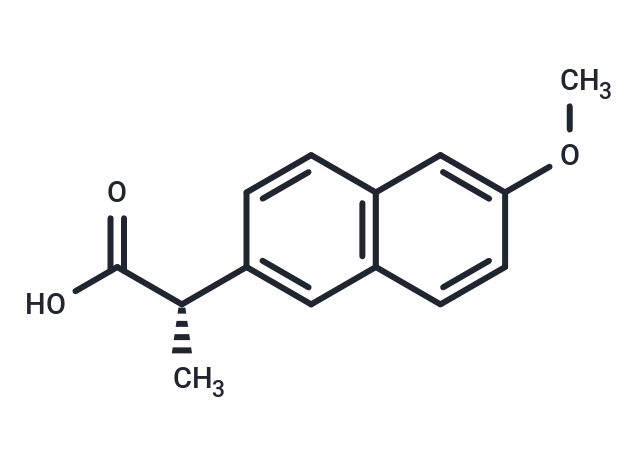
Naproxen

Copy Product Info
😃Good
Catalog No. T1582Cas No. 22204-53-1
Alias (S)-Naproxen

Naproxen ((S)-Naproxen) is a propionic acid derivative and a non-steroidal anti-inflammatory drug (NSAID) with anti-inflammatory, antipyretic and analgesic activities.

Naproxen

Naproxen

Copy Product Info
😃Good
Purity: 99.89%
Catalog No. T1582Alias (S)-NaproxenCas No. 22204-53-1
Naproxen ((S)-Naproxen) is a propionic acid derivative and a non-steroidal anti-inflammatory drug (NSAID) with anti-inflammatory, antipyretic and analgesic activities.
Pack SizePriceUSA WarehouseGlobal WarehouseQuantity
500 mg$40In StockIn Stock
1 g$42-In Stock
5 g$48-In Stock
1 mL x 10 mM (in DMSO)$44In StockIn Stock
Add to Cart
Add to Quotation
In Stock Estimated shipping dateUSA Warehouse[1-2 days] Global Warehouse[5-7 days]
All TargetMol products are for research purposes only and cannot be used for human consumption. We do not provide products or services to individuals. Please comply with the intended use and do not use TargetMol products for any other purpose.
Questions
TargetMol
View More

Batch Information

Select Batch
Purity:99.89%
Color:White
Contact us for more batch information

Resource Download

Product Introduction

Naproxen AI Summary
Naproxen exhibits a comprehensive range of bioactivities and physicochemical properties relevant to pharmacological research. It demonstrates significant binding affinity to human serum albumin with a binding constant of Log K' = 0.25, indicating specific interaction potential. The compound shows effective permeability in humans with a Peff value of 8.3, a pKa value of 4.01, and a log P of 3.58, which suggests favorable absorption characteristics. Its bioactivity profile includes inhibition of prostaglandin synthetase in mouse brain microsomes (IC50 of 13,000 nM), superior anti-inflammatory properties (COX-1 IC50 at 2,700 nM, and COX-2 IC50 at 9,700 nM), and analgesic effects in several inflammation models such as adjuvant-induced arthritis with an ED50 of 0.94 mg/kg. Naproxen also exhibits interactions with cellular targets like the Thyroid Stimulating Hormone Receptor and Mitochondrial Division, indicating broad bioactivity. It displays anti-inflammatory activity with an 81.81% inhibition of carrageenan-induced paw edema in rats at 30 mg/kg and low ulcerogenic activity with a UI of 2.25 at 90 mg/kg. The compound has been observed to interact with lipid peroxidation processes and shows a favorable therapeutic index. Furthermore, Naproxen selectively inhibits COX enzymes, with a higher potency for COX-1 (IC50 at 11,000 nM) over COX-2 (IC50 at 1,010,000 nM), suggesting specific anti-inflammatory action. It also exhibits anti-nociceptive effects and potential hepatotoxicity based on enzyme activity and liver function tests. Its binding affinity to amyloid beta fibrils (Ki of 5.7 nM) suggests possible applications in neurodegenerative disease research. Pharmacokinetically, it shows high bioavailability with extensive binding to plasma proteins (log K of 3.34 in octanol-water partitioning). The compound displays efficient inhibition of various enzymatic pathways (notably aIC50 of 480 nM for AKR1C3) and low permeability across certain membrane models. Overall, Naproxen presents a multi-faceted bioactivity profile with potential therapeutic implications across inflammation, pain relief, and possibly neurodegeneration, meriting further detailed pharmacological and toxicological investigation..
Note: Summary generated by AI. Data source: ChEMBL
Bioactivity
Description
Naproxen ((S)-Naproxen) is a propionic acid derivative and a non-steroidal anti-inflammatory drug (NSAID) with anti-inflammatory, antipyretic and analgesic activities.
Targets&IC50
COX-2:5.15 μM, COX-1:8.72 μM
Synonyms(S)-Naproxen
Chemical Properties
Molecular Weight230.26
FormulaC14H14O3
Cas No.22204-53-1
Smiles[C@H](C(O)=O)(C)C1=CC2=C(C=C(OC)C=C2)C=C1
Relative Density.1.1450 g/cm3 (Estimated)
Storage & Solubility Information
StoragePowder: -20°C for 3 years | In solvent: -80°C for 1 year | Shipping with blue ice/Shipping at ambient temperature.
Solubility Information
DMSO: 250 mg/mL (1085.73 mM), Sonication is recommended.

In Vivo Formulation
10% DMSO+40% PEG300+5% Tween 80+45% Saline: 2 mg/mL (8.69 mM), Sonication is recommended.
Please add the solvents sequentially, clarifying the solution as much as possible before adding the next one. Dissolve by heating and/or sonication if necessary. Working solution is recommended to be prepared and used immediately. The formulation provided above is for reference purposes only. In vivo formulations may vary and should be modified based on specific experimental conditions.
Solution Preparation Table
DMSO
1mg5mg10mg50mg
1 mM4.3429 mL21.7146 mL43.4292 mL217.1458 mL
5 mM0.8686 mL4.3429 mL8.6858 mL43.4292 mL
10 mM0.4343 mL2.1715 mL4.3429 mL21.7146 mL
20 mM0.2171 mL1.0857 mL2.1715 mL10.8573 mL
50 mM0.0869 mL0.4343 mL0.8686 mL4.3429 mL
100 mM0.0434 mL0.2171 mL0.4343 mL2.1715 mL

Calculator

  • Molarity Calculator
  • Dilution Calculator
  • Reconstitution Calculator
  • Molecular Weight Calculator

In Vivo Formulation Calculator (Clear solution)

Please enter your animal experiment information in the following box and click Calculate to obtain the stock solution preparation method and in vivo formula preparation method:
TargetMol | Animal experiments For example, if the intended dosage is 10 mg/kg for animals weighing 20 g , with a dosing volume of 100 μL per animal, TargetMol | Animal experiments and a total of 10 animals are to be administered, using a formulation of TargetMol | reagent 10% DMSO+ 40% PEG300+ 5% Tween 80+ 45% Saline/PBS/ddH2O , the resulting working solution concentration would be 2 mg/mL.

Stock Solution Preparation:

Dissolve 2 mg of the compound in 100 μL DMSOTargetMol | reagent to obtain a stock solution at a concentration of 20 mg/mL . If the required concentration exceeds the compound's known solubility, please contact us for technical support before proceeding.

Preparation of the In Vivo Formulation:

1) Add 100 μL of the DMSOTargetMol | reagent stock solution to 400 μL PEG300TargetMol | reagent and mix thoroughly until the solution becomes clear.

2) Add 50 μL Tween 80 and mix well until fully clarified.

3) Add 450 μL Saline,PBS or ddH2OTargetMol | reagent and mix thoroughly until a homogeneous solution is obtained.

This example is provided solely to demonstrate the use of the In Vivo Formulation Calculator and does not constitute a recommended formulation for any specific compound. Please select an appropriate dissolution and formulation strategy based on your experimental model and route of administration.
All co-solvents required for this protocol, includingDMSO, PEG300/PEG400, Tween 80, SBE-β-CD, and Corn oil, are available for purchase on the TargetMol website.
1 Enter information below:
mg/kg
g
μL
2 Enter the in vivo formulation:
% DMSO
%
% Tween 80
% Saline/PBS/ddH2O

Dose Conversion

You can also refer to dose conversion for different animals. More Dose Conversion

Tech Support

Please see Inhibitor Handling Instructions for more frequently ask questions. Topics include: how to prepare stock solutions, how to store products, and cautions on cell-based assays & animal experiments, etc

Keywords

Related Tags: buy Naproxen | purchase Naproxen | Naproxen cost | order Naproxen | Naproxen chemical structure | Naproxen formula | Naproxen molecular weight