


Shopping Cart
Remove All Your shopping cart is currently empty

Synonyms: NSC 737664, ABT-888
| Pack Size | Price | USA Stock | Global Stock | Quantity |
|---|---|---|---|---|
| 5 mg | $52 | In Stock | In Stock | |
| 10 mg | $74 | In Stock | In Stock | |
| 25 mg | $129 | In Stock | In Stock | |
| 50 mg | $217 | In Stock | In Stock | |
| 100 mg | $349 | In Stock | In Stock | |
| 200 mg | $568 | In Stock | In Stock | |
| 500 mg | $897 | - | In Stock | |
| 1 mL x 10 mM (in DMSO) | $58 | In Stock | In Stock |
| Description | Veliparib (ABT-888) (ABT-888) is an orally bioavailable inhibitor of PARP (Kis: 5.2/2.9 nM for PARP1/2). It enhances apoptosis and autophagy. |
| Targets & IC50 | PARP1:5.2 nM (cell free), PARP2:2.9 nM (cell free) |
| In vitro | Veliparib (ABT-888) is a potent inhibitor of both PARP-1 and PARP-2 with K(i)s of 5.2 and 2.9 nmol/L, respectively [1]. In the HaCaT cell model, ABT-888 can reduce SM-induced NAD(+)/ATP depletion and apoptosis/necrosis [2]. ABT-888 reduced clonogenic survival in H460 lung cancer cells and inhibited DNA repair as shown by enhanced expression of DNA strand break marker histone gamma-H2AX [3]. |
| In vivo | PARP inhibition dramatically increased the efficacy of temozolomide at Veliparib doses as low as 3.1 mg/kg/d and a maximal efficacy achieved at 25 mg/kg/d. In the MX-1 breast xenograft model (BRCA1 deletion and BRCA2 mutation), Veliparib potentiated cisplatin, carboplatin, and cyclophosphamide, causing regression of established tumors, whereas, with comparable doses of cytotoxic agents alone, only modest tumor inhibition was exhibited [1]. Veliparib increased tumor growth delay at well-tolerated doses in murine models. For a 5-fold increase in tumor volume, tumor growth delay was 1 day for Veliparib alone, 7 days for radiation alone, and 13.5 days for combination treatment. A decrease in vitro endothelial tubule formation with Veliparib/radiation combination treatment and von Willebrand factor staining of tumor sections revealed decreased vessel formation in vivo [3]. |
| Synonyms | NSC 737664, ABT-888 |
| Kinase Assay | PARP assays were conducted in a buffer containing 50 mmol/L Tris (pH 8.0), 1 mmol/L DTT, 1.5 μmol/L [3H]NAD+ (1.6 μCi/mmol), 200 nmol/L biotinylated histone H1, 200 nmol/L slDNA, and 1 nmol/L PARP-1 or 4 nmol/L PARP-2 enzyme. Reactions were terminated with 1.5 mmol/L benzamide, transferred to streptavidin Flash plates, and counted using a TopCount microplate scintillation counter [1]. |
| Cell Research | Cell viability was quantified using the Cell Counting Kit-8 (CCK-8). This assay is based on Dojindo's highly water-soluble tetrazolium salt. WST-8 is reduced by dehydrogenases in cells to give an orange, water-soluble formazan dye. The amount of formazan dye generated by dehydrogenases in cells is directly proportional to the number of living cells. Briefly, exponentially growing HaCaT cells were seeded in 96-well plates at a density of 10,000 cells/well. 6 h or 24 h after exposure to SM and the administration of ABT-888, the CCK-8 reagent was added as recommended by the supplier [2]. |
| Animal Research | For oral pharmacokinetic studies, ABT-888 was separated from plasma and brain homogenate using liquid-liquid extraction with a mixture of ethyl acetate and hexane at alkaline pH. ABT-888 and the internal standard were separated from each other and coextracted contaminants on a 50 × 3 mm Keystone Betasil Cyano 5 μm C18 column with acetonitrile: 0.1% trifluoroacetic acid mobile phase (40:60, by volume) at a flow rate of 0.3 mL/min. Analysis was done on a Sciex API3000 Biomolecular Mass Analyzer with a turbo-ionspray interface using Sciex MacQuan software. The analysis of plasma pharmacokinetics from osmotic minipump (OMP) studies was conducted using acidified methanol precipitated plasma. Samples were injected onto a Phenomenex Synergi 4μ Polar RP column and ABT-888 eluted with a mixture of acetonitrile and 0.1% acetic acid in water at a flow rate of 0.4 mL/min. Mass analysis was done with a ThermoFinnigan LCQ Duo using Xcalibur software [1]. |
| Molecular Weight | 244.29 |
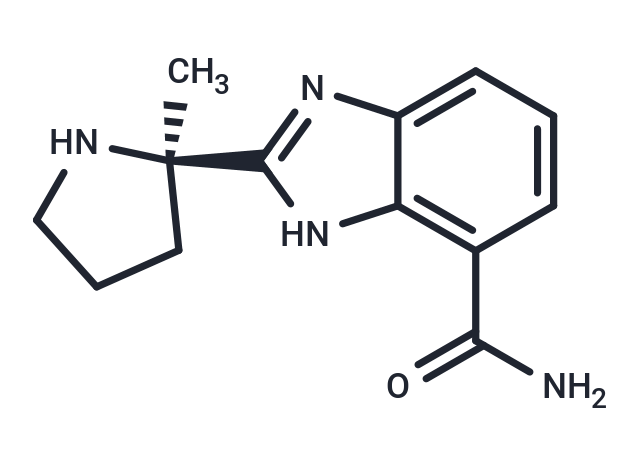
| Formula | C13H16N4O |
| Cas No. | 912444-00-9 |
| Smiles | C(N)(=O)C1=C2C(N=C(N2)[C@@]3(C)CCCN3)=CC=C1 |
| Relative Density. | 1.274 g/cm3 |
| Storage | Powder: -20°C for 3 years | In solvent: -80°C for 1 year Shipping with blue ice/Shipping at ambient temperature. | |||||||||||||||||||||||||||||||||||
| Solubility Information | H2O: < 1 mg/mL (insoluble or slightly soluble) Ethanol: < 1 mg/mL (insoluble or slightly soluble) DMSO: 50 mg/mL (204.67 mM), Sonication is recommended.  | |||||||||||||||||||||||||||||||||||
| In Vivo Formulation | 10% DMSO+40% PEG300+5% Tween 80+45% Saline: 2 mg/mL (8.19 mM), Sonication is recommended. Please add the solvents sequentially, clarifying the solution as much as possible before adding the next one. Dissolve by heating and/or sonication if necessary. Working solution is recommended to be prepared and used immediately. The formulation provided above is for reference purposes only. In vivo formulations may vary and should be modified based on specific experimental conditions. | |||||||||||||||||||||||||||||||||||
Solution Preparation Table | ||||||||||||||||||||||||||||||||||||
DMSO
Note : The dilution table applies only to solid products. For liquid products, please calculate the stock solution based on the stated concentration and/or density. | ||||||||||||||||||||||||||||||||||||
 For example, if the intended dosage is 10 mg/kg for animals weighing 20 g , with a dosing volume of 100 μL per animal, and a total of 10 animals are to be administered, using a formulation of
  10% DMSO+ 40% PEG300+ 5% Tween 80+ 45% Saline/PBS/ddH2O , the resulting working solution concentration would be 2 mg/mL.
Dissolve 2 mg of the compound in 100 μL DMSO to obtain a stock solution at a concentration of 20 mg/mL . If the required concentration exceeds the compound's known solubility, please contact us for technical support before proceeding.
1) Add 100 μL of the DMSO stock solution to 400 µL PEG300 and mix thoroughly until the solution becomes clear.
2) Add 50 µL Tween 80 and mix well until fully clarified.
3) Add 450 µL Saline,PBS or ddH2O and mix thoroughly until a homogeneous solution is obtained.
| Size | Quantity | Unit Price | Amount | Operation |
|---|
 Feedback
 Hello! How can I help you today?
Copyright © 2015-2026 TargetMol Chemicals Inc. All Rights Reserved.
