


Shopping Cart
Remove All
  • TargetMol
    Your shopping cart is currently empty

Scopolamine

Copy Product Info
😃Good
Catalog No. T3S0478Cas No. 51-34-3
Alias Skopolamin, Scopine tropate, Scopine (-)-tropate, Hyoscine
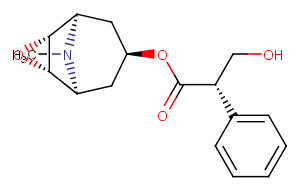
Scopolamine is a high-affinity (nanomolar level) muscarinic receptor antagonist that can reversibly inhibit 5-HT₃ receptor responses (IC₅₀ = 2.09 μM). It is commonly used to induce animal models of Alzheimer's disease or memory impairment.

Scopolamine

Scopolamine

Copy Product Info
😃Good
Purity: 99.95%
Catalog No. T3S0478Alias Skopolamin, Scopine tropate, Scopine (-)-tropate, HyoscineCas No. 51-34-3
Scopolamine is a high-affinity (nanomolar level) muscarinic receptor antagonist that can reversibly inhibit 5-HT₃ receptor responses (IC₅₀ = 2.09 μM). It is commonly used to induce animal models of Alzheimer's disease or memory impairment.
Pack SizePriceUSA WarehouseGlobal WarehouseQuantity
10 mg$37-In Stock
25 mg$56-In Stock
50 mg$83-In Stock
100 mg$118-In Stock
500 mg$242-In Stock
Add to Cart
Add to Quotation
In Stock Estimated shipping dateUSA Warehouse[1-2 days] Global Warehouse[5-7 days]
This molecule is a custom-made product. TargetMol has an excellent synthesis team with the experience and capability to provide you with cost-effective products.If you have any questions, please feel free to contact us. We are committed to serving you wholeheartedly.
All TargetMol products are for research purposes only and cannot be used for human consumption. We do not provide products or services to individuals. Please comply with the intended use and do not use TargetMol products for any other purpose.
Questions
TargetMol
View More

Batch Information

Select Batch
Purity:99.95%
Appearance:Oil
Contact us for more batch information

Resource Download

Product Introduction

Bioactivity
Description
Scopolamine is a high-affinity (nanomolar level) muscarinic receptor antagonist that can reversibly inhibit 5-HT₃ receptor responses (IC₅₀ = 2.09 μM). It is commonly used to induce animal models of Alzheimer's disease or memory impairment.
Targets&IC50
5-HT3:2.09 μM.
Disease Modeling Protocol
Alzheimer's Disease (AD) Model
  • Modeling Mechanism:

    Scopolamine, as an anticholinergic drug, inhibits acetylcholine-mediated neural signaling by blocking central cholinergic receptors. Simultaneously, it induces oxidative stress (accumulation of reactive oxygen species (ROS), inhibits endogenous antioxidant pathways (downregulation of Nrf2/HO-1 expression), activates the NF-κB inflammatory signaling pathway, promotes the release of pro-inflammatory factors (TNF-α) and inflammatory enzymes (COX-2), triggers neuroinflammation, and ultimately leads to learning and memory dysfunction, mimicking the core pathological features of Alzheimer's disease (memory decline, neuroinflammation, and oxidative stress).

  • Related Products:

    Scopolamine (T3S0478)

  • Modeling Method:

    Experimental Subject:

    Mice, BALB/c mice, Male, 7–8 weeks old, Body weight 25–30 g

    Dosage and Administration Route:

    ① Core modelling: Scopolamine, 1 mg/kg/day, dissolved in physiological saline, intraperitoneal injection;
    ② Control treatment: Control group administered equal volume saline solution via intraperitoneal injection; all other housing and treatment conditions identical;
    ③ Intervention validation group (optional): During weeks 2–3 of modelling (one week after scopolamine administration), concurrently administer neuroprotective agent (e.g., ranuncoside) at 10 mg/kg via intraperitoneal injection every other day for 2 weeks;

    Dosing Frequency and Duration Model:

    Once daily for 3 consecutive weeks

  • Validation:

    1. Behavioral indicators: - Morris water maze (MWM): significantly prolonged escape latency (F=10.88, p<0.01), shortened time spent in the target quadrant (F=75, p<0.001), suggesting a decline in spatial learning and memory abilities; - Y maze: significantly reduced percentage of spontaneous alternation behavior (F=262.1, p<0.001), suggesting working memory impairment; 2. Biochemical indicators: - Metabolic indicators: elevated random blood glucose (F=370.4, p<0.01), elevated serum LDL, total cholesterol (TC), and triglycerides (TG), and decreased HDL (p<0.01); 3. Molecular indicators: - Oxidative stress: significantly downregulated expression of Nrf2 and HO-1 proteins in the brain (F=195.9 and 204.5, respectively, p<0.001); - Neuroinflammation: significantly upregulated expression of NF-κB, COX-2, and TNF-α proteins in the brain (F=195.9 and 204.5, respectively, p<0.001); The values were 175.0, 565.1, and 386.8 respectively (p < 0.001).

*Precautions:

*References:Sara Salahuddin H,et,al. Ranuncoside's attenuation of scopolamine-induced memory impairment in mice via Nrf2 and NF-ĸB signaling. Saudi Pharm J. 2023 Sep;31(9):101702.

SynonymsSkopolamin, Scopine tropate, Scopine (-)-tropate, Hyoscine
Chemical Properties
Molecular Weight303.35
FormulaC17H21NO4
Cas No.51-34-3
SmilesCN1[C@H]2C[C@@H](C[C@@H]1[C@H]1O[C@@H]21)OC(=O)[C@H](CO)c1ccccc1
Relative Density.1.31
Storage & Solubility Information
Storagekeep away from direct sunlight | Powder: -20°C for 3 years | In solvent: -80°C for 1 year | Shipping with blue ice/Shipping at ambient temperature.
Solubility Information
DMSO: 75 mg/mL (247.24 mM), Sonication is recommended.

In Vivo Formulation
10% DMSO+40% PEG300+5% Tween 80+45% Saline: 2 mg/mL (6.59 mM), Sonication is recommended.
Please add the solvents sequentially, clarifying the solution as much as possible before adding the next one. Dissolve by heating and/or sonication if necessary. Working solution is recommended to be prepared and used immediately. The formulation provided above is for reference purposes only. In vivo formulations may vary and should be modified based on specific experimental conditions.
Solution Preparation Table
DMSO
1mg5mg10mg50mg
1 mM3.2965 mL16.4826 mL32.9652 mL164.8261 mL
5 mM0.6593 mL3.2965 mL6.5930 mL32.9652 mL
10 mM0.3297 mL1.6483 mL3.2965 mL16.4826 mL
20 mM0.1648 mL0.8241 mL1.6483 mL8.2413 mL
50 mM0.0659 mL0.3297 mL0.6593 mL3.2965 mL
100 mM0.0330 mL0.1648 mL0.3297 mL1.6483 mL

Calculator

  • Molarity Calculator
  • Dilution Calculator
  • Reconstitution Calculator
  • Molecular Weight Calculator

In Vivo Formulation Calculator (Clear solution)

Please enter your animal experiment information in the following box and click Calculate to obtain the stock solution preparation method and in vivo formula preparation method:
TargetMol | Animal experiments For example, if the intended dosage is 10 mg/kg for animals weighing 20 g , with a dosing volume of 100 μL per animal, TargetMol | Animal experiments and a total of 10 animals are to be administered, using a formulation of TargetMol | reagent 10% DMSO+ 40% PEG300+ 5% Tween 80+ 45% Saline/PBS/ddH2O , the resulting working solution concentration would be 2 mg/mL.

Stock Solution Preparation:

Dissolve 2 mg of the compound in 100 μL DMSOTargetMol | reagent to obtain a stock solution at a concentration of 20 mg/mL . If the required concentration exceeds the compound's known solubility, please contact us for technical support before proceeding.

Preparation of the In Vivo Formulation:

1) Add 100 μL of the DMSOTargetMol | reagent stock solution to 400 μL PEG300TargetMol | reagent and mix thoroughly until the solution becomes clear.

2) Add 50 μL Tween 80 and mix well until fully clarified.

3) Add 450 μL Saline,PBS or ddH2OTargetMol | reagent and mix thoroughly until a homogeneous solution is obtained.

This example is provided solely to demonstrate the use of the In Vivo Formulation Calculator and does not constitute a recommended formulation for any specific compound. Please select an appropriate dissolution and formulation strategy based on your experimental model and route of administration.
All co-solvents required for this protocol, includingDMSO, PEG300/PEG400, Tween 80, SBE-β-CD, and Corn oil, are available for purchase on the TargetMol website.
1 Enter information below:
mg/kg
g
μL
2 Enter the in vivo formulation:
% DMSO
%
% Tween 80
% Saline/PBS/ddH2O

Dose Conversion

You can also refer to dose conversion for different animals. More Dose Conversion

Tech Support

Please see Inhibitor Handling Instructions for more frequently ask questions. Topics include: how to prepare stock solutions, how to store products, and cautions on cell-based assays & animal experiments, etc

Keywords

Related Tags: buy Scopolamine | purchase Scopolamine | Scopolamine cost | order Scopolamine | Scopolamine chemical structure | Scopolamine formula | Scopolamine molecular weight




