


Shopping Cart
Remove All Your shopping cart is currently empty


Synonyms: Naftopidil DiHCl, KT-611 2HCl
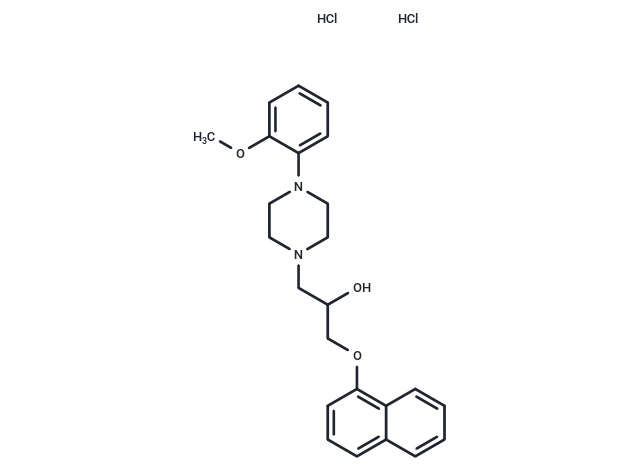
| Pack Size | Price | USA Stock | Global Stock | Quantity |
|---|---|---|---|---|
| 25 mg | $29 | In Stock | In Stock | |
| 1 mL x 10 mM (in DMSO) | $29 | In Stock | In Stock |
| Description | Naftopidil dihydrochloride (KT-611 2HCl) is a selective 5-HT1A and α1-adrenergic receptor antagonist with IC50 of 0.1 μM and 0.2 μM, respectively. |
| Targets & IC50 | 5-HT1A:0.1 μM, α1B-adrenoceptor:20 nM (Ki), α1D-adrenoceptor:1.2 (Ki), α1-adrenoceptor:0.2 μM, α1A-adrenoceptor:3.7 nM (Ki) |
| In vitro | Naftopidil diHCl possesses 5-HT1A agonistic properties in addition to being an α1-adrenoceptor antagonist. [1] Naftopidil has growth inhibitory effect in androgen-sensitive and -insensitive human prostate cancer cell lines. Naftopidil inhibits the growth of androgen-sensitive LNCaP cells and androgen-insensitive PC-3 cells with IC50 of 22.2 μM and 33.2 μM, respectively. Cell growth inhibition by Naftopidil is due to the arrest of the G1 cell cycle. Expressions of p27kip1 and p21cip1 are significantly increased in LNCaP cells treated with Naftopidil. In PC-3 cells, Naftopidil induces p21cip1 but not p27kip1. [2] Naftopidil produces a concentration-dependent inhibition of collagen-induced Ca2+ mobilization, maximum inhibition (22.9%) occurring with 40 μM Naftopidil. The adrenaline-induced rise in [Ca2+]i is inhibited dose dependently by Naftopidil. [3] Naftopidil is significantly more effective than tamsulosin in relieving nocturia. [4] Naftopidil induces G(1) cell-cycle arrest in both PCa cells and PrSC. In Naftopidil-treated PrSC, total interleukin-6 protein is significantly reduced with increased suppression of cell proliferation. [5] |
| In vivo | Oral administration of Naftopidil to nude mice inhibits the growth of PC-3 tumors as compared to vehicle-treated controls. Naftopidil improves bladder capacity and relaxed voiding via inhibition of afferent nerve activity. [2] Naftopidil (0.1 μg–30 μg) transiently abolishes isovolumetric rhythmic bladder contraction. The amplitude of bladder contraction is decreased by intrathecal injection of naftopidil (3 μg–30 μg). [6] Naftopidil selectively inhibits the phenylephrine-induced increase in prostatic pressure compared with mean blood pressure in the anesthetized dog model. [7] |
| Synonyms | Naftopidil DiHCl, KT-611 2HCl |
| Cell Research | Cell cycle analysis is performed by flow cytometry. Cells are treated with either 20 μM Naftopidil (LNCaP), 40 μM Naftopidil (PC-3) or vehicle (0.1% DMSO) for 24 hours, then trypsinized and washed once with phosphate-buffer saline (PBS), fixed in 70% ethanol and stored at 4 °C for subsequent cell cycle analysis. Fixed cells are washed with PBS and incubated with PBS containing 20 μg/mL RNaseA and 0.3% NP-40 for 30 minutes at 37 °C, then stained with 50 μg/mL propidium iodide (PI) for 30 minutes at 4 癈 in the dark. The DNA content of 1 ?106 stained cells is analyzed on a FACS Caliburflow cytometer. The fractions of cells in the G0/G1, S and G2/M phases are calculated using Cell Quest software.(Only for Reference) |
| Molecular Weight | 465.41 |
| Formula | C24H28N2O3·2HCl |
| Cas No. | 57149-08-3 |
| Smiles | Cl.Cl.COC1=CC=CC=C1N1CCN(CC(O)COC2=C3C=CC=CC3=CC=C2)CC1 |
| Relative Density. | 1.184g/cm3 |
| Storage | Powder: -20°C for 3 years | In solvent: -80°C for 1 year Shipping with blue ice/Shipping at ambient temperature. | |||||||||||||||||||||||||||||||||||
| Solubility Information | H2O: < 1 mg/mL (insoluble or slightly soluble) Ethanol: 2 mg/mL (4.3 mM), Sonication is recommended. DMSO: 39 mg/mL (83.8 mM), Sonication is recommended. | |||||||||||||||||||||||||||||||||||
Solution Preparation Table | ||||||||||||||||||||||||||||||||||||
Ethanol/DMSO
DMSO
Note : The dilution table applies only to solid products. For liquid products, please calculate the stock solution based on the stated concentration and/or density. | ||||||||||||||||||||||||||||||||||||
 For example, if the intended dosage is 10 mg/kg for animals weighing 20 g , with a dosing volume of 100 μL per animal, and a total of 10 animals are to be administered, using a formulation of
  10% DMSO+ 40% PEG300+ 5% Tween 80+ 45% Saline/PBS/ddH2O , the resulting working solution concentration would be 2 mg/mL.
Dissolve 2 mg of the compound in 100 μL DMSO to obtain a stock solution at a concentration of 20 mg/mL . If the required concentration exceeds the compound's known solubility, please contact us for technical support before proceeding.
1) Add 100 μL of the DMSO stock solution to 400 µL PEG300 and mix thoroughly until the solution becomes clear.
2) Add 50 µL Tween 80 and mix well until fully clarified.
3) Add 450 µL Saline,PBS or ddH2O and mix thoroughly until a homogeneous solution is obtained.
| Size | Quantity | Unit Price | Amount | Operation |
|---|
 Feedback
 Hello! How can I help you today?
Copyright © 2015-2026 TargetMol Chemicals Inc. All Rights Reserved.
