


Shopping Cart
Remove All Your shopping cart is currently empty

Synonyms:

| Pack Size | Price | USA Stock | Global Stock | Quantity |
|---|---|---|---|---|
| 1 mg | $48 | In Stock | In Stock | |
| 2 mg | $67 | In Stock | In Stock | |
| 5 mg | $125 | In Stock | In Stock | |
| 10 mg | $216 | In Stock | In Stock | |
| 25 mg | $393 | In Stock | In Stock | |
| 50 mg | $589 | In Stock | In Stock | |
| 100 mg | $843 | - | In Stock | |
| 1 mL x 10 mM (in DMSO) | $125 | In Stock | In Stock |
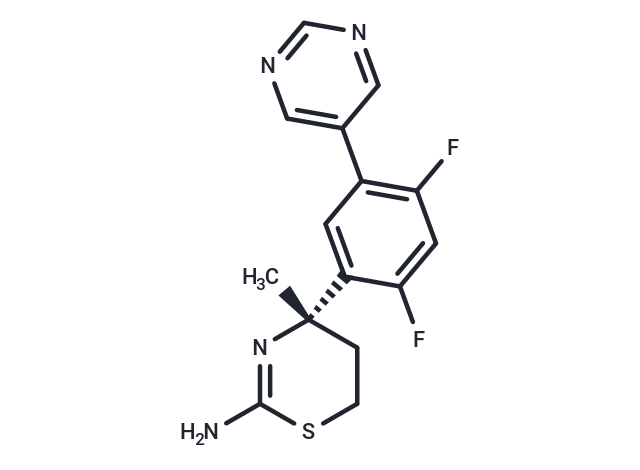
| Description | LY2811376, an orally available non-peptidic β-secretase(BACE1) inhibitor (IC50: 239-249 nM), can decrease Aβ secretion (EC50: 300 nM). It has 10-fold selectivity towards BACE1 over BACE2, and more than 50-fold inhibition over other aspartic proteases including pepsin, cathepsin D, or renin. |
| Targets & IC50 | BACE1:239 nM-249 nM, β-Amyloid:300 nM(EC50) |
| In vitro | In the APPV717F mouse model of Aβ pathology, LY2811376 (10/30/100 mg/kg) induced a dose-dependent significant reduction in Aβ, sAPPβ, and C99, which are the closest breakdown products following the hydrolysis of APP by BACE1 protein. In beagle dogs, LY2811376 (5 mg/kg) resulted in a decrease in plasma Aβ1-x levels, with the maximum reduction of 85% occurring between 4-12 hours post-administration. |
| In vivo | LY2811376 exhibits a concentration-dependent reduction in the secretion of Aβ in HEK293 cells overexpressing APP. It also concentration-dependently inhibits hBACE1, including small synthetic peptide substrates (IC50: 239 nM) and larger chimeric protein substrates (IC50: 249 nM). In primary neuronal cultures from PDAPP transgenic mice, LY2811376 inhibits Aβ secretion (EC50: 100 nM). |
| Kinase Assay | Determination of enzymatic ef?ciency: The stock solution for each FRET peptide substrate is prepared at 30 mM in dimethylsulfoxide (DMSO). The huBACE1:Fc muBACE1:Fc preparation is concentrated through YM10 Centricon. to a ?nal concentration of at least 7 mg/mL. The optimal enzyme concentration for each FRET peptide substrate is determined individually at 30 μM FRET peptide substrate in 50 mM ammonium acetate, pH 4.6, 1 mg/mL BSA and 1 mM Triton X-100. The enzymatic ef?ciency (kcat /Km) of either of the BACE1 orthologs toward individual FRET peptide substrates at 15, 30 and 100 μM is determined under the optimal conditions for each substrate. The progress of the reaction is monitored by measuring an increase of the emission signal at 420 nm with excitation wavelength set at 320 nm, using a GEMINI ?uorescence plate reader. Amino acid conjugated aminobenzoate is used to convert the emission signal in the relative ?uorescence units into the molar concentration of product generated in the reaction mixture. The initial phase of the timedependence curve is ?tted with a linear function whose slope is used to calculate the initial rate for huBACE1:Fc toward each peptide substrate. The kcat /Km values are calculated from the linear dependence of the initial rate on the concentration of each peptide. |
| Cell Research | The cytotoxicity in the HEK293Swe cell model is assessed using a CellTiter 96 Aqueous Non-Radioactive Cell Proliferation Assay. (Only for Reference) |
| Molecular Weight | 320.36 |
| Formula | C15H14F2N4S |
| Cas No. | 1194044-20-6 |
| Smiles | C[C@]1(CCSC(N)=N1)c1cc(c(F)cc1F)-c1cncnc1 |
| Relative Density. | 1.42 g/cm3 |
| Storage | Powder: -20°C for 3 years | In solvent: -80°C for 1 year Shipping with blue ice/Shipping at ambient temperature. | ||||||||||||||||||||||||||||||||||||||||
| Solubility Information | H2O: < 1 mg/mL (insoluble or slightly soluble) DMSO: 13 mg/mL (40.58 mM), Sonication is recommended. Ethanol: 60 mg/mL (187.29 mM), Sonication is recommended. | ||||||||||||||||||||||||||||||||||||||||
| In Vivo Formulation | 10% DMSO+40% PEG300+5% Tween 80+45% Saline: 2 mg/mL (6.24 mM), Sonication is recommended. Please add the solvents sequentially, clarifying the solution as much as possible before adding the next one. Dissolve by heating and/or sonication if necessary. Working solution is recommended to be prepared and used immediately. The formulation provided above is for reference purposes only. In vivo formulations may vary and should be modified based on specific experimental conditions. | ||||||||||||||||||||||||||||||||||||||||
Solution Preparation Table | |||||||||||||||||||||||||||||||||||||||||
DMSO/Ethanol
Ethanol
Note : The dilution table applies only to solid products. For liquid products, please calculate the stock solution based on the stated concentration and/or density. | |||||||||||||||||||||||||||||||||||||||||
 For example, if the intended dosage is 10 mg/kg for animals weighing 20 g , with a dosing volume of 100 μL per animal, and a total of 10 animals are to be administered, using a formulation of
  10% DMSO+ 40% PEG300+ 5% Tween 80+ 45% Saline/PBS/ddH2O , the resulting working solution concentration would be 2 mg/mL.
Dissolve 2 mg of the compound in 100 μL DMSO to obtain a stock solution at a concentration of 20 mg/mL . If the required concentration exceeds the compound's known solubility, please contact us for technical support before proceeding.
1) Add 100 μL of the DMSO stock solution to 400 µL PEG300 and mix thoroughly until the solution becomes clear.
2) Add 50 µL Tween 80 and mix well until fully clarified.
3) Add 450 µL Saline,PBS or ddH2O and mix thoroughly until a homogeneous solution is obtained.
| Size | Quantity | Unit Price | Amount | Operation |
|---|
 Feedback
 Hello! How can I help you today?
Copyright © 2015-2026 TargetMol Chemicals Inc. All Rights Reserved.
