


Shopping Cart
Remove All Your shopping cart is currently empty


Synonyms: SB-715992, CK0238273
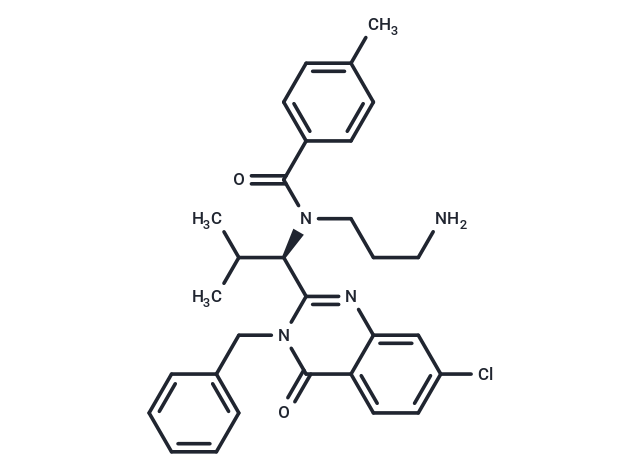

| Pack Size | Price | USA Stock | Global Stock | Quantity |
|---|---|---|---|---|
| 2 mg | $41 | In Stock | In Stock | |
| 5 mg | $72 | In Stock | In Stock | |
| 10 mg | $121 | In Stock | In Stock | |
| 25 mg | $222 | In Stock | In Stock | |
| 50 mg | $356 | In Stock | In Stock | |
| 100 mg | $587 | In Stock | In Stock | |
| 200 mg | $839 | In Stock | In Stock | |
| 1 mL x 10 mM (in DMSO) | $82 | In Stock | In Stock |
| Description | Ispinesib (SB-715992), a selective, effectvie and reversible inhibitor of kinesin spindle protein (KSP), is derived from quinazolinone, with antineoplastic properties. |
| Targets & IC50 | KSP (HsEg5):1.7 nM(Ki app) |
| In vitro | In PC-3 prostate cancer cells, Ispinesib (5 nM and 30 nM) inhibited cell proliferation and induced apoptosis by modulating the level of gene expression of signals. In breast cancer cell lines, Ispinesib (7.4 nM-600 nM) exhibited broad-spectrum inhibitory activity. In tumor cell lines (Colo205, Colo201, HT-29, M5076, Madison-109, and MX-1), Ispinesib (IC50=1.2-9.5 nM) is highly cytotoxic. |
| In vivo | In PC-3 prostate cancer cells, Ispinesib (5 nM and 30 nM) inhibited cell proliferation and induced apoptosis by modulating the level of gene expression of signals. In breast cancer cell lines, Ispinesib (7.4 nM-600 nM) exhibited broad-spectrum inhibitory activity. In tumor cell lines (Colo205, Colo201, HT-29, M5076, Madison-109, and MX-1), Ispinesib (IC50=1.2-9.5 nM) is highly cytotoxic. |
| Synonyms | SB-715992, CK0238273 |
| Kinase Assay | Steady-State Kinetic Analysis of Human KSP ATPase Activity and Inhibition by Ispinesib: Kinesin specificity analysis is carried out using a pyruvate kinase-lactate dehydrogenase detection system that couples the production of ADP to oxidation of NADH. Absorbance changes are monitored at 340 nm. Steady-state studies using nanomolar concentrations of KSP are performed using a sensitive fluorescence-based assay utilizing a pyruvate kinase, pyruvate oxidase, and horseradish peroxidase (HRP) coupled detection system that couples the generation of ADP to oxidation of Amplex Red to fluorescent resorufin. Generation of resorufin is monitored by fluorescence (λexcitation = 520 nm and λemission = 580 nm). Steady-state biochemical experiments are performed in PEM25 buffer [25 mM Pipes-K+ (pH 6.8), 2 mM MgCl2, 1 mM EGTA] supplemented with 10 μM paclitaxel for experiments involving microtubules. The IC50 for steady-state inhibition is determined at 500 μM ATP, 5 μM Microtubules, and 1 nM KSP in PEM25 buffer. Ki app (apparent inhibitor dissociation constant) values of Ispinesib are extracted from the dose-response curves, with explicit correction for enzyme concentration by using the Morrison equation. Inhibitor modality (e.g., competitive, noncompetitive, uncompetitive, or mixed) under steady-state conditions is determined by measuring the effect of inhibitor concentration on initial velocity as a function of substrate concentrations. Data are fit using equations in GraFit to velocity equations for the various modes of inhibition. |
| Cell Research | Cells are plated in log phase of growth in 96-well plates and treated with Ispinesib for 72 hours. Then, cell growth is measured using CellTiter-Glo, and luminescence is detected using BioTek FLx800. Data are analyzed and the IC50 value, defined as the drug concentration that results in 50% growth inhibition relative to control, is calculated.(Only for Reference) |
| Molecular Weight | 517.06 |
| Formula | C30H33ClN4O2 |
| Cas No. | 336113-53-2 |
| Smiles | CC(C)[C@@H](N(CCCN)C(=O)c1ccc(C)cc1)c1nc2cc(Cl)ccc2c(=O)n1Cc1ccccc1 |
| Relative Density. | 1.216g/cm3 |
| Storage | Store at low temperature,Store under nitrogen Powder: -20°C for 3 years | In solvent: -80°C for 1 year Shipping with blue ice/Shipping at ambient temperature. | |||||||||||||||||||||||||||||||||||
| Solubility Information | Ethanol: 95 mg/mL (183.73 mM), Sonication is recommended. DMSO: 250 mg/mL (483.5 mM), Sonication is recommended.  | |||||||||||||||||||||||||||||||||||
| In Vivo Formulation | 10% DMSO+40% PEG300+5% Tween 80+45% Saline: 3.3 mg/mL (6.38 mM), Sonication is recommended. Please add the solvents sequentially, clarifying the solution as much as possible before adding the next one. Dissolve by heating and/or sonication if necessary. Working solution is recommended to be prepared and used immediately. The formulation provided above is for reference purposes only. In vivo formulations may vary and should be modified based on specific experimental conditions. | |||||||||||||||||||||||||||||||||||
Solution Preparation Table | ||||||||||||||||||||||||||||||||||||
Ethanol/DMSO
Note : The dilution table applies only to solid products. For liquid products, please calculate the stock solution based on the stated concentration and/or density. | ||||||||||||||||||||||||||||||||||||
 For example, if the intended dosage is 10 mg/kg for animals weighing 20 g , with a dosing volume of 100 μL per animal, and a total of 10 animals are to be administered, using a formulation of
  10% DMSO+ 40% PEG300+ 5% Tween 80+ 45% Saline/PBS/ddH2O , the resulting working solution concentration would be 2 mg/mL.
Dissolve 2 mg of the compound in 100 μL DMSO to obtain a stock solution at a concentration of 20 mg/mL . If the required concentration exceeds the compound's known solubility, please contact us for technical support before proceeding.
1) Add 100 μL of the DMSO stock solution to 400 µL PEG300 and mix thoroughly until the solution becomes clear.
2) Add 50 µL Tween 80 and mix well until fully clarified.
3) Add 450 µL Saline,PBS or ddH2O and mix thoroughly until a homogeneous solution is obtained.
| Size | Quantity | Unit Price | Amount | Operation |
|---|
 Feedback
 Hello! How can I help you today?
Copyright © 2015-2026 TargetMol Chemicals Inc. All Rights Reserved.
