


Shopping Cart
Remove All Your shopping cart is currently empty


Synonyms: ABT-493
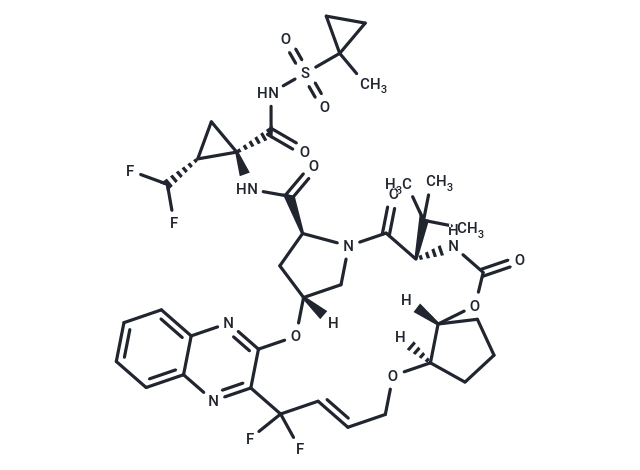

| Pack Size | Price | USA Stock | Global Stock | Quantity |
|---|---|---|---|---|
| 2 mg | $32 | In Stock | In Stock | |
| 5 mg | $52 | In Stock | In Stock | |
| 10 mg | $77 | In Stock | In Stock | |
| 25 mg | $158 | In Stock | In Stock | |
| 50 mg | $288 | In Stock | In Stock | |
| 100 mg | $448 | In Stock | In Stock | |
| 1 mL x 10 mM (in DMSO) | $73 | In Stock | In Stock |
| Description | Glecaprevir (ABT-493) is a small-molecule inhibitor that functions as an HCV NS3/4A protease inhibitor (IC50=3.5–11.3 nM) and also inhibits SARS-CoV-2 3CLpro (IC50=4.09 μM). It possesses oral bioavailability and antiviral activity, and is used for the treatment of hepatitis C as well as potential anti-coronavirus research. |
| Targets & IC50 | HCV NS3/4A protease:3.5-11.3 nM, 3CLpro (SARS CoV):4.09 μM, the replication of stable HCV subgenomic replicons containing proteases from genotypes 1 to 6:0.21-4.6 nM (EC50), Huh7 cells:0.2 nM (EC50) |
| In vitro | Methods: The inhibitory activity of Glecaprevir against HCV NS3/4A protease was determined by biochemical assay, and its antiviral activity against subgenomic replicons containing HCV proteases of different genotypes and clinical sample replicons was tested in Huh-7 cells. Results: Glecaprevir inhibited HCV genotypes 1-6 NS3/4A proteases with IC50 values of 3.5 to 11.3 nM; it was active against stable replicons containing genotypes 1a, 1b, 2a, 2b, 3a, 4a, 5a, 6a, and 6e proteases with EC50 values of 0.21 to 4.6 nM, including an EC50 value of 1.9 nM against the most difficult-to-treat genotype 3 replicon, showing superior activity compared to paritaprevir and grazoprevir; the median EC50 value against replicons containing clinical samples of genotypes 1a, 1b, 2a, 2b, 3a, 4a, 4d, and 5a was 0.30 nM (range 0.05-3.8 nM).[1] |
| In vivo | Methods: In healthy volunteers and HCV-infected patients, single or multiple oral doses of Glecaprevir 300 mg (in combination with Pibrentasvir) were administered, and pharmacokinetic parameters were determined. Results: The half-life was 6–9 hours; exposure in patients with cirrhosis was approximately 2.2-fold higher than in those without cirrhosis; exposure in patients with end-stage renal disease increased by 86%. [2] |
| Synonyms | ABT-493 |
| Kinase Assay | Eight recombinant HCV NS3/4A proteases were generated for use in evaluating glecaprevir activity in a biochemical assay. Each recombinant protein contained the entire coding regions of NS3 (amino acids 1 to 631) and NS4A (amino acids 1 to 54) from HCV genotypes 1 to 6, a 6-histidine tag at the N terminus to facilitate purification by affinity chromatography, and three lysine residues at the C terminus to increase the solubility of the protein. Genes encoding NS3/4A were derived from laboratory strains 1a-H77 and 1b-N or from clinical samples from patients infected with genotype 2a, 2b, 3a, or 4a. All patients provided written informed consent. Clinical studies were designed according to Good Clinical Practice guidelines, the Declaration of Helsinki, and applicable local regulations, with independent ethics committee or institutional review board approval for all study sites. The genotype 5a NS3/4A gene sequence was synthetically constructed based on the sequence of the clinical isolate SA13, whereas the genotype 6a NS3/4A gene sequence was synthetically constructed based on a consensus sequence derived from the alignment of 15 genotype 6a sequences available in GenBank. The NS3/4A genes were each cloned into the protein expression vector pET14b, and a clone with an NS3/4A protease sequence that matched the consensus sequence for each sample was subsequently selected for protein expression and purification. Protease activity was measured by continuous monitoring of the fluorescence change associated with the cleavage of a fluorogenic depsipeptide (EDANS/DABCYL) substrate using a purified recombinant HCV NS3/4A protease as described previously. The IC50 for each HCV protease was determined in studies in which the protease was preincubated with glecaprevir for 30 min. The percent inhibition was calculated from the initial rates of the inhibited reactions relative to the rate for the uninhibited control [1]. |
| Cell Research | The activity of glecaprevir, paritaprevir, or grazoprevir against cells of nine cell lines each stably transfected with an HCV subgenomic replicon containing NS3 protease from a different HCV genotype was determined using a luciferase reporter assay as described previously. Five of these nine cell lines have been described previously, including those transfected with genotypes 1a H77, 1b Con1, 3a, 4a, and 6a. The other four cell lines were established by transfecting cells with a nonchimeric genotype 2a JFH-1 replicon, two genotype 2a JFH-1 chimeric replicons containing either a genotype 2b NS3 protease domain (N-terminal 251 amino acids) or a sequence encoding full-length NS3 through the first 39 amino acids of NS5B from genotype 5a (strain SA13), and one chimeric replicon with a genotype 1b Con1 backbone containing full-length NS3 and NS4A sequences from genotype 6e. The genotype 2b and 6e NS3 sequences were each synthetically constructed based on a consensus sequence derived from the alignment of 15 genotype 2b and 4 genotype 6e sequences, respectively. All replicon constructs were bicistronic subgenomic replicons similar to those described by Bartenschlager and coworkers, and the replicon cell lines were generated by introducing these constructs into cells of an Huh-7 human hepatoma-derived cell line. The inhibitory effect of the PIs on HCV replication in replicon cells was determined in Dulbecco's modified Eagle medium containing 5% fetal bovine serum with or without 40% human plasma. The EC50s were determined using nonlinear regression curve fitting as described previously [1]. |
| Molecular Weight | 838.87 |
| Formula | C38H46F4N6O9S |
| Cas No. | 1365970-03-1 |
| Smiles | [H][C@@]12C[C@H](N(C1)C(=O)[C@@H](NC(=O)O[C@]1([H])CCC[C@@]1([H])OC\C=C\C(F)(F)c1nc3ccccc3nc1O2)C(C)(C)C)C(=O)N[C@@]1(C[C@H]1C(F)F)C(=O)NS(=O)(=O)C1(C)CC1 |
| Relative Density. | 1.46 g/cm3 (Predicted) |
| Storage | Powder: -20°C for 3 years | In solvent: -80°C for 1 year Shipping with blue ice/Shipping at ambient temperature. | |||||||||||||||||||||||||||||||||||
| Solubility Information | DMSO: 130 mg/mL (154.97 mM), Sonication is recommended.  | |||||||||||||||||||||||||||||||||||
| In Vivo Formulation | 10% DMSO+40% PEG300+5% Tween 80+45% Saline: 4 mg/mL (4.77 mM), Sonication is recommended. Please add the solvents sequentially, clarifying the solution as much as possible before adding the next one. Dissolve by heating and/or sonication if necessary. Working solution is recommended to be prepared and used immediately. The formulation provided above is for reference purposes only. In vivo formulations may vary and should be modified based on specific experimental conditions. | |||||||||||||||||||||||||||||||||||
Solution Preparation Table | ||||||||||||||||||||||||||||||||||||
DMSO
Note : The dilution table applies only to solid products. For liquid products, please calculate the stock solution based on the stated concentration and/or density. | ||||||||||||||||||||||||||||||||||||
 For example, if the intended dosage is 10 mg/kg for animals weighing 20 g , with a dosing volume of 100 μL per animal, and a total of 10 animals are to be administered, using a formulation of
  10% DMSO+ 40% PEG300+ 5% Tween 80+ 45% Saline/PBS/ddH2O , the resulting working solution concentration would be 2 mg/mL.
Dissolve 2 mg of the compound in 100 μL DMSO to obtain a stock solution at a concentration of 20 mg/mL . If the required concentration exceeds the compound's known solubility, please contact us for technical support before proceeding.
1) Add 100 μL of the DMSO stock solution to 400 µL PEG300 and mix thoroughly until the solution becomes clear.
2) Add 50 µL Tween 80 and mix well until fully clarified.
3) Add 450 µL Saline,PBS or ddH2O and mix thoroughly until a homogeneous solution is obtained.
| Size | Quantity | Unit Price | Amount | Operation |
|---|
 Feedback
 Hello! How can I help you today?
Copyright © 2015-2026 TargetMol Chemicals Inc. All Rights Reserved.
