


Shopping Cart
Remove All Your shopping cart is currently empty

Synonyms: VS-6063, PF-04554878
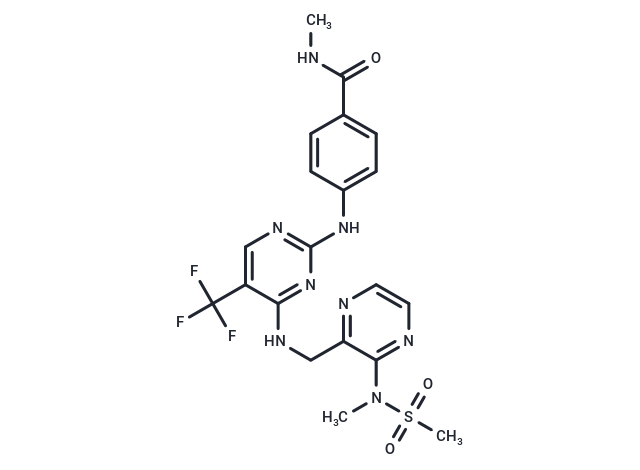
| Pack Size | Price | USA Stock | Global Stock | Quantity |
|---|---|---|---|---|
| 1 mg | $31 | In Stock | In Stock | |
| 2 mg | $41 | In Stock | In Stock | |
| 5 mg | $67 | In Stock | In Stock | |
| 10 mg | Inquiry | In Stock | In Stock | |
| 25 mg | Inquiry | In Stock | In Stock | |
| 50 mg | Inquiry | 待询 | 待询 | |
| 1 mL x 10 mM (in DMSO) | $75 | In Stock | In Stock |
| Description | Defactinib (VS-6063) is a second-generation inhibitor of FAK that inhibits FAK phosphorylation at the Tyr397 site. Defactinib has potential antitumor activity. |
| Targets & IC50 | TT cells:1.98 µM, HCT116 cells:2.65 μM, A549 cells:4.09 μM, MDA-MB-231 cells:3.75 μM, B-CPAP cells:23.04 µM, HEK293 cells:4.07 μM, K1 cells:10.34 µM, HepG2 cells:3.69 μM, TPC1 cells:> 50 µM, BxPC-3 cells:3.25 μM, HCT15 cells:4.36 μM, HUVECs:3.24 μM, MCF-10A cells:18.42 μM, L02 cells:4.66 μM, MCF-7 cells:5.81 μM |
| In vitro | METHODS: Thyroid cancer cell lines TT, K1, BCPAP and TPC1 were treated with Defactinib (1-50 µM) for 24 h and cell viability was measured by MTS assay. RESULTS: Defactinib reduced cell viability in a dose-dependent manner in TT, K1, BCPAP and TPC1 cell lines with IC50s of 1.98 µM, 10.34 µM, 23.04 µM and >50 µM, respectively.[1] METHODS: Taxane-sensitive cell line HeyA8 and Taxane-resistant cell line HeyA8-MDR were treated with Defactinib (0.001-10 mM) for 1-48 h, and target protein expression levels were detected by Western Blot. RESULTS: Defactinib statistically significantly inhibited the expression of pFAK (Tyr397) in a dose-dependent manner. pFAK (Tyr397) expression was inhibited by Defactinib within 3 h and was gradually restored within 48 h. Defactinib was also shown to inhibit pFAK (Tyr397) expression in a dose-dependent manner. [2] |
| In vivo | METHODS: To assay antitumor activity in vivo, Defactinib (25 mg/kg orally twice daily) and PTX (2 mg/kg intraperitoneally once weekly) were administered to thymus-free nude mice bearing SKOV3ip1, SKOV3-TR, HeyA8 or HeyA8-MDR xenografts for 35 or 28 days. RESULTS: In the HeyA8 model, PTX monotherapy resulted in an 87.4% reduction in tumor weight, and combination therapy resulted in the greatest reduction in tumor weight, 97.9% compared with PTX. In the SKOV3ip1 model, tumor weight was reduced by 92.7% in the combination group compared to PTX.Treatment with PTX alone was ineffective in the HeyA8 MDR model and the SKOV3-TR model, but treatment with Defactinib resulted in a reduction in tumor weight of 42.6% and 67.1%, respectively, with the combination leading to an even greater reduction in tumor growth. [2] |
| Synonyms | VS-6063, PF-04554878 |
| Kinase Assay | Cell-free Kinase Activity Assays: IC50 values for TG101348 are determined commercially using the InVitrogen kinase profiling service for a 223 kinase screen that included JAK2 and JAK2V617F or Carna Biosciences for the screen of all Janus kinase family members including JAK1 and Tyk2. ATP concentration is set to approximately the Km value for each kinase. |
| Cell Research | Ovarian cancer cells are treated with increasing concentrations of VS-6063 for 96 hours and then subjected to the MTT assay. Results are confirmed with triplicate experiments.(Only for Reference) |
| Molecular Weight | 510.49 |
| Formula | C20H21F3N8O3S |
| Cas No. | 1073154-85-4 |
| Smiles | CNC(=O)c1ccc(Nc2ncc(c(NCc3nccnc3N(C)S(C)(=O)=O)n2)C(F)(F)F)cc1 |
| Relative Density. | 1.495 g/cm3 (Predicted) |
| Storage | Store at low temperature Powder: -20°C for 3 years | In solvent: -80°C for 1 year Shipping with blue ice/Shipping at ambient temperature. | ||||||||||||||||||||||||||||||
| Solubility Information | DMSO: 50 mg/mL (97.95 mM), Sonication is recommended.  | ||||||||||||||||||||||||||||||
| In Vivo Formulation | 10% DMSO+40% PEG300+5% Tween 80+45% Saline: 5 mg/mL (9.79 mM), Suspension. Please add the solvents sequentially, clarifying the solution as much as possible before adding the next one. Dissolve by heating and/or sonication if necessary. Working solution is recommended to be prepared and used immediately. The formulation provided above is for reference purposes only. In vivo formulations may vary and should be modified based on specific experimental conditions. | ||||||||||||||||||||||||||||||
Solution Preparation Table | |||||||||||||||||||||||||||||||
DMSO
Note : The dilution table applies only to solid products. For liquid products, please calculate the stock solution based on the stated concentration and/or density. | |||||||||||||||||||||||||||||||
 For example, if the intended dosage is 10 mg/kg for animals weighing 20 g , with a dosing volume of 100 μL per animal, and a total of 10 animals are to be administered, using a formulation of
  10% DMSO+ 40% PEG300+ 5% Tween 80+ 45% Saline/PBS/ddH2O , the resulting working solution concentration would be 2 mg/mL.
Dissolve 2 mg of the compound in 100 μL DMSO to obtain a stock solution at a concentration of 20 mg/mL . If the required concentration exceeds the compound's known solubility, please contact us for technical support before proceeding.
1) Add 100 μL of the DMSO stock solution to 400 µL PEG300 and mix thoroughly until the solution becomes clear.
2) Add 50 µL Tween 80 and mix well until fully clarified.
3) Add 450 µL Saline,PBS or ddH2O and mix thoroughly until a homogeneous solution is obtained.
| Size | Quantity | Unit Price | Amount | Operation |
|---|
 Feedback
 Hello! How can I help you today?
Copyright © 2015-2026 TargetMol Chemicals Inc. All Rights Reserved.
