


Shopping Cart
Remove All Your shopping cart is currently empty

Synonyms:
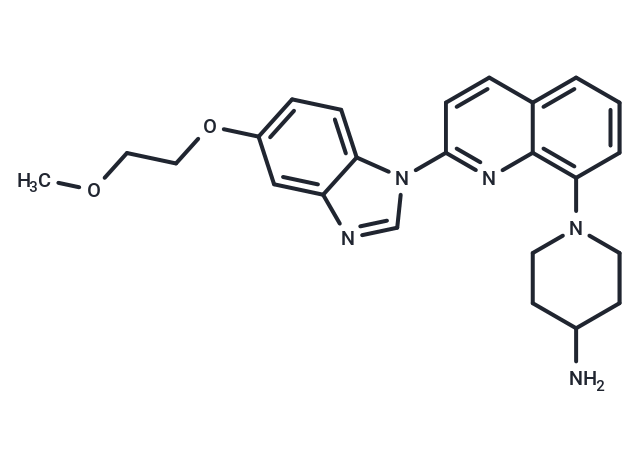

| Pack Size | Price | USA Stock | Global Stock | Quantity |
|---|---|---|---|---|
| 1 mg | $44 | In Stock | In Stock | |
| 2 mg | $60 | In Stock | In Stock | |
| 5 mg | $97 | In Stock | In Stock | |
| 10 mg | $189 | In Stock | In Stock | |
| 25 mg | $372 | In Stock | In Stock | |
| 50 mg | $569 | In Stock | In Stock | |
| 100 mg | $819 | In Stock | In Stock | |
| 500 mg | $1,690 | Inquiry | Inquiry | |
| 1 mL x 10 mM (in DMSO) | $116 | In Stock | In Stock |
| Description | CP-673451 is a specific inhibitor of PDGFRα/β (IC50: 10/1 nM) with antiangiogenic and antitumor activity and the selectivity is higher 450-fold than other angiogenic receptors. |
| Targets & IC50 | PDGFRα:10 nM, PDGFRβ:1 nM |
| In vitro | CP 673451 is a selective inhibitor of PDGFRα/β with IC50 of 10 nM/1 nM, exhibits >450-fold selectivity over other angiogenic receptors. In glioblastoma tumors, CP-673451 (33 mg/kg) provides >50% inhibition of PDGFR-β receptor for 4 hours corresponding to an EC50 of 120 ng/mL in plasma at Cmax. In a sponge angiogenesis model, CP-673451 inhibits 70% of PDGF-BB-stimulated angiogenesis at a dose of 3 mg/kg (q.d. ×5, p.o., corresponding to 5.5 ng/mL at Cmax).[1] CP-673451 decreases cell proliferation rate through mechanisms involving reduced phosphorylation of GSK-3α and GSK-3β. In both RD and RUCH2 cultures, CP-673451 impairs rhabdosphere-forming capacity and cell differentiation, causes increased senescence. [2] |
| In vivo | CP 673451 (once-daily p.o.) inhibits tumor growth (ED50 < 33 mg/kg) in a number of human tumor xenografts grown s.c. in athymic mice, including H460 human lung carcinoma, Colo205 and LS174T human colon carcinomas, and U87 mg human glioblastoma multiforme. [1] In RUCH2 xenograft-bearing mice, CP 673451 reduces tumor growth and stromal cell infiltration. [2] |
| Kinase Assay | Kinase inhibition assay: A glutathione S-transferase-tagged kinase domain construct of the intracellular portion of the PDGFR-β (amino acids 693-1401, accession no. J03278) is expressed in Sf-9 cells (baculovirus expression system). Enzyme kinetics are determined by incubating the enzyme with increasing concentrations of ATP in phosphorylation buffer [50 mmol/L HEPES (pH 7.3), 125 mmol/L NaCl, 24 mmol/L MgCl2 in Nunc Immuno MaxiSorp 96-well plates previously coated with 100 μL of 100 μg/mL poly-Glu-Tyr (4:1 ratio) diluted in PBS. After 10 minutes, the plates are washed (PBS, 0.1% Tween 20), incubated with anti-phosphotyrosine-horseradish peroxidase antibody, and diluted in PBS, 0.05% Tween 20, 3% BSA for 30 minutes at room temperature. The plates are washed as above and incubated with 3,3',5,5'-tetramethylbenzidine. The reaction is stopped by adding an equal volume of 0.09 NaH2SO4. The phosphotyrosine-dependent signal is then quantitated on a plate reader at 450 nm. For routine enzyme assays, the enzyme is incubated with 10 μM ( final) ATP in the presence of compound diluted in DMSO (1.6% v/v DMSO assay final) for 30 minutes at room temperature in plates, as above, previously coated with 100 μL of 6.25 μg/mL poly-Glu-Tyr. The remainder of the assay is carried out as above, and IC50 values are calculated as percent inhibition of control. |
| Cell Research | PAE cells stably expressing full-length PDGFR and VEGFR have been generated. For cell-based selectivity assays, PAE cells are transfected with fulllength human PDGFR-a, PDGFR-h, or VEGFR-2. Cells are seeded at 4×10⁵ cells/mL in 50 μL growth medium (Ham's F-12 media supplemented with 10% fetal bovine serum, 50,000 units each penicillin and streptomycin, and 500 μg/mL gentamicin) per well in 96-well plates. After 6 to 8 hours, the growth medium is replaced with 50 μL serum-depleted medium (as above, but with 0.1% fetal bovine serum) and cells are incubated overnight. Immediately before compound addition, the medium was replaced with 95 μL serum-depleted medium. Compounds are diluted in 100% DMSO, added to the cells at a final DMSO concentration of 0.25% v/v, and incubated at 37°C for 10 minutes. Cells are stimulated with the appropriate ligand and incubated as above for an additional 8 minutes. The medium is removed and the cells washed once with PBS, then lysed with 50 μL HNTG buffer [20 mmol/L HEPES (pH 7.5), 150 mmol/L NaCl, 2% Triton X-100, 10% glycerol, 5 μmol/L EDTA, 2 mmol/L NaVO4, and 1 EDTA-free complete protease inhibitor tablet per 25 mL] for 5 minutes at room temperature. Lysates are then diluted with 50 μL HG buffer [20 mmol/L HEPES (pH 7.5), 10% glycerol]. The diluted cell lysates are mixed thoroughly, 50 μL of supernatant are transferred to the ELISA capture plate, and incubated at room temperature for 2 hours with agitation. ELISA capture plates are prepared by coating 96-well ReactiBind goat-antirabbit plates with 100 μL/well of 5 μg/mL rabbit anti-human PDGFR-h, anti-PDGFR-a, or anti-VEGFR-2 antibody for 60 to 90 minutes. At the end of the 2-hour incubation the plates are washed (PBS, 0.1% Tween 20) before incubation with anti-phosphotyrosine-horseradish peroxidase antibody (diluted in PBS, 0.05% Tween 20) for 30 minutes at room temperature. The plates are washed again, then incubated with tetramethylbenzidine and evaluated as described above.IC50 values are calculated as percent inhibition of control.(Only for Reference) |
| Molecular Weight | 417.5 |
| Formula | C24H27N5O2 |
| Cas No. | 343787-29-1 |
| Smiles | COCCOc1ccc2n(cnc2c1)-c1ccc2cccc(N3CCC(N)CC3)c2n1 |
| Relative Density. | 1.32 g/cm3 |
| Storage | Powder: -20°C for 3 years | In solvent: -80°C for 1 year Shipping with blue ice/Shipping at ambient temperature. | ||||||||||||||||||||||||||||||||||||||||
| Solubility Information | Ethanol: 41.8 mg/mL (100.12 mM), Sonication is recommended. DMSO: 20.83 mg/mL (49.89 mM), Sonication is recommended.  | ||||||||||||||||||||||||||||||||||||||||
| In Vivo Formulation | 10% DMSO+40% PEG300+5% Tween 80+45% Saline: 2 mg/mL (4.79 mM), Sonication is recommended. Please add the solvents sequentially, clarifying the solution as much as possible before adding the next one. Dissolve by heating and/or sonication if necessary. Working solution is recommended to be prepared and used immediately. The formulation provided above is for reference purposes only. In vivo formulations may vary and should be modified based on specific experimental conditions. | ||||||||||||||||||||||||||||||||||||||||
Solution Preparation Table | |||||||||||||||||||||||||||||||||||||||||
DMSO/Ethanol
Ethanol
Note : The dilution table applies only to solid products. For liquid products, please calculate the stock solution based on the stated concentration and/or density. | |||||||||||||||||||||||||||||||||||||||||
 For example, if the intended dosage is 10 mg/kg for animals weighing 20 g , with a dosing volume of 100 μL per animal, and a total of 10 animals are to be administered, using a formulation of
  10% DMSO+ 40% PEG300+ 5% Tween 80+ 45% Saline/PBS/ddH2O , the resulting working solution concentration would be 2 mg/mL.
Dissolve 2 mg of the compound in 100 μL DMSO to obtain a stock solution at a concentration of 20 mg/mL . If the required concentration exceeds the compound's known solubility, please contact us for technical support before proceeding.
1) Add 100 μL of the DMSO stock solution to 400 µL PEG300 and mix thoroughly until the solution becomes clear.
2) Add 50 µL Tween 80 and mix well until fully clarified.
3) Add 450 µL Saline,PBS or ddH2O and mix thoroughly until a homogeneous solution is obtained.
| Size | Quantity | Unit Price | Amount | Operation |
|---|
 Feedback
 Hello! How can I help you today?
Copyright © 2015-2026 TargetMol Chemicals Inc. All Rights Reserved.
