


Shopping Cart
Remove All Your shopping cart is currently empty


Synonyms: SKI-606
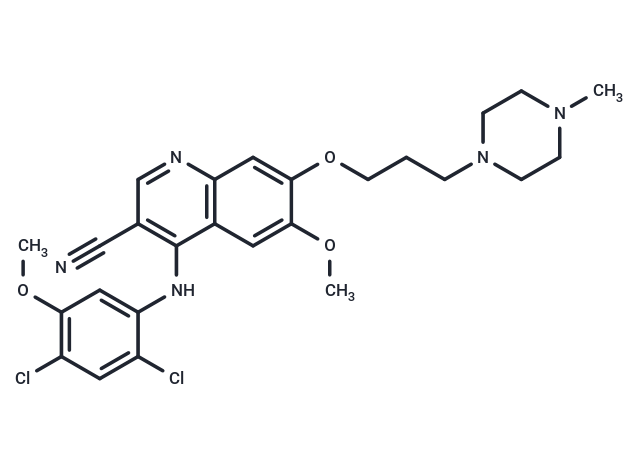
| Pack Size | Price | USA Stock | Global Stock | Quantity |
|---|---|---|---|---|
| 5 mg | $33 | In Stock | In Stock | |
| 10 mg | $50 | In Stock | In Stock | |
| 25 mg | $63 | In Stock | In Stock | |
| 50 mg | $81 | In Stock | In Stock | |
| 100 mg | $98 | In Stock | In Stock | |
| 500 mg | $237 | In Stock | In Stock | |
| 1 mL x 10 mM (in DMSO) | $39 | In Stock | In Stock |
| Description | Bosutinib (SKI-606) is a synthetic quinolone derivative and dual kinase inhibitor that targets both Abl (IC50: 1 nM) and Src (IC50: 1.2 nM) kinases. |
| Targets & IC50 | Src:1.2 nM (cell free), Abl:1 nM (cell free) |
| In vitro | Bosutinib has the antiproliferative activity against three different Bcr-Abl-positive leukemia cell lines (KU812, K562, and MEG-01). Bosutinib inhibited the proliferation of all three cell lines, with IC50s ranging from 5 nM in the KU812 line to 20 nM for the K562 and MEG-01 cell lines. Inhibition of proliferation by Bosutinib is associated with cell cycle arrest and cell death. Treatment with Bosutinib at 100 nM for 24 h (KU812) or 48 h (K562) resulted in a reduction of S and G2-M phase cells and an increase of cells with a DNA content of less than 2N. Treatment with Bosutinib at 100 nm also led to PARP degradation after 48 h. The potent antiproliferative activity of Bosutinib against CML lines was not a general property for leukemia cell lines. Molt-4, HL-60, Ramos, and other leukemia cell lines were unaffected by Bosutinib at concentrations less than 1 μM [2]. |
| In vivo | Bosutinib (30/25 mg/kg, b.i.d) reduces tumor growth in unstaged and staged Src-transformed fibroblast mouse xenograft models. Bosutinib (100 mg/kg) also induces complete tumor regression in a K562 mouse xenograft model when administered once per day for five days [2]. |
| Synonyms | SKI-606 |
| Kinase Assay | The Src kinase activity is measured in an ELISA format. Src (3 units/reaction), reaction buffer (50 mM Tris-HCl pH 7.5, 10 mM MgCl2, 0.1 mM EGTA, 0.5 mM Na3VO4) and cdc2 substrate peptide are added to various concentration of Bosutinib and incubated at 30 °C for 10 minutes. The reaction is started by the addition of ATP to a final concentration of 100 μM, incubated at 30 °C for 1 hour and stopped by addition of EDTA. Instructions from the manufacturer are followed for subsequent steps. The Abl kinase assay is performed in a DELFIA solid phase europium-based detection assay format. Biotinylated peptide (2 μM) is bound to streptavidin-coated microtitration plates for 1.5 hours in 1 mg/mL ovalbumin in PBS. The plates are washed for 1 hour with PBS/0.1% Tween 80, followed by a PBS wash. The kinase reaction is incubated for 1 hour at 30°C. Abl kinase (10 units) is mixed with 50 mM Tris-HCl (pH 7.5), 10 mM MgCl2, 80 μM EGTA, 100 μM ATP, 0.5 mM Na3VO4, 1% DMSO, 1 mM HEPES (pH 7.0), 200 μg/mL ovalbumin and various concentration of Bosutinib. The reaction is stopped with EDTA at a final concentration of 50 mM. The reaction is monitored with Eu-labeled phosphotyrosine antibody and DELFIA enhancement solution [2]. |
| Cell Research | Cells are exposed to various concentrations of Bosutinib for 72 hours. Anchorage-independent proliferation of Abl-MLV-transformed fibroblasts is measured in 96-well ultra-low binding plates treated with Sigmacote to block residual cell attachment. Cell proliferation is measured with MTS or Cell-Glo. For the determination of cell cycle or cell death, cells are prepared for FACS analysis in the CycleTest Plus DNA reagent kit and analyzed on a fluorescence-activated cell sorter flow cytometer [2]. |
| Animal Research | K562 cells were suspended to 50 million cells/ml in Matrigel (1 volume of cells with 1 volume of cold Matrigel). Nude female mice 6–7 weeks of age were given injections of 0.2 ml of this suspension. Tumors were staged for 10 days, at which time they entered the growth phase. At this time, the compound was administered by oral gavage in a 0.2-ml suspension with 0.5% methocel/0.4% Tween 80 [2]. |
| Molecular Weight | 530.45 |
| Formula | C26H29Cl2N5O3 |
| Cas No. | 380843-75-4 |
| Smiles | N(C=1C2=C(C=C(OCCCN3CCN(C)CC3)C(OC)=C2)N=CC1C#N)C4=CC(OC)=C(Cl)C=C4Cl |
| Relative Density. | 1.36 g/cm3 |
| Storage | Store at low temperature Powder: -20°C for 3 years | In solvent: -80°C for 1 year Shipping with blue ice/Shipping at ambient temperature. | ||||||||||||||||||||||||||||||||||||||||
| Solubility Information | DMSO: 65 mg/mL (122.54 mM), Sonication is recommended.  Ethanol: 13.3 mg/mL (25.07 mM), Sonication is recommended. | ||||||||||||||||||||||||||||||||||||||||
| In Vivo Formulation | 10% DMSO+40% PEG300+5% Tween 80+45% Saline: 2 mg/mL (3.77 mM), Sonication is recommended. Please add the solvents sequentially, clarifying the solution as much as possible before adding the next one. Dissolve by heating and/or sonication if necessary. Working solution is recommended to be prepared and used immediately. The formulation provided above is for reference purposes only. In vivo formulations may vary and should be modified based on specific experimental conditions. | ||||||||||||||||||||||||||||||||||||||||
Solution Preparation Table | |||||||||||||||||||||||||||||||||||||||||
Ethanol/DMSO
DMSO
Note : The dilution table applies only to solid products. For liquid products, please calculate the stock solution based on the stated concentration and/or density. | |||||||||||||||||||||||||||||||||||||||||
 For example, if the intended dosage is 10 mg/kg for animals weighing 20 g , with a dosing volume of 100 μL per animal, and a total of 10 animals are to be administered, using a formulation of
  10% DMSO+ 40% PEG300+ 5% Tween 80+ 45% Saline/PBS/ddH2O , the resulting working solution concentration would be 2 mg/mL.
Dissolve 2 mg of the compound in 100 μL DMSO to obtain a stock solution at a concentration of 20 mg/mL . If the required concentration exceeds the compound's known solubility, please contact us for technical support before proceeding.
1) Add 100 μL of the DMSO stock solution to 400 µL PEG300 and mix thoroughly until the solution becomes clear.
2) Add 50 µL Tween 80 and mix well until fully clarified.
3) Add 450 µL Saline,PBS or ddH2O and mix thoroughly until a homogeneous solution is obtained.
| Size | Quantity | Unit Price | Amount | Operation |
|---|
 Feedback
 Hello! How can I help you today?
Copyright © 2015-2026 TargetMol Chemicals Inc. All Rights Reserved.
