


Shopping Cart
Remove All Your shopping cart is currently empty


Synonyms: ABL001
| Pack Size | Price | USA Stock | Global Stock | Quantity |
|---|---|---|---|---|
| 1 mg | $57 | In Stock | In Stock | |
| 2 mg | $84 | In Stock | In Stock | |
| 5 mg | $129 | In Stock | In Stock | |
| 10 mg | $197 | In Stock | In Stock | |
| 25 mg | $322 | In Stock | In Stock | |
| 50 mg | $450 | In Stock | In Stock | |
| 100 mg | $663 | In Stock | In Stock | |
| 500 mg | $1,390 | In Stock | In Stock | |
| 1 mL x 10 mM (in DMSO) | $142 | In Stock | In Stock |
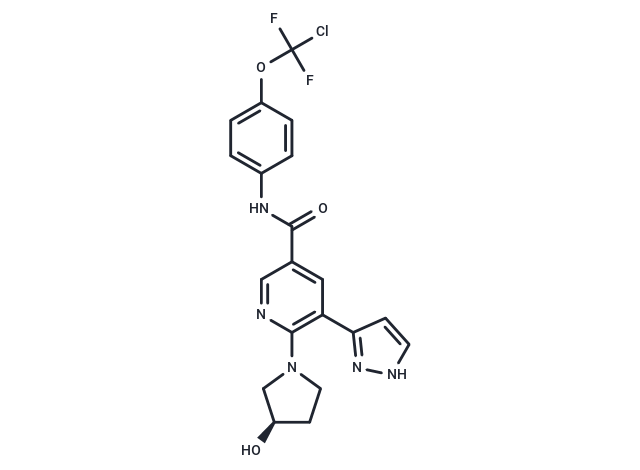
| Description | Asciminib (ABL001) (ABL001) is a potent and selective Bcr-Abl inhibitor (Kd: 0.5–0.8nM). |
| Targets & IC50 | Abl-1:0.45 nM |
| In vitro | In Asciminib-transformed Ba/F3 cells grown without IL-3, ABL001 had an anti-proliferative IC50 value of 0.25nM. By contrast, the addition of IL-3 to bypass Asciminib dependence renders these cells insensitive to ABL001. In the CML blast-phase cell line KCL-22, ABL001 inhibited phosphorylation of both STAT5 (Tyr694; pSTAT5) and Asciminib (Tyr245; pAsciminib) after 1h using concentrations that correlate with those required for inhibition of cell proliferation [1]. K562-Dox and K562-ABCG2 cells demonstrated increased LD50 (asciminib) vs K562 control cells: 256 and 299 nM respectively vs 24 nM. Sensitivity was completely restored with specific inhibitors cyclosporine (ABCB1) and Ko143 (ABCG2): K562-Dox LD50 (asciminib+cyclosporine) = 13 nM, K562-ABCG2 LD50 (asciminib+Ko143) = 15 nM [2]. |
| In vivo | Single doses of 7.5, 15 and 30mg kg1 ABL001, administered to mice bearing KCL22 xenografts, inhibited pSTAT5 (Tyr694), which returned to baseline at 10, 12 and 16–20h after administration of the dose, respectively. In mice implanted with KCL-22 tumours, the minimum dose of ABL001 required for complete regression was 7.5mg/kg twice a day (BID) or 30mg/kg once a day (QD), and was tolerated at doses up to 250mg kg1 BID. Similarly, in xenografts derived from patients with Ph+ ALL, treatment with 7.5 and 30mg/kg ABL001 led to regressions that were maintained during dosing [1]. |
| Synonyms | ABL001 |
| Cell Research | Cells were resuspended in fresh culture media before culture in 24-well plates in the presence of TKI or asciminib at a density of 2 × 10⁵ cells/mL. Plates were seeded with 1 mL of cell suspension and incubated for 72 h before cell viability determination with 7-aminoactinomycin (7-AAD) and Phycoerythrin (PE)-conjugated Annexin V. Flow cytometric analysis was conducted with a BD LSRFortessa X-20 and FACSDiva software. The lethal dose of asciminib (LD50 asciminib), imatinib (LD50 IM), nilotinib (LD50 NIL) and dasatinib (LD50 DAS) required to cause 50% death of cells was calculated [2]. |
| Animal Research | Asciminib efficacy in three patient-derived ALL systemic xenograft models (ALL-7015, AL-7119 and AL-7155) is assessed by FACS monitoring of the percentage of CD45+ cells per live cell in blood samples taken at varying time points after dosing with either 7.5 mg/kg BID (group 2) or 30 mg/kg BID (group 3) asciminib for 3 weeks [1]. |
| Molecular Weight | 449.84 |
| Formula | C20H18ClF2N5O3 |
| Cas No. | 1492952-76-7 |
| Smiles | C(NC1=CC=C(OC(Cl)(F)F)C=C1)(=O)C2=CC(=C(N=C2)N3CC[C@@H](O)C3)C=4C=CNN4 |
| Relative Density. | 1.518 g/cm3 (Predicted) |
| Storage | Powder: -20°C for 3 years | In solvent: -80°C for 1 year Shipping with blue ice/Shipping at ambient temperature. | |||||||||||||||||||||||||||||||||||
| Solubility Information | H2O: Insoluble DMSO: 245 mg/mL (544.64 mM), Sonication is recommended.  | |||||||||||||||||||||||||||||||||||
| In Vivo Formulation | 10% DMSO+40% PEG300+5% Tween 80+45% Saline: 10 mg/mL (22.23 mM), Solution. 10% DMSO+90% Saline: < 10 mg/mL (22.23 mM), Lower concentrations may be soluble, but exact solubility limit is unknown. Please add the solvents sequentially, clarifying the solution as much as possible before adding the next one. Dissolve by heating and/or sonication if necessary. Working solution is recommended to be prepared and used immediately. The formulation provided above is for reference purposes only. In vivo formulations may vary and should be modified based on specific experimental conditions. | |||||||||||||||||||||||||||||||||||
Solution Preparation Table | ||||||||||||||||||||||||||||||||||||
DMSO
Note : The dilution table applies only to solid products. For liquid products, please calculate the stock solution based on the stated concentration and/or density. | ||||||||||||||||||||||||||||||||||||
 For example, if the intended dosage is 10 mg/kg for animals weighing 20 g , with a dosing volume of 100 μL per animal, and a total of 10 animals are to be administered, using a formulation of
  10% DMSO+ 40% PEG300+ 5% Tween 80+ 45% Saline/PBS/ddH2O , the resulting working solution concentration would be 2 mg/mL.
Dissolve 2 mg of the compound in 100 μL DMSO to obtain a stock solution at a concentration of 20 mg/mL . If the required concentration exceeds the compound's known solubility, please contact us for technical support before proceeding.
1) Add 100 μL of the DMSO stock solution to 400 µL PEG300 and mix thoroughly until the solution becomes clear.
2) Add 50 µL Tween 80 and mix well until fully clarified.
3) Add 450 µL Saline,PBS or ddH2O and mix thoroughly until a homogeneous solution is obtained.
| Size | Quantity | Unit Price | Amount | Operation |
|---|
 Feedback
 Hello! How can I help you today?
Copyright © 2015-2026 TargetMol Chemicals Inc. All Rights Reserved.
