


Shopping Cart
Remove All Your shopping cart is currently empty

Synonyms: GNF 5
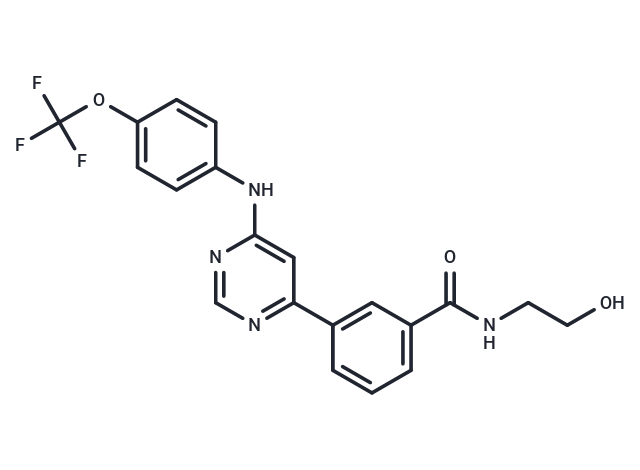

| Pack Size | Price | USA Stock | Global Stock | Quantity |
|---|---|---|---|---|
| 10 mg | $30 | In Stock | In Stock | |
| 25 mg | $47 | In Stock | In Stock | |
| 50 mg | $81 | In Stock | In Stock | |
| 100 mg | $119 | In Stock | In Stock | |
| 200 mg | $215 | - | In Stock | |
| 1 mL x 10 mM (in DMSO) | $30 | In Stock | In Stock |
| Description | GNF-5 is a specific non-ATP competitive inhibitor of Bcr-Abl (IC50: 0.22±0.1 uM, Wild-type Abl). It is an analog of GNF-2 with improved pharmacokinetic properties. |
| Targets & IC50 | BCR-ABL:0.22±0.1 μM |
| In vitro | Concurrent administration of GNF-5 (75 mg/kg) with nilotinib (50 mg/kg) has been shown to increase the overall survival rate in a T315I Bcr-Abl BMT model. Additionally, GNF-5 (100 mg/kg) demonstrated therapeutic efficacy against both wild-type and T315I Bcr-Abl-dependent proliferation in xenograft and bone marrow transplantation models. |
| In vivo | GNF-5 exhibits strong antiproliferative activities, inhibiting the proliferation of cells expressing wild-type Bcr-Abl (EC50: 430 nM) and its E255K mutant variant (EC50: 580 nM). When used in combination with nilotinib or imatinib, GNF-5 suppresses the emergence of resistant mutations in vitro and demonstrates enhanced inhibitory effects against the Bcr-Abl T315I mutant in both cell-based and biochemical assays. |
| Synonyms | GNF 5 |
| Kinase Assay | Kinetic characterization of Abl inhibition: The ATP/NADH-coupled assay system in a 96-well format is used to determine the initial velocity of Abl tyrosine kinase catalyzed peptide phosphorylation. The reaction mixture contained 20 mM Tris-HCl, (pH 8.0), 50 mM NaCl, 10 mM MgCl2, 2 mM PEP [2-(Phosphonooxy)- 2-propenoic acid) and 20 μg Abl peptide substrate (EAIYAAPFAKKK), fixed or varied (to determine inhibitor kinetic parameters) concentration of inhibitor applied, 1/50 of the final reaction mixture volume of PK/LDH enzyme (pyruvate kinase/lactic dehydrogenase enzymes from rabbit muscle), 160 μM NADH, 0.16 μM Abl, and ATP added last to start the reaction. Absorbance data are collected every 20s at 340 nm using a SpectraMax M5 Microplate Reader. |
| Cell Research | Ba/F3.p210 cells are obtained by transfecting the IL-3-dependent murine hematopoietic Ba/F3 cell line with a pEYK vector containing p210BCR-ABL and Bcr-Abl mutations. All cell lines are cultured with 5% CO2 at 37 °C in RPMI 1640 with 10% fetal bovine serum (FBS) and supplemented with 1% l-glutamine. Parental Ba/F3 cells are similarly cultured with 10% WEHI-conditioned medium as a source of IL-3. Transfected cell lines are cultured in media supplemented with 25 μg/mL zeocin. The 48 h cell proliferation studies are obtained using the CellTiter-Glo assay.(Only for Reference) |
| Molecular Weight | 418.37 |
| Formula | C20H17F3N4O3 |
| Cas No. | 778277-15-9 |
| Smiles | N(C1=CC(=NC=N1)C2=CC(C(NCCO)=O)=CC=C2)C3=CC=C(OC(F)(F)F)C=C3 |
| Relative Density. | 1.385 g/cm3 (Predicted) |
| Storage | Powder: -20°C for 3 years | In solvent: -80°C for 1 year Shipping with blue ice/Shipping at ambient temperature. | |||||||||||||||||||||||||
| Solubility Information | Ethanol: 16 mg/mL (38.24 mM), Sonication is recommended. DMSO: 16.67 mg/mL (39.85 mM), Sonication is recommended.  H2O: < 1 mg/mL (insoluble or slightly soluble) | |||||||||||||||||||||||||
| In Vivo Formulation | 10% DMSO+40% PEG300+5% Tween 80+45% Saline: 2 mg/mL (4.78 mM), Sonication is recommended. Please add the solvents sequentially, clarifying the solution as much as possible before adding the next one. Dissolve by heating and/or sonication if necessary. Working solution is recommended to be prepared and used immediately. The formulation provided above is for reference purposes only. In vivo formulations may vary and should be modified based on specific experimental conditions. | |||||||||||||||||||||||||
Solution Preparation Table | ||||||||||||||||||||||||||
Ethanol/DMSO
Note : The dilution table applies only to solid products. For liquid products, please calculate the stock solution based on the stated concentration and/or density. | ||||||||||||||||||||||||||
 For example, if the intended dosage is 10 mg/kg for animals weighing 20 g , with a dosing volume of 100 μL per animal, and a total of 10 animals are to be administered, using a formulation of
  10% DMSO+ 40% PEG300+ 5% Tween 80+ 45% Saline/PBS/ddH2O , the resulting working solution concentration would be 2 mg/mL.
Dissolve 2 mg of the compound in 100 μL DMSO to obtain a stock solution at a concentration of 20 mg/mL . If the required concentration exceeds the compound's known solubility, please contact us for technical support before proceeding.
1) Add 100 μL of the DMSO stock solution to 400 µL PEG300 and mix thoroughly until the solution becomes clear.
2) Add 50 µL Tween 80 and mix well until fully clarified.
3) Add 450 µL Saline,PBS or ddH2O and mix thoroughly until a homogeneous solution is obtained.
| Size | Quantity | Unit Price | Amount | Operation |
|---|
 Feedback
 Hello! How can I help you today?
Copyright © 2015-2026 TargetMol Chemicals Inc. All Rights Reserved.
