


Shopping Cart
Remove All Your shopping cart is currently empty

Synonyms: Δ13-Dehydrochaparrinone

| Pack Size | Price | USA Stock | Global Stock | Quantity |
|---|---|---|---|---|
| 1 mg | $36 | In Stock | In Stock | |
| 5 mg | $80 | In Stock | In Stock | |
| 10 mg | $118 | In Stock | In Stock | |
| 25 mg | Preferential | In Stock | In Stock | |
| 50 mg | Preferential | - | In Stock | |
| 1 mL x 10 mM (in DMSO) | $89 | In Stock | In Stock |
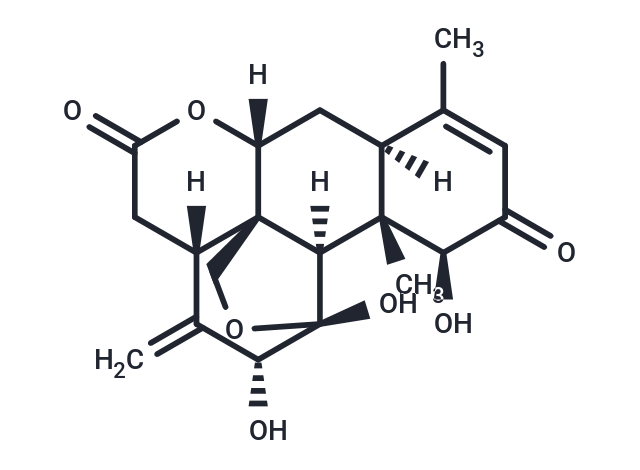
| Description | Ailanthone (AIL) is a natural compound derived from the tree Ailanthus altissima and has anti-hepatocellular carcinoma (HCC) properties. It can induce G0/G1 phase cell cycle arrest by downregulating the expression of cyclins and CDKs, while upregulating the expression of p21 and p27. Additionally, Ailanthone is a potent androgen receptor (AR) inhibitor, capable of inhibiting both the full-length androgen receptor (IC50: 69 nM) and constitutively active splice variants (IC50: 309 nM). |
| Targets & IC50 | Androgen receptor:69 nM |
| In vitro | Ailanthone binds to the co-chaperone protein p23 and prevents AR's interaction with HSP90, thus resulting in the disruption of the AR-chaperone complex followed by ubiquitin/proteasome-mediated degradation of AR as well as other p23 clients including AKT and Cdk4, and downregulates AR and its target genes in PCa cell lines and orthotopic animal tumors. In addition, Ailanthone blocks tumor growth and metastasis of CRPC [1]. Ailanthone has been shown to possess a growth-inhibitory effect against several cancer cell lines including R-HepG2, Jurkat, HeLa, HepG2, Hep3B, MCF-7, MDA-MB-231, and A549 cells. Ailanthone inhibits Huh7 cell growth through the induction of mitochondrion-mediated cell apoptosis and G0/G1 cell cycle arrest. Ailanthone-induced apoptosis is mitochondrion-mediated and involved the PI3K/AKT signaling pathway in Huh7 cells [2]. |
| In vivo | Ailanthone (i.p. or p.o.) has excellent efficiency for blocking the growth of CRPC xenografts. In pharmacokinetic studies, Ailanthone exhibits good solubility in water and good bioavailability (>20%). In addition, Ailanthone effectively suppresses CRPC tumor growth, despite not reaching a steady state of plasma drug concentration during the course of treatment [1]. |
| Synonyms | Δ13-Dehydrochaparrinone |
| Cell Research | For SRB assay, cells are cultured in complete RPMI 1640 and incubated with indicated concentrations of Ailanthone or cells are maintained in fresh phenol red-free RPMI 1640 medium with 5% charcoal-stripped FBS, 1?nM DHT and indicated compounds. After 48 or 72?h, the cells are then fixed and the cell growth is detected with the SRB assay. For colony formation assay, prostate cancer cells are incubated with indicated concentrations of Ailanthone in complete RPMI 1640 for 2 weeks and then cells are fixed with 4% paraformaldehyde and stained with crystal violet. Colonies are visualized under a microscope, and all of the fields are imaged and counted. Colony formation as a percentage of vehicle control for each cell line is presented [1]. |
| Animal Research | In the orthotopic castration-resistant prostate cancer xenografts model, mice are intraperitoneally injected with Ailanthone (2?mg/kg), MDV (10 mg/kg) or DMSO (as controls). Prostate tumor growth and local metastasis are monitored weekly using the IVIS Imaging System. Images and measurements of bioluminescent signals are acquired and analyzed using software [1]. |
| Molecular Weight | 376.4 |
| Formula | C20H24O7 |
| Cas No. | 981-15-7 |
| Smiles | [H][C@]12[C@@]3(O)OC[C@@]11[C@@]([H])(C[C@@]4([H])C(C)=CC(=O)[C@@H](O)[C@]24C)OC(=O)C[C@@]1([H])C(=C)[C@H]3O |
| Relative Density. | 1.47g/cm3 |
| Storage | Powder: -20°C for 3 years | In solvent: -80°C for 1 year Shipping with blue ice/Shipping at ambient temperature. | |||||||||||||||||||||||||||||||||||
| Solubility Information | DMSO: 262.5 mg/mL (697.4 mM), Sonication is recommended.  | |||||||||||||||||||||||||||||||||||
| In Vivo Formulation | 10% DMSO+40% PEG300+5% Tween 80+45% Saline: 3.3 mg/mL (8.77 mM), Sonication is recommended. Please add the solvents sequentially, clarifying the solution as much as possible before adding the next one. Dissolve by heating and/or sonication if necessary. Working solution is recommended to be prepared and used immediately. The formulation provided above is for reference purposes only. In vivo formulations may vary and should be modified based on specific experimental conditions. | |||||||||||||||||||||||||||||||||||
Solution Preparation Table | ||||||||||||||||||||||||||||||||||||
DMSO
Note : The dilution table applies only to solid products. For liquid products, please calculate the stock solution based on the stated concentration and/or density. | ||||||||||||||||||||||||||||||||||||
 For example, if the intended dosage is 10 mg/kg for animals weighing 20 g , with a dosing volume of 100 μL per animal, and a total of 10 animals are to be administered, using a formulation of
  10% DMSO+ 40% PEG300+ 5% Tween 80+ 45% Saline/PBS/ddH2O , the resulting working solution concentration would be 2 mg/mL.
Dissolve 2 mg of the compound in 100 μL DMSO to obtain a stock solution at a concentration of 20 mg/mL . If the required concentration exceeds the compound's known solubility, please contact us for technical support before proceeding.
1) Add 100 μL of the DMSO stock solution to 400 µL PEG300 and mix thoroughly until the solution becomes clear.
2) Add 50 µL Tween 80 and mix well until fully clarified.
3) Add 450 µL Saline,PBS or ddH2O and mix thoroughly until a homogeneous solution is obtained.
| Size | Quantity | Unit Price | Amount | Operation |
|---|
 Feedback
 Hello! How can I help you today?
Copyright © 2015-2026 TargetMol Chemicals Inc. All Rights Reserved.
