


Shopping Cart
Remove All Your shopping cart is currently empty

Synonyms:
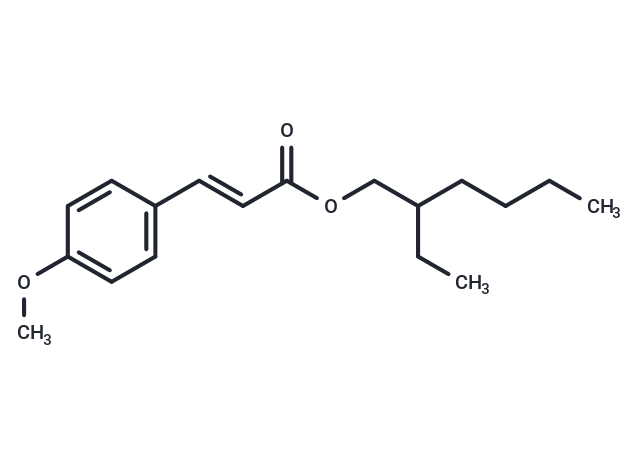
| Pack Size | Price | USA Stock | Global Stock | Quantity |
|---|---|---|---|---|
| 100 mg | $30 | - | In Stock | |
| 500 mg | $68 | - | In Stock | |
| 1 g | $102 | - | In Stock | |
| 2 g | $148 | - | In Stock |
| Description | 2-Ethylhexyl trans-4-methoxycinnamate is a sunscreen agent. |
| In vitro | This study aims to assess the removal of a set of non-polar pollutants in biologically treated wastewater using ozonation, ultraviolet (UV 254 nm low pressure mercury lamp) and visible light (Xe-arc lamp) irradiation as well as visible light photocatalysis using Ce-doped TiO2. The compounds tracked include UV filters, synthetic musks, herbicides, insecticides, antiseptics and polyaromatic hydrocarbons. METHODS AND RESULTS:Raw wastewater and treated samples were analyzed using stir-bar sorptive extraction coupled with comprehensive two-dimensional gas chromatography (SBSE-CG × GC-TOF-MS). Ozone treatment could remove most pollutants with a global efficiency of over 95% for 209 μM ozone dosage. UV irradiation reduced the total concentration of the sixteen pollutants tested by an average of 63% with high removal of the sunscreen 2-Ethylhexyl trans-4-methoxycinnamate (EHMC), the synthetic musk 7-acetyl-1,1,3,4,4,6-hexamethyltetrahydronaphthalene (tonalide, AHTN) and several herbicides. Visible light Ce-TiO2 photocatalysis reached ~70% overall removal with particularly high efficiency for synthetic musks. In terms of power usage efficiency expressed as nmol kJ(-1), the results showed that ozonation was by far the most efficient process, ten-fold over Xe/Ce-TiO2 visible light photocatalysis, the latter being in turn considerably more efficient than UV irradiation. In all cases the efficiency decreased along the treatments due to the lower reaction rate at lower pollutant concentration. The use of photocatalysis greatly improved the efficiency of visible light irradiation. The collector area per order decreased from 9.14 ± 5.11 m(2) m(-3) order(-1) for visible light irradiation to 0.16 ± 0.03 m(2) m(-3) order(-1) for Ce-TiO2 photocatalysis. The toxicity of treated wastewater was assessed using the green alga Pseudokirchneriella subcapitata. CONCLUSIONS: Ozonation reduced the toxicity of treated wastewater, while UV irradiation and visible light photocatalysis limited by 20-25% the algal growth due to the accumulation of reaction by-products. Three transformation products were identified and tracked along the treatments[1]. |
| Molecular Weight | 290.4 |
| Formula | C18H26O3 |
| Cas No. | 83834-59-7 |
| Smiles | C(=C/C(OCC(CCCC)CC)=O)\C1=CC=C(OC)C=C1 |
| Relative Density. | 1.01. Temperature:20 °C. |
| Storage | Pure form: -20°C for 3 years | In solvent: -80°C for 1 year Shipping with blue ice/Shipping at ambient temperature. | |||||||||||||||||||||||||||||||||||
| Solubility Information | DMSO: 60 mg/mL (206.61 mM), Sonication is recommended.  | |||||||||||||||||||||||||||||||||||
Solution Preparation Table | ||||||||||||||||||||||||||||||||||||
DMSO
Note : The dilution table applies only to solid products. For liquid products, please calculate the stock solution based on the stated concentration and/or density. | ||||||||||||||||||||||||||||||||||||
 For example, if the intended dosage is 10 mg/kg for animals weighing 20 g , with a dosing volume of 100 μL per animal, and a total of 10 animals are to be administered, using a formulation of
  10% DMSO+ 40% PEG300+ 5% Tween 80+ 45% Saline/PBS/ddH2O , the resulting working solution concentration would be 2 mg/mL.
Dissolve 2 mg of the compound in 100 μL DMSO to obtain a stock solution at a concentration of 20 mg/mL . If the required concentration exceeds the compound's known solubility, please contact us for technical support before proceeding.
1) Add 100 μL of the DMSO stock solution to 400 µL PEG300 and mix thoroughly until the solution becomes clear.
2) Add 50 µL Tween 80 and mix well until fully clarified.
3) Add 450 µL Saline,PBS or ddH2O and mix thoroughly until a homogeneous solution is obtained.
| Size | Quantity | Unit Price | Amount | Operation |
|---|
 Feedback
 Hello! How can I help you today?
Copyright © 2015-2026 TargetMol Chemicals Inc. All Rights Reserved.
